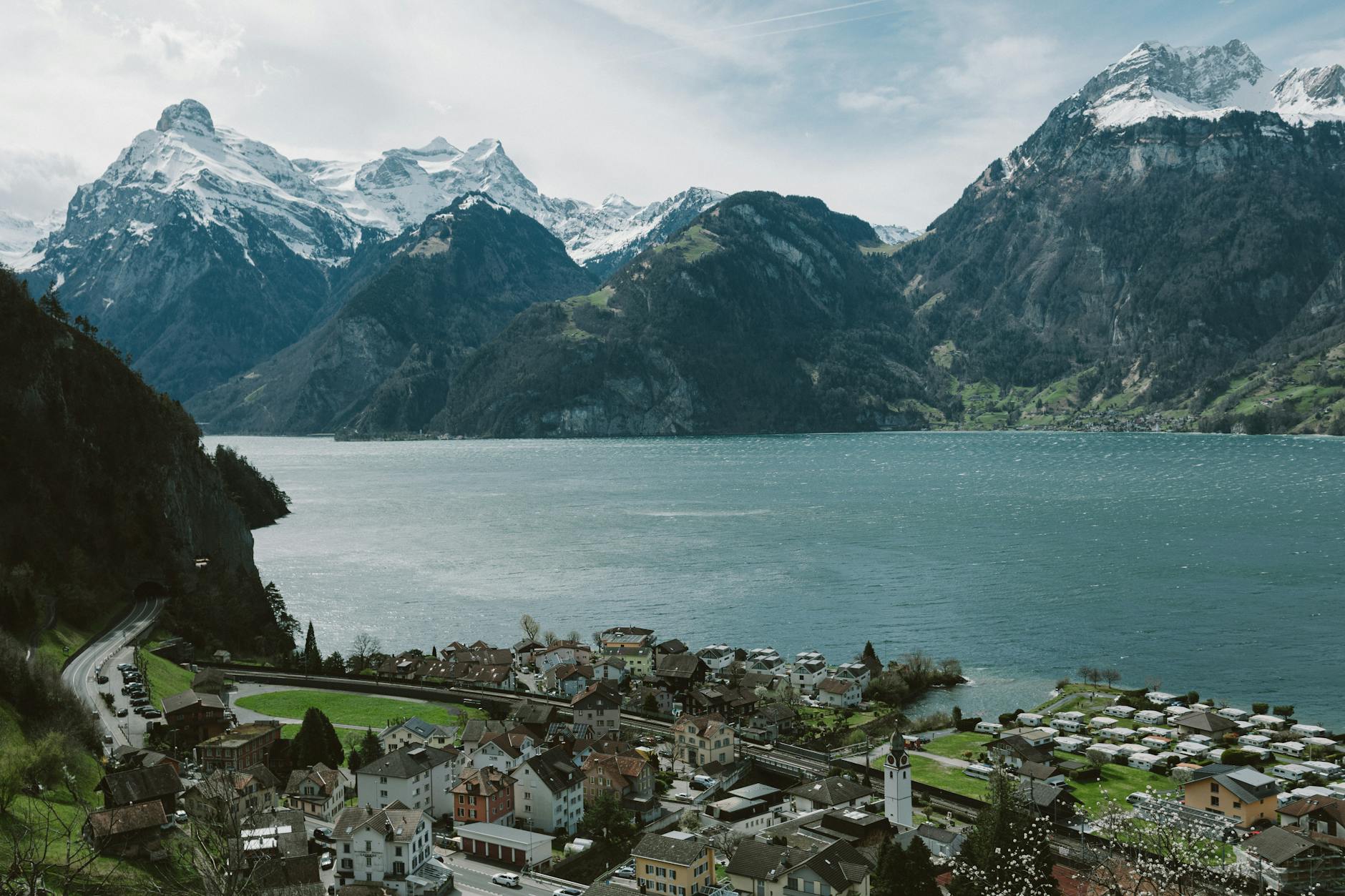
Switzerland looks simple on a map. It is small, orderly, safe, wealthy, and almost absurdly well connected by train. That apparent simplicity is the trap.
Start Here
The country is not hard because it is chaotic. Switzerland is hard because it is vertical, seasonal, expensive, multilingual, weather-sensitive, and full of places that look close but behave like separate worlds. A short train ride can move you from German-speaking financial Zürich to medieval Bern, from lakeside Lucerne to glacial peaks, from French-speaking vineyards above Lake Geneva to palm-lined Ticino, from cow pastures to high-altitude railways, from fondue rooms to design museums, from a rainy valley floor to a blue-sky mountain ridge.
Most first-time visitors arrive with a mental postcard: the Matterhorn, alpine villages, chocolate, cheese, red trains, clean lakes, cowbells, flower boxes, snow peaks, maybe a luxury watch shop. Switzerland gives you all of that. But the best Swiss trip is not about collecting postcard scenes. It is about understanding how the country works: bases, passes, rail lines, lake boats, mountain lifts, weather windows, language regions, and the difference between seeing the Alps and actually planning around them.
The first-timer mistake is trying to “do Switzerland” as one compact object: Zürich, Lucerne, Interlaken, Jungfraujoch, Zermatt, Geneva, Bern, Lugano, St. Moritz, Glacier Express, Rhine Falls, and maybe a hike, all in a week. That itinerary is technically possible. It is also the fastest way to turn one of Europe’s most beautiful countries into a transfer spreadsheet.
A world-class Switzerland guide has to do more than list mountains and cities. It has to help you decide which Switzerland you want: the rail-and-lake Switzerland, the high-Alps Switzerland, the hiking Switzerland, the ski Switzerland, the food-and-wine Switzerland, the design-and-city Switzerland, the family Switzerland, the luxury Switzerland, the budget-conscious Switzerland, the slow-village Switzerland, the road-trip Switzerland, or the cross-border Switzerland that pairs naturally with France, Italy, Germany, Austria, or Liechtenstein.
Switzerland in one sentence: Switzerland is a small country with large-country complexity, where the best trip comes from choosing one coherent route, respecting mountain weather, using the rail network intelligently, and letting lakes, valleys, languages, and seasons shape the pace.
Basic data
| Population | About 9 million |
|---|---|
| Area | 41,285 km2 |
| Major religions | Christian heritage with large secular and Muslim communities |
| Political system | Federal directorial republic with strong cantonal autonomy |
| Economic system | High-income mixed market economy led by finance, pharmaceuticals, precision manufacturing, services, and trade |
Quick Verdict
| Question | Answer |
|---|---|
| Best for | Scenic rail, mountain views, hiking, skiing, lakes, clean cities, design, museums, family travel, luxury hotels, chocolate, cheese, wine, public transport, slow villages, wellness, photography, and travelers who like natural beauty with logistical precision. |
| Not ideal for | Travelers who want low prices, spontaneous peak-season lodging, guaranteed mountain views, late-night budget nightlife, warm beaches, or a country where one cheap rental car solves every problem. Switzerland can be easy, but it is rarely casual on cost. |
| Ideal first visit | 7 to 10 days. Five days gives a taste. One week can combine Zürich/Lucerne/Bernese Oberland or Geneva/Lake Geneva/Zermatt. Ten days lets you include two alpine regions or one scenic rail route without rushing. Two weeks allows a genuinely rich loop. |
| Best first route | Zürich or Geneva arrival, Lucerne, Bernese Oberland, Bern, Lake Geneva or Zermatt, then exit by Zürich or Geneva. For rail lovers, build around the Grand Train Tour logic rather than random backtracking. |
| Best time overall | June to September for hiking, lakes, high mountain access, and long days; September is especially strong. December to March for winter sports and Christmas/winter atmosphere. May and October can be excellent but require flexibility because some mountain services and hotels may be between seasons. |
| Best for hiking | July to September for most high trails. June can be beautiful with wildflowers and snow on peaks, but higher routes may still be closed or muddy. Always check trail and lift status. |
| Best for skiing | January to March for the most winter-focused trips, with resort and altitude variation. December has holiday atmosphere but snow reliability varies by altitude and year. |
| Best first-timer bases | Lucerne for classic lake-and-mountain Switzerland; Interlaken/Grindelwald/Wengen/Mürren for the Bernese Oberland; Zermatt for the Matterhorn and Valais; Zürich for arrival, museums, food, and rail access; Lausanne/Montreux/Geneva for Lake Geneva, Lavaux, and French-speaking Switzerland; Lugano/Locarno for Ticino. |
| Biggest planning mistake | Booking a scenic mountain base without understanding altitude, lift schedules, transfer time, weather risk, and what happens if clouds hide the view. In Switzerland, the Plan B matters as much as the dream view. |
| One thing to book early | Peak-season mountain hotels, famous scenic trains with seat reservations, Jungfraujoch/Schilthorn-style timed excursions when weather is favorable, Glacier Express/Bernina Express seats, high-end restaurants, ski lodging, and family rooms. |
| One thing to leave flexible | Mountain-view days. Do not hard-code your most expensive mountain excursion onto a bad-weather day if your itinerary allows flexibility. |
| Best low-effort pleasures | Lake boats, scenic ordinary trains, old-town walks, supermarket picnics, public swimming areas, city river swims where safe and local, free viewpoints, church towers, parks, local bakeries, and riding a PostBus into a valley. |
| Most important warning | Switzerland rewards planning, but punishes overplanning. Build a route with fewer bases, more weather flexibility, and fewer expensive “must-do” reservations than your first instinct suggests. |
The Move
For a first trip, choose one primary mountain region and one lake/city region. Example: Lucerne + Bernese Oberland + Bern/Zürich. Or Lake Geneva + Zermatt + Lausanne/Montreux. Or Zürich + Graubünden/Engadin + Lucerne. The country is compact, but the best Swiss trips are not built by bouncing between every famous postcard.
Who Will Love Switzerland?
You will probably love Switzerland if you want:
- A country where trains, boats, trams, buses, mountain railways, and cable cars form part of the experience rather than merely the logistics.
- Big scenery with comfort: clean hotels, clear signage, reliable transport, safe-feeling towns, tidy trails, and organized mountain infrastructure.
- A trip that can be active without being rough: day hikes, lake swims, easy mountain trains, village walks, skiing, sledding, wellness hotels, and scenic lunches.
- A place where different language regions genuinely feel different: German-speaking Zürich and Lucerne, French-speaking Lake Geneva, Italian-speaking Ticino, Romansh-influenced Graubünden.
- A country that works well for families, older travelers, solo travelers, rail travelers, photographers, hikers, skiers, and couples who want a high-comfort scenic trip.
- A high-value splurge destination where paying more can buy real convenience, views, transport efficiency, and access.
You may struggle with Switzerland if you want:
- Cheap hotels and meals in the most famous places.
- A loose itinerary during peak summer, ski weeks, or holiday periods.
- Guaranteed views from expensive mountain excursions.
- A single “best city” that explains the whole country.
- Warm-water beach culture or late-night budget nightlife.
- A road trip without mountain-road stress, parking costs, weather concerns, or vignette requirements.
- A trip where you can ignore weather apps and still have the same experience.
Switzerland is not difficult in the usual sense. It is extremely functional. But it demands good choices. The country’s polish can make people underestimate the mountains, the costs, and the planning logic. Treat the Alps as real mountains, not theme-park scenery, and Switzerland becomes much easier to love.
Switzerland at a Glance
| Practical | Detail |
|---|---|
| Country | Switzerland, officially the Swiss Confederation. It is in central Europe and is not an EU member, but it participates in the Schengen area. |
| Capital | Bern is the federal city and practical capital, though Zürich is the largest city and Geneva is a major international city. |
| Languages | Switzerland has four national languages: German, French, Italian, and Romansh. German is the most widely spoken; French dominates the west; Italian dominates Ticino and parts of Graubünden; Romansh is spoken in parts of Graubünden.[17] |
| Currency | Swiss franc, CHF. Switzerland is not in the eurozone. Euros may be accepted in some places, but change is often given in francs and the rate may be poor.[10] |
| Payments | Cards are widely accepted, especially in cities, transport, restaurants, shops, and hotels. Carry some CHF cash for mountain huts, small bakeries, village markets, lockers, tips, rural buses, or places with card minimums.[10] |
| Time zone | Central European Time, UTC+1; Central European Summer Time, UTC+2 during daylight saving time. |
| Main airports | Zürich (ZRH), Geneva (GVA), and EuroAirport Basel-Mulhouse-Freiburg (BSL/MLH/EAP). Milan, Lyon, and Munich can also be useful for some border-region itineraries. |
| Entry basics | Short-stay visitors are generally governed by Schengen logic. Third-country nationals can generally stay in the Schengen area for up to 90 days in any 180-day period, subject to nationality-specific visa rules.[1] |
| EES / ETIAS | The EU Entry/Exit System applies to Switzerland as a Schengen/EES country for many non-EU short-stay travelers; ETIAS is scheduled to start in the last quarter of 2026 for visa-exempt travelers to participating European countries.[2][3] |
| Electricity | 230V, 50Hz. Switzerland uses Type C and Type J plugs. Type C two-pin Europlugs often fit; many bulkier European plugs do not fit Type J sockets. Bring the right adapter. |
| Emergency numbers | 112 for European emergency number; 117 police; 118 fire; 144 ambulance; 145 poison control.[9] |
| Tap water | Generally safe to drink. Public fountains are common in many towns and villages; confirm signage in specific locations. |
| Best transport app | SBB Mobile for public transport planning and ticketing. SBB describes it as Switzerland’s most popular public transport app and a tool for timetable enquiries and ticket purchase.[6] |
| Best weather source | MeteoSwiss, the Federal Office for Meteorology and Climatology; use it for forecasts and warnings, especially before mountain days.[12] |
| Best mountain-safety sources | Natural Hazards Portal, SLF avalanche bulletin, swisstopo, SwitzerlandMobility, local lift/trail status pages, and resort websites.[13][14][15][16] |
| Best map tools | SBB Mobile for transport, swisstopo for high-quality Swiss maps and outdoor planning, SwitzerlandMobility for hiking/cycling route networks.[15][16] |
| Do you need a car? | Usually no for a first trip built around cities, lakes, major mountain resorts, and scenic trains. A car can help for remote valleys, road-trip photography, luggage-heavy families, or off-rail rural stays. |
| Motorway vignette | Cars, motorcycles, trailers, caravans, delivery vans, and campers up to 3.5 tonnes need a vignette for Swiss motorways and expressways. The 2026 vignette costs CHF 40 and is valid from Dec. 1, 2025 to Jan. 31, 2027.[11] |
First-Timer Mistake
Many visitors ask, “Should I stay in Interlaken?” The better question is: What version of the Bernese Oberland do I want? Interlaken is practical and connected. Grindelwald is busier and more mountain-facing. Wengen and Mürren are more atmospheric and car-free. Lauterbrunnen is dramatic but valley-bound. Your base changes the whole trip.
2026 Visitor Notes
Schengen Rules Are Central, But Nationality Still Matters
Switzerland participates in Schengen short-stay travel. The Swiss State Secretariat for Migration explains that third-country nationals can generally enter the Schengen area for a maximum of 90 days within a 180-day period, but visa requirements, document validity, residence permits, airport transit rules, and nationality-specific exceptions matter.[1]
The move: Do not rely on “Switzerland is visa-free” as a blanket statement. Check your passport nationality, previous Schengen days, passport validity, onward travel, and whether your route enters or exits through another Schengen country.
EES and ETIAS Belong in Any Current Switzerland Guide
The European Entry/Exit System is the digital border system for non-EU nationals making short stays in participating European countries, including Switzerland. EU information says EES registers non-EU nationals each time they cross external borders and, as of the 2026 guidance, is fully operational after progressive implementation.[2] ETIAS is the separate travel authorisation planned for visa-exempt travelers and is scheduled to start operations in the last quarter of 2026.[3]
The move: For publication, keep a short “Europe entry systems” update box near the top. Travelers are confused by EES vs ETIAS. EES is border registration. ETIAS is pre-travel authorization for visa-exempt travelers once active.
Swiss Travel Pass Prices and Strategy Matter
The Swiss Travel Pass is convenient, but it is not automatically the cheapest option. SBB lists 2026 adult Swiss Travel Pass prices, with second-class passes ranging from CHF 254 for 3 days to CHF 499 for 15 days, valid through Dec. 31, 2026, subject to change.[4] The Swiss Half Fare Card costs CHF 150, is valid for one month, and gives half-price or reduced-price travel on trains, buses, boats, panorama trains, many mountain railways, gondolas, and public transport in more than 90 Swiss towns and cities.[5]
The move: If you are moving almost every day and value simplicity, price the Swiss Travel Pass. If you are staying in fewer bases but doing expensive mountain lifts, the Half Fare Card often deserves serious consideration. For the Bernese Oberland, Valais, and Graubünden, compare regional passes too.
The Weather Is Not a Footnote
MeteoSwiss notes that July and August bring the highest temperatures in lower-lying regions, with heatwaves most intense in June, July, and August; mountain weather can change quickly and altitude changes everything.[12]
The move: Build every mountain itinerary with a weather hierarchy: one must-see mountain day, one flexible backup day, one valley/lake/city alternative, and one indoor/cultural option. This is not pessimism. It is how Switzerland works.
The Motorway Vignette Is Simple, But Not Optional
If you drive on Swiss motorways or expressways, you need a vignette. In 2026 it costs CHF 40, there are no daily/weekly/monthly versions, and the official Swiss portal notes a fine if you drive without one.[11]
The move: Rental cars picked up in Switzerland usually have it. Cars rented in France, Germany, Austria, or Italy may not. Check before entering Swiss motorways.
Switzerland Is Safe, But the Mountains Are Real
Urban Switzerland is generally low-stress for visitors. The risk profile changes quickly in the Alps: avalanches, storms, heat, snowfields, rockfall, river currents, steep trails, altitude, fog, closed paths, and late-afternoon weather shifts. The official Natural Hazards Portal covers hazards such as severe weather, heavy rain, snow, wind, floods, avalanches, and earthquakes, and the SLF avalanche bulletin is a key winter planning tool.[13][14]
The move: Treat mountain activity as mountain activity even when reached by train, cable car, or postcard-perfect village paths. Dress, plan, and turn back accordingly.
How to Understand Switzerland
Switzerland becomes much easier when you stop treating it as a single Alpine postcard and start reading it as a set of connected regions, each shaped by language, altitude, transport, and season.
The Five Switzerlands a First-Timer Actually Meets
| Switzerland | Where you feel it | What it gives you |
|---|---|---|
| The lake-and-city Switzerland | Zürich, Lucerne, Geneva, Lausanne, Montreux, Lugano, Thun, Lucerne, Basel | Clean cities, old towns, museums, lake boats, design, river swims, food, culture, easy rail logistics. |
| The classic Alps Switzerland | Bernese Oberland, Zermatt/Valais, Central Switzerland, Graubünden/Engadin | Peaks, trains, cable cars, hiking, skiing, waterfalls, mountain villages, panoramic views. |
| The scenic rail Switzerland | Glacier Express, Bernina Express, GoldenPass, Gotthard Panorama, Luzern–Interlaken Express, ordinary SBB routes | Slow travel, route-as-experience, lake-and-mountain transitions, easy car-free touring. |
| The multilingual Switzerland | Romandie, Ticino, Graubünden, German-speaking plateau and Alps | Cultural shifts, different food, different architecture, language changes, regional identity. |
| The expensive-but-worth-it Switzerland | Famous mountain resorts, luxury hotels, peak lifts, scenic trains, ski resorts, lakefront cities | High cost, high quality, smooth logistics, views, comfort, and the need to choose splurges wisely. |
Country Logic
Switzerland is organized less by “north/south/east/west” and more by:
- Language regions: German, French, Italian, Romansh.
- Altitude: city/lake, valley, mountain resort, high alpine.
- Transport corridors: SBB rail lines, lake boats, PostBus valleys, mountain railways, cable cars, road passes.
- Season: ski winter, hiking summer, shoulder-season gaps, lake season, Christmas markets, autumn color.
- Base quality: a village with one bad-weather option is different from a town with rail, boats, museums, and multiple valley exits.
A place can be geographically close and logistically awkward. A mountain view can be famous and weather-dependent. A car can feel freeing and then become a parking liability. A train can look slower than a car on paper but be better when you include traffic, tunnels, passes, parking, and fatigue.
The Central Contrasts
Switzerland is compelling because its contradictions are practical, not abstract:
- Small country vs huge terrain: The map is compact; the mountains are not.
- Precision vs weather: Timetables work; clouds do not care.
- Wealth vs rural tradition: Luxury watch boutiques and five-star hotels coexist with hay barns, alpine dairies, local festivals, and grazing cows.
- International vs intensely local: Geneva and Zürich are global; dialects, cantons, valleys, and village traditions remain specific.
- Convenience vs cost: The country makes difficult travel easy, but you pay for the privilege.
- Train efficiency vs mountain slowness: A city-to-city train may be fast; a mountain excursion can take half a day even when it looks nearby.
Local Logic
Switzerland’s famous order is not only a stereotype. It is a system. Trains connect with buses. Boats meet rail lines. Cable cars run by timetable. Trails are marked. Fountains flow. Villages are tidy. Recycling is serious. Quiet hours matter. This cooperation is part of why travel here feels so smooth.
The trade-off is that you should not treat Switzerland as a place where every rule is flexible. Buy the right ticket. Respect quiet in hotels and apartments. Stay off private land where not permitted. Do not walk through protected meadows. Do not assume restaurants serve all day. Do not board trains without understanding ticket requirements. Do not treat trails, ski runs, or lake currents casually.
Choose Your Switzerland Trip
This is the most important planning section. Switzerland is not a country where every first trip should look the same.
Route Family 1: The Classic First Switzerland Trip
Best for: First-timers, couples, families, photographers, low-risk planning.
Core route: Zürich or Geneva → Lucerne → Bernese Oberland → Bern → Zürich/Geneva.
What it gives you: A city arrival, lake-and-mountain Lucerne, classic Alps, medieval Bern, and efficient rail connections.
Ideal length: 7 to 10 days.
Common mistake: Staying only in Interlaken and thinking you have “done” the Bernese Oberland. Give yourself time for Wengen, Mürren, Grindelwald, Lauterbrunnen, Kleine Scheidegg, lake boats, valley walks, and weather pivots.
Route Family 2: The Scenic Rail Trip
Best for: Rail lovers, non-drivers, older travelers, low-stress travel, winter scenery, shoulder seasons.
Core route: Zürich → Lucerne → Interlaken → Montreux → Zermatt → St. Moritz/Chur → Zürich.
What it gives you: Lakes, panoramic trains, mountains, vineyards, resort towns, and varied regions.
Ideal length: 10 to 14 days.
Official frame: Switzerland Tourism describes the Grand Train Tour as a year-round rail route covering 1,280 km, 8 sections, 11 large lakes, 5 UNESCO World Heritage Sites, and 4 official languages.[7]
Common mistake: Treating panoramic trains as the only scenic trains. Ordinary Swiss trains are often stunning, cheaper, and easier to use spontaneously.
Route Family 3: The Bernese Oberland Deep Dive
Best for: First-time Alps, hiking, families, dramatic valleys, mountain railways.
Core route: Zürich/Lucerne/Bern → Interlaken region → Wengen/Mürren/Grindelwald/Lauterbrunnen → Lake Thun/Brienz.
What it gives you: Eiger, Mönch, Jungfrau, waterfalls, high routes, lake boats, classic mountain villages, famous excursions.
Ideal length: 5 to 7 nights in the region if hiking; 3 nights minimum if passing through.
Common mistake: Scheduling only one mountain-view day. Clouds can erase your most expensive plan.
Route Family 4: Zermatt and Valais
Best for: Matterhorn views, high alpine scenery, skiing, hiking, luxury, car-free resort atmosphere.
Core route: Geneva/Lausanne/Montreux → Sion/Valais → Zermatt → maybe Saas-Fee, Aletsch, or Glacier Express onward.
What it gives you: Iconic peaks, glacier scenery, wine valleys, car-free village atmosphere, serious mountain tourism.
Ideal length: 3 to 5 nights; longer if hiking or skiing.
Common mistake: Going to Zermatt only for a day trip and expecting the Matterhorn to perform on command.
Route Family 5: Lake Geneva, Lavaux, and French-Speaking Switzerland
Best for: Wine, museums, lake views, Belle Époque hotels, Geneva institutions, Montreux, Lausanne, Chillon, slower elegance.
Core route: Geneva → Lausanne → Lavaux → Montreux/Vevey → Gruyères or Valais.
What it gives you: French-speaking Switzerland, vineyards, lake steamers, museums, castle scenery, easy rail.
Ideal length: 4 to 6 days.
Common mistake: Dismissing Geneva as “just international organizations” or Montreux as “just a lakefront.” This region rewards slow lake-and-vineyard pacing.
Route Family 6: Ticino and the Italian-Speaking South
Best for: Travelers who want Switzerland with Italianate warmth, lakes, stone villages, palm-lined promenades, milder weather, and food that feels different from the north.
Core route: Zürich/Lucerne → Gotthard route → Lugano → Locarno/Ascona → Valle Verzasca/Maggia → Bellinzona.
What it gives you: Alpine-meets-Mediterranean mood, lakes, valleys, castles, grotto restaurants, and an easy link to northern Italy.
Ideal length: 3 to 6 days.
Common mistake: Treating Ticino as an add-on after exhausting mountain travel. It deserves its own rhythm.
Route Family 7: Graubünden, Engadin, and Eastern Switzerland
Best for: Repeat visitors, rail travelers, hikers, winter sports, architecture, Romansh culture, St. Moritz, Bernina Express, Swiss National Park.
Core route: Zürich → Chur → Davos/St. Moritz/Engadin → Swiss National Park → Bernina route → Ticino or back to Zürich.
What it gives you: A more expansive, less first-trip-obvious Switzerland with high valleys, rail engineering, villages, national park landscapes, and Italian-border connections.
Ideal length: 5 to 8 days.
Common mistake: Only riding Bernina Express without spending time in the valleys it crosses.
Route Family 8: City, Art, Design, and Food Switzerland
Best for: Museum lovers, architecture travelers, winter visitors, rainy-season planners, people who want Switzerland beyond mountains.
Core route: Zürich → Basel → Bern → Lausanne/Geneva or Lucerne.
What it gives you: Kunsthaus Zürich, Basel museums, Bern old town, design, architecture, food, river/lake culture, day trips.
Ideal length: 5 to 8 days.
Common mistake: Thinking Swiss cities are only arrival points. They are not as large as Paris or Rome, but they are culturally rich and exceptionally easy to pair with nature.
Best Time to Visit Switzerland
Switzerland is a year-round destination, but not the same destination year-round. Your best month depends on whether you want hiking, skiing, scenic trains, lake swims, Christmas markets, lower prices, or high-mountain views.
Best Overall Months
June, September, and early October are the strongest general-purpose months for many travelers. June brings long days, green valleys, wildflowers, waterfalls, and snow still visible on peaks, though some high trails may remain closed. September is often the best all-around month: summer infrastructure is still running, hiking is strong, lake towns remain lively, and crowds ease after August. Early October can be gorgeous for lower hikes, vineyards, cities, and autumn color, but high mountain services may start to reduce.
July and August are best for full summer infrastructure, high-altitude hiking, lake swimming, families on school holidays, and mountain villages at their most active. They are also crowded and expensive.
December to March is winter Switzerland: ski resorts, snow sports, Christmas markets, fondue, scenic trains, winter walks, and alpine hotels. Snow reliability depends on altitude, exposure, and year.
May and November are shoulder-season months. They can be excellent for cities, lake regions, and value, but tricky for mountain-focused trips because some lifts, hotels, trails, and restaurants may be closed between seasons.
Season-by-Season
| Season | What to expect | Best for | Watch out for |
|---|---|---|---|
| Spring: March–May | Lower valleys wake up, cities are pleasant, lakeside flowers bloom, mountains may still be snowy or muddy. | Cities, museums, lake towns, lower hikes, Ticino, photography with snowy peaks. | Closed mountain lifts, muddy/snowy high trails, changeable weather, limited resort services. |
| Summer: June–August | Long days, full mountain infrastructure, lake swimming, wildflowers, peak hiking, high prices. | Hiking, families, alpine villages, lake boats, panoramic trains, outdoor dining. | Crowds, storms, heat in lower regions, expensive hotels, booked mountain lodging. |
| Autumn: September–November | September is excellent; October brings color and harvest; November is quiet and transitional. | Hiking, wine, cities, photography, value in some areas. | Reduced lift schedules later in season, shorter days, early snow in high areas. |
| Winter: December–February | Ski season, Christmas markets, snow resorts, fondue, scenic rail, city museums. | Skiing, winter hiking, luxury hotels, festive travel, rail scenery. | High ski prices, avalanche risk, short days, weather disruption, city fog in lower regions. |
Month-by-Month Guide
| Month | Verdict |
|---|---|
| January | Best for serious winter trips, skiing, snowshoeing, winter hotels, and fondue. Cities can be cold and gray. Alpine conditions require avalanche awareness. |
| February | Strong ski month and school-holiday period in some markets. Book resorts early. Good for winter scenery and snow-focused travel. |
| March | Late winter in the mountains, early spring lower down. Skiing can still be good at altitude; cities and Ticino begin to soften. |
| April | Transitional. Good for cities, museums, lakes, and some lower regions. Risky for a mountain-only itinerary because many areas pause after ski season. |
| May | Beautiful in lower areas and often good value, but high trails may still be closed. Excellent for city + lake + lower valley trips. |
| June | One of the best months if you accept that not every high route is open. Long days, flowers, waterfalls, green valleys, and strong scenery. |
| July | Peak summer. Best for high hikes and full infrastructure, but busy and expensive. Book mountain bases early. |
| August | Peak family travel and lake season. Great for hiking and swimming, but popular places are crowded. Thunderstorms and heat are possible. |
| September | Probably the best all-around month for hiking, scenery, transport, and fewer crowds than high summer. Book still-important bases early. |
| October | Excellent for cities, vineyards, Ticino, lower hikes, and autumn color. Check lift schedules and mountain closures. |
| November | Quiet, cheaper in some places, and useful for cities, museums, wellness, and food. Poor for a classic mountain-lift itinerary. |
| December | Christmas markets, winter atmosphere, resort openings, festive cities, and fondue. Snow varies by altitude and timing. Holiday weeks are expensive. |
Rain Plan
Switzerland is better than many mountain countries for bad weather because towns, trains, museums, spas, boats, and cities are close. Use rain days for:
- Zürich or Basel museums.
- Lucerne old town, churches, transport museum, lakefront cafés.
- Bern arcades and museums.
- Lausanne, Vevey, Montreux, or Geneva museums.
- Scenic trains below cloud level.
- Spa/wellness hotels.
- Chocolate factories or cheese dairies.
- Lower-elevation village walks if safe.
- Restaurant lunches, bakeries, and cafés.
The Move
Never make your most expensive mountain excursion the only non-flexible item in a short trip. Keep one “weather-switch” day. In Switzerland, patience is often cheaper than forcing the view.
How Many Days You Need
The Honest Answer
You need 7 to 10 days for a satisfying first Switzerland trip. Five days can work if you choose one region plus one city. Two weeks is ideal if you want multiple language regions, scenic trains, and hiking without rushing.
| Length | What it feels like |
|---|---|
| 1 day | A layover taste. Choose Zürich, Geneva, Basel, Lucerne, Bern, or a single lake/city day. Do not try to “see the Alps” unless weather, transport, and expectations align. |
| 2–3 days | One compact route: Zürich + Lucerne, Geneva + Lake Geneva, or Bern + Bernese Oberland edge. Good for a taste, not a country trip. |
| 4–5 days | One strong region plus arrival city. Example: Lucerne + Bernese Oberland; Geneva + Montreux/Lavaux; Zürich + Lucerne + Bern. |
| 7 days | Solid first trip. Combine city arrival, Lucerne or Bern, Bernese Oberland or Zermatt, and one lake/culture region. |
| 10 days | Best first-trip length. Add a second mountain region or a scenic rail leg without destroying the pace. |
| 14 days | Excellent. Build a loop: Zürich, Lucerne, Bernese Oberland, Valais/Zermatt, Lake Geneva, Bern/Basel, or add Ticino/Graubünden. |
| 3 weeks+ | Switzerland becomes a slow-travel country. Add hiking bases, language regions, rural stays, wine regions, and cross-border extensions. |
Minimum Worthwhile Stays by Region
| Region | Minimum | Better |
|---|---|---|
| Zürich | 1 night | 2 nights |
| Lucerne / Central Switzerland | 2 nights | 3–4 nights |
| Bernese Oberland | 3 nights | 5–7 nights |
| Zermatt / Valais | 2 nights | 3–5 nights |
| Lake Geneva region | 2 nights | 4–5 nights |
| Ticino | 2 nights | 4–5 nights |
| Graubünden / Engadin | 3 nights | 5–7 nights |
| Basel | 1 night | 2–3 nights |
Itinerary Philosophy
A strong Switzerland day usually has:
- One anchor: a mountain excursion, hike, museum, boat ride, scenic rail leg, village, or city.
- One weather-aware pairing: lake walk, old town, lower trail, café, museum, spa, or food stop.
- One viewpoint or rest block: Switzerland’s beauty is less enjoyable when you are always transferring.
- One backup: weather and lifts decide more than your calendar does.
Do not change hotels every night unless the route itself is the point. Switzerland’s trains make day trips easy, but over-fragmenting bases turns every morning into luggage management.
Where to Go: Regions and Bases
Zürich
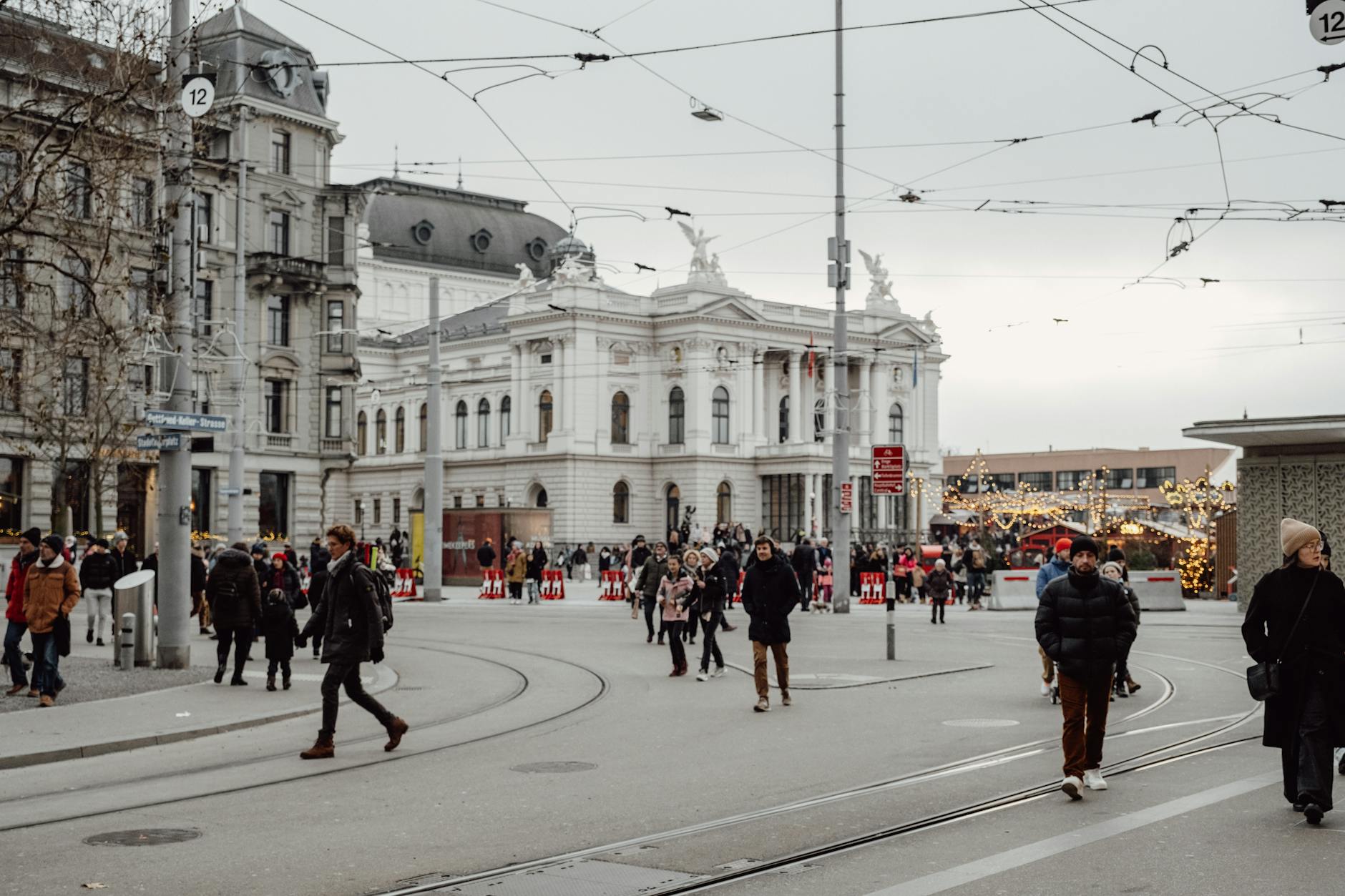
Identity: Switzerland’s largest city, financial center, museum hub, lake city, food-and-design base, and the country’s most useful arrival point.
Best for: Arrival, first night, museums, shopping, lake walks, food, nightlife, design, rail connections.
Why go: Zürich is not just an airport city. It has an attractive old town, strong museums, excellent restaurants, lake and river swimming culture in warm months, design shops, and superb rail links.
Best time: Year-round. Summer for lake/river life; winter for museums, shopping, and Christmas atmosphere.
How long: 1–2 nights for first-timers; 3 nights if you like cities.
Best pairings: Lucerne, Rhine Falls, St. Gallen, Basel, Bern, Graubünden, airport arrival/departure.
Skip if: You only have four days and care almost exclusively about Alps. Still, it may be useful as an arrival/departure night.
The move: Use Zürich as a smart logistics base, not as a guilt stop. Either give it a real day or move on efficiently.
Lucerne and Central Switzerland
Identity: The classic Swiss postcard in compact form: old town, wooden bridge, lake, mountain boats, nearby peaks, and easy transport.
Best for: First-timers, families, couples, short trips, scenic boat rides, Mount Rigi/Pilatus/Titlis-type excursions, rainy-day flexibility.
Why go: Lucerne gives you a city, lake, and mountain base without needing a long transfer. It is one of the easiest places to understand why Switzerland works.
How long: 2–4 nights.
Best pairings: Zürich, Bernese Oberland, Gotthard route, Ticino, Bern.
Common mistake: Treating Lucerne as only a one-afternoon bridge photo. Its value is the lake-and-mountain system around it.
Bern
Identity: Federal city, UNESCO-listed old town, arcades, river bends, museums, and an understated Swiss capital mood.
Best for: Old-town walking, history, museums, arcades, rainy days, lower-stress city break, transit between regions.
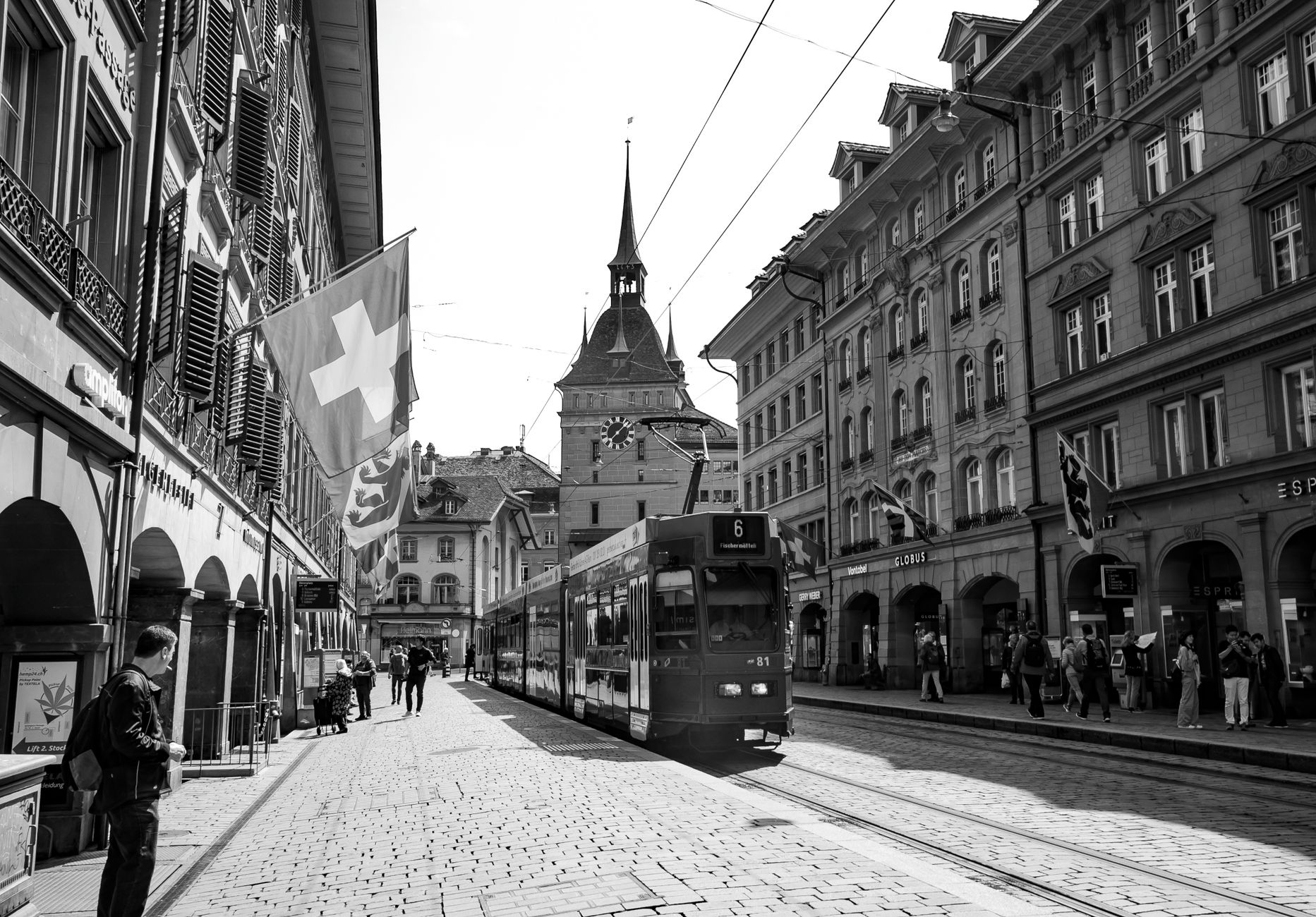
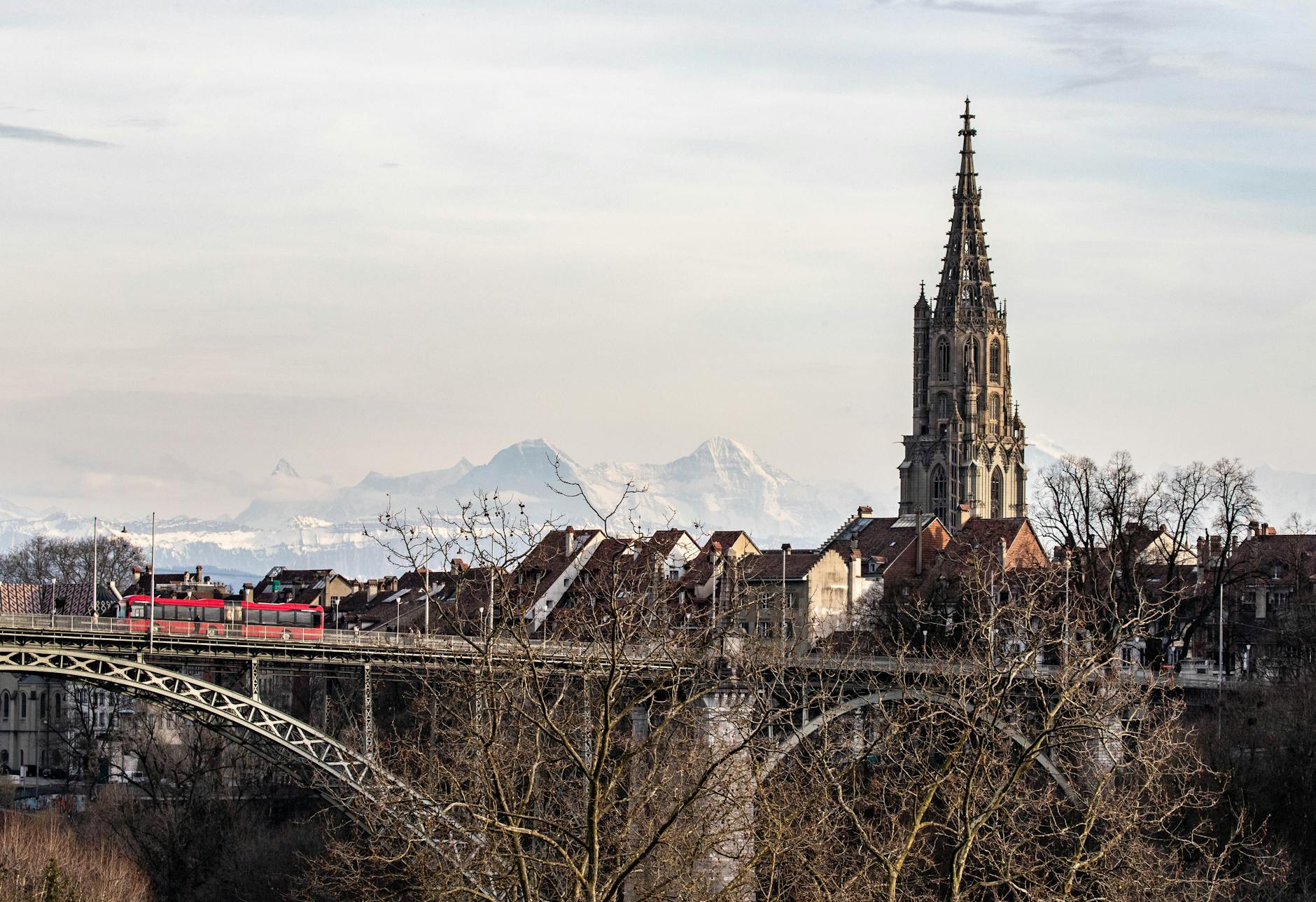
Why go: Bern is one of Switzerland’s most atmospheric cities. It is smaller and calmer than Zürich or Geneva, with beautiful urban fabric and useful access to the Bernese Oberland.
How long: 1–2 nights, or a full day trip.
Best pairings: Lucerne, Interlaken/Thun, Gruyères, Basel, Zürich.
The move: Visit Bern on a day when clouds cover the high Alps. It is one of the best bad-weather pivots near the Bernese Oberland.
Bernese Oberland and Jungfrau Region
Identity: Switzerland distilled: waterfalls, glacial peaks, chalet villages, dramatic valleys, lake towns, famous railways, and some of the country’s most iconic hiking.
Switzerland Tourism calls the Bernese Oberland “the very epitome of Switzerland,” emphasizing mountains, glaciers, lakes, waterfalls, and valleys.[20]
Best for: First-time Alps, hiking, families, mountain railways, photography, classic village scenery.
Main bases: Interlaken, Grindelwald, Wengen, Mürren, Lauterbrunnen, Wilderswil, Thun, Brienz.
| Base | Best for | Watch out for |
|---|---|---|
| Interlaken | Transport convenience, budget options, adventure sports, lake access. | Less atmospheric than mountain villages; can feel busy and commercial. |
| Grindelwald | Eiger views, First area, easier resort infrastructure, families. | Crowded, developed, and busy in peak season. |
| Wengen | Car-free village atmosphere, access to Kleine Scheidegg/Männlichen, families. | Requires train access; fewer late-night options. |
| Mürren | Car-free high-village drama, Schilthorn side, views, quiet evenings. | More effort with luggage; weather can isolate the mood. |
| Lauterbrunnen | Waterfall valley drama, access to both Wengen and Mürren sides. | Valley-floor base; lodging demand high; not the same as staying high. |
| Thun/Brienz | Lake towns, lower-cost or calmer base, boat trips. | Less immediate high-mountain atmosphere. |
How long: 3 nights minimum; 5–7 nights for hiking.
Common mistake: Booking one night and expecting to see the “whole” region.
Valais, Zermatt, Aletsch, and Saas-Fee
Identity: High alpine Switzerland: Matterhorn, glaciers, dry valleys, wine terraces, car-free resorts, ski culture, and some of the country’s most dramatic mountain scenery.
Best for: Matterhorn views, serious alpine atmosphere, skiing, high hiking, scenic trains, luxury, photography.
Main bases: Zermatt, Täsch, Visp/Brig, Sion, Crans-Montana, Saas-Fee, Bettmeralp/Riederalp for Aletsch.
How long: 3–5 nights for Zermatt and Valais; 2 nights minimum if route-bound.
Why go: Zermatt is touristy because it deserves to be. The Matterhorn is genuinely one of the world’s great mountain forms. But Valais is more than Zermatt: wine, side valleys, Aletsch Glacier, historic towns, and high-altitude resorts.
Common mistake: Doing Zermatt as a frantic day trip from far away. If the Matterhorn is clouded over, the entire premise collapses.
Lake Geneva Region: Geneva, Lausanne, Montreux, Vevey, Lavaux
Identity: French-speaking Switzerland: lake elegance, vineyards, museums, international Geneva, Lausanne hills, Montreux Riviera mood, castles, wine, and easy rail.
Best for: Wine, museums, lake walks, slower travel, couples, Geneva institutions, soft scenery, Chillon Castle, Lavaux terraces.
Main bases: Geneva, Lausanne, Montreux, Vevey.
How long: 3–5 nights.
Why go: This is the Switzerland many first-time Alps chasers miss. It is less dramatic than Zermatt or Jungfrau, but rich in culture, food, architecture, lake light, and vineyards.
Common mistake: Treating Geneva as a half-day airport city and missing Lausanne, Lavaux, Vevey, and Montreux.
Basel and Northwestern Switzerland
Identity: Art-city Switzerland with museums, Rhine life, architecture, design, and easy links to France and Germany.
Best for: Museums, architecture, Christmas markets, Rhine walks, city breaks, art/design, cross-border travel.
How long: 1–3 nights.
Why go: Basel is one of Europe’s strongest small museum cities. It is especially valuable for winter, rain, or culture-focused itineraries.
Common mistake: Ignoring Basel because it is not alpine. That is precisely why it is useful when mountains are socked in.
Ticino: Lugano, Locarno, Ascona, Bellinzona, Valle Verzasca, Valle Maggia
Identity: Italian-speaking Switzerland: lakes, palms, stone villages, piazzas, grotto restaurants, castles, valleys, and warmer light.
Best for: Mild weather, lake towns, food, slower travel, scenic valleys, northern Italy pairings.
How long: 3–5 nights.
Why go: Ticino feels like a cultural shift without leaving Switzerland. It is less about one knockout peak and more about atmosphere, villages, rivers, and food.
Common mistake: Trying to “see Ticino” in one day from Zürich. The Gotthard route is beautiful, but Ticino needs time.
Graubünden, Engadin, Davos, St. Moritz, Chur, Swiss National Park
Identity: Eastern alpine Switzerland: big valleys, Romansh culture, high resorts, rail engineering, national park landscapes, winter sports, and the Bernina route.
Best for: Scenic rail, repeat visitors, hiking, skiing, architecture, quiet valleys, Swiss National Park, St. Moritz/Engadin.
How long: 4–7 nights.
Why go: Graubünden is vast by Swiss standards and rewards travelers who want a less basic first-trip route. The Swiss National Park in the Engadine is over 170 square kilometers and was founded in 1914, making it the oldest national park in the Alps.[21]
Common mistake: Thinking St. Moritz is the whole Engadin. The valley, villages, lakes, and rail routes are the real story.
Eastern Switzerland, Appenzell, St. Gallen, Rhine Falls
Identity: A quieter Switzerland of abbeys, textile history, rolling hills, dairy culture, Rhine scenery, and less congested day trips from Zürich.
Best for: Repeat visitors, short city-based trips, culture, families, gentler landscapes, St. Gallen Abbey, Appenzell traditions, Rhine Falls.
How long: 1–3 nights, or day trips from Zürich.
Why go: This region is ideal when you want Swiss culture and landscape without competing for every Jungfrau-region hotel room.
Jura and Three-Lakes Region
Identity: Watchmaking towns, lakes, wine, cycling, quieter landscapes, and French-speaking regional texture.
Best for: Slow travelers, cyclists, watchmaking heritage, repeat visitors, lower-key lake towns, value compared with famous alpine resorts.
How long: 2–4 nights.
Why go: It is not the obvious first-trip postcard, but it broadens Switzerland beyond peaks and luxury resorts.
Where to Stay
Where you stay in Switzerland changes the trip more than in many countries because bases determine your weather options, lift access, rail time, food options, and evening atmosphere.
The Short Answer
- For a first trip with limited time: Stay in Lucerne and one Bernese Oberland base.
- For classic Alps: Stay in Wengen, Mürren, Grindelwald, Lauterbrunnen, or Zermatt.
- For easy logistics: Stay in Zürich, Lucerne, Interlaken, Bern, Lausanne, Montreux, or Visp/Brig.
- For atmosphere: Choose car-free villages like Wengen, Mürren, Zermatt, Bettmeralp, or mountain-resort villages with real evening life.
- For bad-weather resilience: Choose places with museums, rail exits, lake options, restaurants, and multiple day-trip directions.
- For value: Look beyond the most famous names, stay near rail rather than directly under the headline view, and consider apartments or guesthouses.
Base Decision Tree
| You want... | Stay in... |
|---|---|
| Best all-purpose first city | Zürich or Lucerne |
| Classic lake + mountain without complexity | Lucerne |
| Bernese Oberland transport convenience | Interlaken or Wilderswil |
| Bernese Oberland mountain village atmosphere | Wengen, Mürren, Grindelwald, Lauterbrunnen |
| Matterhorn-focused trip | Zermatt or Täsch if saving money |
| French-speaking lake elegance | Lausanne, Montreux, Vevey, Geneva |
| Ticino atmosphere | Lugano, Locarno, Ascona, Bellinzona |
| Scenic rail loop | Lucerne, Interlaken, Montreux, Zermatt, St. Moritz/Chur |
| Ski-focused trip | Zermatt, Verbier, St. Moritz, Davos/Klosters, Saas-Fee, Grindelwald/Wengen, Andermatt |
| Family base | Lucerne, Interlaken region, Wengen, Grindelwald, Montreux, Zürich with day trips |
| Museum/city trip | Zürich, Basel, Bern, Lausanne, Geneva |
| Better value | Bern, Thun, Brig/Visp, Chur, Bellinzona, smaller towns near major regions |
| Lower-walking older traveler trip | Zürich, Lucerne, Montreux/Vevey, Bern, lakeside hotels near stations |
Lodging Types
| Type | Best for | Notes |
|---|---|---|
| City hotels | Arrival nights, museums, rail logistics, business comfort. | Rooms can be expensive but efficient; location near station saves time. |
| Mountain hotels | Views, hiking, skiing, romance, alpine atmosphere. | Book early; check lift access, luggage logistics, restaurant closures, and cancellation terms. |
| Apartments / holiday rentals | Families, longer stays, cooking, budget control. | Respect quiet rules, waste/recycling instructions, tourist taxes, and check-in complexity. |
| Guesthouses / pensions | Value, local feel, village stays. | May have limited reception hours and simpler facilities. |
| Hostels | Budget travelers, hikers, solo travelers. | Switzerland has good hostels, but popular regions still book up. |
| Wellness hotels | Winter, rain, couples, recovery after hiking/skiing. | Can be a smart splurge when weather is uncertain. |
| Mountain huts | Hikers, alpine routes, hut-to-hut trekking. | Not casual hotels. Reserve early, bring appropriate gear, and understand hut etiquette. |
| Car-free resort lodging | Atmosphere and views. | Plan luggage transport and arrival timing. |
Common Booking Mistakes
- Choosing the cheapest hotel without checking train and lift access.
- Booking a mountain village for one night and spending most of the visit in transit.
- Staying in Interlaken only because it is famous, then wishing you were in Wengen or Mürren.
- Booking Zermatt for one night and losing the Matterhorn to clouds.
- Ignoring whether a hotel restaurant closes on certain days.
- Ignoring summer heat in lower-city hotels without adequate cooling.
- Booking a rental apartment without understanding cleaning fees, quiet hours, stairs, trash rules, or tourist tax.
- Assuming every mountain hotel can be reached by car.
- Forgetting that car-free villages require rail/cable-car/luggage planning.
- Booking peak ski or summer dates too late.
Best Things to Do
Switzerland’s best experiences are not just attractions. They are systems: train-to-boat connections, valley-to-peak excursions, lakefront public life, old towns, hiking networks, winter resorts, and regional food rituals.
1. Ride the Rails Properly
Switzerland’s rail network is both transport and attraction. Scenic branded trains are famous, but ordinary trains can be just as useful and often nearly as beautiful.
Best for: First-timers, non-drivers, families, older travelers, rail lovers.
Time needed: One day to two weeks, depending route.
Book ahead? Ordinary trains usually do not require seat reservations. Panoramic trains may require or strongly benefit from reservations.
Worth it? Yes, but do not build a trip where you spend every day sitting on trains. The train is a means of experiencing Switzerland, not the only experience.
2. Spend Real Time in the Bernese Oberland
The Bernese Oberland is the Switzerland many people imagine: dramatic valleys, the Eiger/Mönch/Jungfrau massif, mountain villages, alpine railways, lake boats, hiking routes, and classic views.
Best for: First-time Alps, families, hikers, photographers.
Time needed: 3 nights minimum; 5–7 nights ideal for hiking.
Book ahead? Lodging in peak season; key mountain excursions can be decided closer if weather-dependent.
Common mistake: Trying to see Jungfraujoch, Schilthorn, Grindelwald First, Lauterbrunnen, Wengen, Mürren, and both lakes in two days.
3. See the Matterhorn, But Give It Time
Zermatt is famous because the Matterhorn is famous, and the mountain deserves its reputation. But clouds are common, and the best trip gives you multiple chances.
Best for: Iconic scenery, skiing, luxury, hiking, photography.
Time needed: 3 nights minimum if Matterhorn views matter.
Book ahead? Hotels and popular restaurants, especially ski season and summer.
Worth it? Yes, if you accept the risk of weather and the cost of the resort.
4. Take a Lake Boat
Swiss lakes are not background scenery. They are transport corridors and travel experiences: Lake Lucerne, Lake Geneva, Lake Thun, Lake Brienz, Lake Zurich, Lake Lugano, Lake Maggiore, and more.
Best for: Slow travel, families, older travelers, photographers, sunny afternoons.
Time needed: 1–4 hours, or a full day with stops.
Pair it with: City walks, mountain railways, lakeside towns, picnics, vineyards.
The move: Use boats as transit when possible rather than as a separate “tour.”
5. Walk Old Towns Slowly
Switzerland’s cities are compact and polished, but not interchangeable. Bern, Lucerne, Zürich, Basel, Lausanne, Geneva, Fribourg, St. Gallen, Solothurn, and Bellinzona all reward walking.
Best for: Culture, rain days, history, photography, low-cost travel.
Time needed: Half-day to full day per city.
Worth it? Yes, especially when mountains are cloudy.
6. Hike Within Your Level
Switzerland has hikes for nearly every ability, from lakefront paths to steep alpine routes. The infrastructure is excellent, but that does not make every trail easy.
Best for: Active travelers, families, photographers, repeat visitors.
Tools: swisstopo, SwitzerlandMobility, local tourist offices, lift/trail status, weather, and appropriate maps.[15][16]
Common mistake: Choosing trails by Instagram rather than distance, elevation gain, exposure, snow, descent, and exit options.
7. Use Mountain Railways and Cable Cars Selectively
Jungfraujoch, Schilthorn, Gornergrat, Matterhorn Glacier Paradise, Pilatus, Rigi, Titlis, Stanserhorn, Rochers-de-Naye, and countless local lifts can be magnificent. They can also be expensive and weather-dependent.
Best for: Views, families, non-hikers, accessible mountain days, winter/summer scenery.
Book ahead? Sometimes. More important: check weather and live webcams.
Worth it? Pick the ones that fit your route. Do not collect peaks mechanically.
8. Visit Lavaux and Lake Geneva
Lavaux’s vineyard terraces above Lake Geneva are one of Switzerland’s most beautiful cultural landscapes and a good antidote to peak-chasing.
Best for: Wine, walking, lake views, photography, couples, food.
Time needed: Half-day to full day.
Pair it with: Lausanne, Vevey, Montreux, Chillon Castle, lake boat.
9. Eat Cheese in Context
Fondue and raclette are famous for a reason, but Swiss cheese is not just a tourist meal. Try alpine cheese, Gruyère, Vacherin Fribourgeois, Appenzeller, Tête de Moine, raclette in Valais, and regional dairy products.
Best for: Food travelers, winter trips, families, culture.
Common mistake: Eating fondue only at a tourist-menu restaurant in August and deciding Swiss food is heavy. Food changes by region and season.
10. Visit Basel for Art and Museums
Basel is not the classic mountain postcard, but it is one of Switzerland’s strongest culture cities.
Best for: Art, architecture, design, rainy days, winter, city travelers.
Time needed: 1–3 days.
Pair it with: Zürich, Bern, Alsace, Black Forest.
11. Go South to Ticino
Ticino changes the emotional temperature of the trip: Italian language, lakes, piazzas, stone villages, palm trees, and grotti.
Best for: Food, lake scenery, warmer weather, Italy pairings, repeat visitors.
Time needed: 3–5 days.
Pair it with: Lucerne via Gotthard, Graubünden via Bernina route, Milan/Lake Como.
12. Experience Winter Beyond Skiing
Winter Switzerland is not only for expert skiers. There are winter walks, sledding, spa hotels, Christmas markets, scenic trains, fondue nights, lake cities, museums, and mountain viewpoints.
Best for: Couples, families, non-skiers, festive travel, scenery.
Watch out: Avalanche danger, icy paths, short days, holiday prices, and resort closures.
13. Visit UNESCO Sites Intelligently
Switzerland has UNESCO-listed cultural and natural sites including the Old City of Bern, Abbey of St. Gall, Lavaux Vineyard Terraces, Jungfrau-Aletsch, Rhaetian Railway in the Albula/Bernina Landscapes, and more.[19]
Best for: Culture, history, landscape, route depth.
The move: Use UNESCO sites as route anchors, not checklist items.
14. Swim, Float, or Sit by Water
In warm months, lakes and rivers shape Swiss daily life. Zürich, Basel, Bern, Lucerne, Lausanne, and Geneva all have strong water culture.
Best for: Summer, low-cost pleasure, city breaks.
Safety note: River swimming is local-specific. Follow local rules and never enter fast water casually.
15. Take the Grand Tour by Car Only If You Want a Road Trip
Switzerland Tourism’s Grand Tour is a 1,643 km road circuit with 46 attractions, 22 lakes, 5 Alpine passes, and 13 UNESCO World Heritage sites across 8 stages.[8]
Best for: Drivers, photographers, EV road trips, repeat visitors, flexible travelers.
Not ideal for: First-timers who can see the same major highlights more easily by train, or nervous mountain-road drivers.
Switzerland Itineraries
These are pacing models, not commandments. Adjust by weather, budget, season, luggage, and arrival airport.
3 Days: A Fast Swiss Taste
Best for: Layover extension, Europe rail add-on, city + lake + one mountain.
Option A: Zürich + Lucerne
- Day 1: Arrive Zürich. Old town, lake, museum or food evening.
- Day 2: Lucerne day: Chapel Bridge, old town, lake boat, Rigi/Pilatus if weather fits.
- Day 3: Zürich museum/shopping or Rhine Falls/St. Gallen; depart.
Option B: Geneva + Lake Geneva
- Day 1: Geneva lakefront and old town.
- Day 2: Lausanne, Lavaux, Vevey/Montreux.
- Day 3: Chillon Castle, lake boat, or Gruyères; depart.
Do not do: Zürich + Lucerne + Interlaken + Zermatt in 3 days. That is not a trip; it is train sampling.
5 Days: One Region Done Well
Best for: Short vacation, first Switzerland taste, lower stress.
Classic version:
- Day 1: Arrive Zürich, transfer to Lucerne.
- Day 2: Lucerne + lake/mountain excursion.
- Day 3: Train to Bernese Oberland. Base in Wengen/Mürren/Grindelwald/Interlaken.
- Day 4: Mountain day or valley/lake day depending weather.
- Day 5: Bern or Zürich; depart.
The move: Use Lucerne and Bernese Oberland. Do not add Zermatt unless the entire trip is built around it.
7 Days: Classic First Trip
- Day 1: Arrive Zürich. Overnight Zürich or Lucerne.
- Day 2: Lucerne old town, lake boat, Rigi/Pilatus/Titlis depending season/weather.
- Day 3: Travel to Bernese Oberland. Settle into base.
- Day 4: High mountain day: Jungfrau side, Schilthorn side, or major hike.
- Day 5: Weather-flex day: lake boat, valley walk, Männlichen/Kleine Scheidegg, Grindelwald First, Trümmelbach Falls, Thun/Brienz.
- Day 6: Bern day or transfer to Lake Geneva.
- Day 7: Zürich or Geneva departure.
What it gives you: The classic Swiss emotional arc without overloading.
10 Days: Best First Switzerland Trip
- Day 1: Arrive Zürich. Old town, lake, easy dinner.
- Day 2: Lucerne. Boat/mountain pairing.
- Day 3: Lucerne second day or transfer via scenic route toward Interlaken/Bernese Oberland.
- Day 4: Bernese Oberland mountain day.
- Day 5: Bernese Oberland weather-flex day.
- Day 6: Bern day, then continue to Lausanne/Montreux.
- Day 7: Lavaux, Vevey, Montreux, Chillon Castle.
- Day 8: Transfer to Zermatt.
- Day 9: Zermatt mountain day or hike.
- Day 10: Depart via Geneva or Zürich.
What to cut if tired: Zermatt. Replace with more Lake Geneva or Bern/Lucerne. Better to do fewer regions well.
14 Days: Grand First Loop
- Days 1–2: Zürich.
- Days 3–4: Lucerne and Central Switzerland.
- Days 5–8: Bernese Oberland.
- Day 9: Bern.
- Days 10–11: Lake Geneva, Lavaux, Montreux/Lausanne.
- Days 12–13: Zermatt or Valais.
- Day 14: Depart Geneva or Zürich.
Alternative 14-day rail loop: Zürich → Lucerne → Interlaken → Montreux → Zermatt → St. Moritz/Chur → Zürich.
Scenic Rail Itinerary: 10–12 Days
- Zürich.
- Lucerne.
- Lucerne–Interlaken Express.
- Interlaken / Bernese Oberland.
- GoldenPass route to Montreux.
- Lake Geneva / Lavaux.
- Zermatt.
- Glacier Express to St. Moritz or Chur.
- Bernina route toward Tirano/Lugano or return north.
- Zürich departure.
The move: Consider breaking famous scenic rail journeys into smaller segments if you want flexibility. The Glacier Express is iconic, but it is a long sit-down day.
Hiking Trip: 10 Days
- Days 1–2: Arrive Zürich/Lucerne; warm-up lake and mountain walk.
- Days 3–7: Bernese Oberland hiking base.
- Days 8–10: Zermatt, Aletsch, or Engadin hiking base.
Season: July–September for high routes.
Warning: Build rest and weather days. Hiking every day in Switzerland is physically and mentally demanding if you also move hotels.
Winter Trip: 7–10 Days
- Days 1–2: Zürich, Basel, Lucerne, or Christmas-market/city start.
- Days 3–7: One ski/winter base: Zermatt, St. Moritz, Davos/Klosters, Verbier, Grindelwald/Wengen, Saas-Fee, Andermatt.
- Days 8–10: Scenic train, spa hotel, or city culture.
The move: Non-skiers should choose resorts with winter walking, sledding, spa, restaurants, viewpoints, and good rail access.
Food, Wine, and Culture Itinerary: 8–10 Days
- Zürich food/design and museums.
- Lucerne or Bern old town.
- Gruyères and Fribourg.
- Lausanne, Lavaux, Vevey, Montreux.
- Valais wine and raclette.
- Optional Ticino for grotti, merlot, risotto, and lake towns.
Family Itinerary: 8 Days
- Lucerne for easy city/lake/mountain activities.
- Bernese Oberland for trains, waterfalls, gentle hikes, playgrounds, cable cars.
- Bern or Zürich for museums and recovery.
The move: Stay longer in fewer places. Kids remember boat rides, cows, trains, chocolate, and one good mountain day more than they remember how many cantons you crossed.
Food and Drink
Swiss food is often reduced to cheese and chocolate. That is unfair, though cheese and chocolate are not a bad place to start. Swiss food is regional, seasonal, and shaped by language borders, alpine agriculture, neighboring countries, and practical mountain living.
Switzerland’s national-dishes guidance notes that fondue and raclette are more typically winter dishes, while muesli/Birchermüesli and rösti are popular year-round; it describes fondue as melted cheese served in a caquelon and rösti as one of the country’s best-known dishes.[18]
Swiss Food Identity
- Cheese culture: Gruyère, Vacherin Fribourgeois, Appenzeller, Emmentaler, Raclette du Valais, Tête de Moine, alpine cheeses.
- Mountain food: Fondue, raclette, rösti, älplermagronen, polenta in Ticino, hearty soups, sausages, dried meats.
- City food: Modern Swiss dining, international cuisine, bakeries, cafés, market halls, vegetarian/vegan options, immigrant influences.
- Regional influence: French-speaking Switzerland leans toward wine, refined lake/city dining, cheese; Ticino leans Italian; German-speaking regions have hearty classics and bakery culture; Graubünden has capuns, pizzoccheri, barley soup, nut tart.
- Sweet culture: Chocolate, pastries, Luxemburgerli, Nusstorte, meringues, biscuits, seasonal sweets.
- Wine: Swiss wine is under-exported because much is consumed domestically. Key regions include Valais, Vaud/Lavaux, Geneva, Ticino, Neuchâtel, and German-speaking Swiss regions.
What to Eat
| Dish / drink | What it is | Where to try it |
|---|---|---|
| Fondue | Melted cheese, wine, bread, shared pot. | Fribourg/Gruyères, Valais, Bernese Oberland, winter restaurants, traditional city spots. |
| Raclette | Melted cheese scraped over potatoes/pickles; especially associated with Valais. | Valais, mountain restaurants, winter menus. |
| Rösti | Fried grated potato dish, often with additions. | German-speaking Switzerland, Bern, mountain huts, traditional restaurants. |
| Älplermagronen | Alpine macaroni with cheese, potatoes, onions, sometimes applesauce. | Mountain restaurants, central/eastern Switzerland. |
| Zürcher Geschnetzeltes | Sliced veal in cream sauce, often with rösti. | Zürich traditional restaurants. |
| Birchermüesli | Swiss muesli with oats, fruit, yogurt/milk. | Breakfast buffets, cafés, supermarkets. |
| Capuns | Graubünden chard-wrapped dumpling-like parcels. | Graubünden/Engadin. |
| Bündner Nusstorte | Nut tart from Graubünden. | Engadin, Graubünden bakeries. |
| Polenta / risotto / grotti dishes | Italianate Ticino staples. | Ticino valleys, Lugano/Locarno/Ascona. |
| Swiss chocolate | From industrial icons to bean-to-bar makers. | Zürich, Geneva, Broc, Lausanne, specialty shops. |
| Swiss wine | Chasselas, Pinot Noir, Merlot, Petite Arvine, Cornalin, and more. | Lavaux, Valais, Geneva, Ticino, Neuchâtel. |
Where to Eat by Situation
| Situation | Best approach |
|---|---|
| First dinner after arrival | Keep it close: hotel restaurant, station-area bistro, Swiss casual, Italian, or simple old-town restaurant. Do not make your first night a mountain transfer plus hard reservation. |
| Mountain lunch | Choose a mountain restaurant, hut, or picnic from a bakery/supermarket. Views often matter as much as cuisine. |
| Budget meal | Supermarket picnic, bakery, takeaway, casual Asian/Italian, kebab, university areas, market halls, lunch specials. |
| Splurge meal | Lakefront fine dining, mountain hotel restaurant, Zürich/Basel/Geneva/Lausanne fine dining, wine-region tasting menu. |
| Family meal | Coop/Migros restaurants where available, casual Swiss restaurants, pizzerias, hotel dining, mountain cafés, apartment cooking. |
| Rainy day | Long lunch, city museum café, food hall, chocolate visit, cheese dairy, wine tasting. |
| Vegetarian/vegan | Easy in cities, more limited in rural/mountain traditional restaurants. Plan ahead in smaller villages. |
| Gluten-free/allergies | Manageable with planning, but mountain huts and traditional restaurants may have limited options. Bring translation cards if needed. |
Restaurant Practicalities
- Many restaurants close between lunch and dinner.
- Sunday and Monday closures can matter, especially outside city centers.
- Reservations are wise for good restaurants, mountain resorts, weekends, and peak season.
- Tipping is not like in the United States. Service is generally included; rounding up or leaving a modest extra for good service is common.
- Tap water may be available, but bottled water is often offered and can be expensive. Ask clearly.
- Lunch menus can be better value than dinner.
- In mountain resorts, hotel half-board can make sense if restaurants are limited.
- Supermarkets are generally closed or limited on Sundays except some station/airport locations.
The Move
Use supermarkets and bakeries as part of the trip, not as a failure of dining. A Swiss picnic by a lake or on a train platform with bread, cheese, fruit, chocolate, and local yogurt can beat a mediocre tourist restaurant.
Getting Around
Switzerland is one of the easiest countries in the world to travel without a car. The harder question is not “Can I get there?” but “Which ticket/pass combination makes sense, and how much movement is too much?”
Arrival Guide
Zürich Airport
Best for Zürich, Lucerne, eastern Switzerland, Graubünden, Bernese Oberland, and many national loops. The airport is directly connected to the rail network, making onward travel unusually simple.
The move: If you land early and sleep in Lucerne or Zürich, the first day is easy. If you land late and continue to a mountain village, check last connections and luggage effort.
Geneva Airport
Best for Geneva, Lausanne, Montreux, Lake Geneva, Valais/Zermatt, western Switzerland, and France-side pairings.
The move: Geneva is a smart entry for Lake Geneva + Zermatt or French Alps + Switzerland routes.
Basel EuroAirport
Best for Basel, northwestern Switzerland, Alsace, Black Forest, and Zürich/Bern connections. It is physically in France near the Swiss border and has Swiss/French sector logistics.
The move: Great for culture or cross-border itineraries, less obvious for classic first-time Alps unless fares are excellent.
Public Transport
SBB Mobile is the key tool. It lets travelers search timetables and buy tickets; SBB describes it as Switzerland’s most popular public transport app.[6]
Switzerland’s public transport system includes:
- Intercity and regional trains.
- City trams and buses.
- PostBus routes into valleys.
- Lake boats.
- Mountain railways.
- Cable cars, gondolas, and funiculars.
- Panoramic trains.
Ticket Strategy
Point-to-Point Tickets
Best when you have a small number of journeys and can buy specific tickets. Supersaver tickets and Saver Day Passes can reduce cost but reduce flexibility.
Swiss Travel Pass
Best when you travel often, want simplicity, use trains/boats/city transit extensively, visit museums, and dislike buying tickets constantly. It is convenient and can be worth it, but not automatically.
Swiss Half Fare Card
The Swiss Half Fare Card costs CHF 150, lasts one month, and reduces many rail, bus, boat, city transit, mountain railway, and gondola costs.[5]
Best when you:
- Stay in fewer bases.
- Plan expensive mountain excursions.
- Want flexibility without committing to a full pass.
- Are traveling for more than a few days.
- Will compare regional passes.
Regional Passes
Look closely in:
- Bernese Oberland / Jungfrau region.
- Central Switzerland / Tell-Pass region.
- Valais / Zermatt areas.
- Graubünden / Engadin.
- Lake Geneva local options.
The move: Build your actual route, then price it. Do not buy a pass because a stranger on the internet said it was always worth it.
Scenic Trains
| Route | Best for | Notes |
|---|---|---|
| Glacier Express | Zermatt–St. Moritz/Chur panoramic day. | Famous, long, reservation/surcharge; not the only way to ride the route. |
| Bernina Express | Graubünden to Tirano/Lugano, high alpine to Italy. | Spectacular; reservation on named panoramic service. Regional trains also run. |
| GoldenPass Express / route | Interlaken–Montreux scenery. | Useful for linking Bernese Oberland and Lake Geneva. |
| Gotthard Panorama Express | Lucerne–Ticino with boat/train combination. | Seasonal/route-specific; check operation. |
| Luzern–Interlaken Express | Easy classic lake-to-mountain link. | Useful and scenic, not just a tourist train. |
| Gornergrat Railway | Zermatt mountain views. | Weather-dependent, expensive, often worthwhile. |
| Jungfrau Railway | Jungfraujoch access. | Iconic, costly, weather-dependent. |
Driving
You usually do not need a car for a first Swiss trip. Driving can make sense for:
- Remote villages not well connected by rail.
- Photography road trips.
- Families with lots of luggage.
- Alpine pass driving as a goal.
- Rural stays outside major corridors.
- Cross-border regions where rail is awkward.
Driving can be a mistake for:
- Zürich/Lucerne/Bern/Geneva/Basel city stays.
- Car-free villages.
- Famous mountain resorts with expensive parking.
- Nervous mountain drivers.
- Winter travel without snow/ice confidence.
- Itineraries where trains are direct and scenic.
Remember: The motorway vignette is required for Swiss motorways/expressways and costs CHF 40 for 2026.[11]
Boats
Lake boats are part of public transport and sightseeing. They are especially useful on Lake Lucerne, Lake Geneva, Lake Thun, Lake Brienz, Lake Zurich, and Ticino lakes.
The move: Use a boat leg to slow down a travel day. Switzerland is too beautiful to make every transfer the fastest possible transfer.
Luggage
Switzerland is train-friendly, but luggage still matters. Stairs, platform changes, cobbled streets, mountain railways, car-free villages, and small rooms can make big suitcases annoying.
The move: Pack lighter and use luggage services where useful, especially if combining mountain villages and scenic trains.
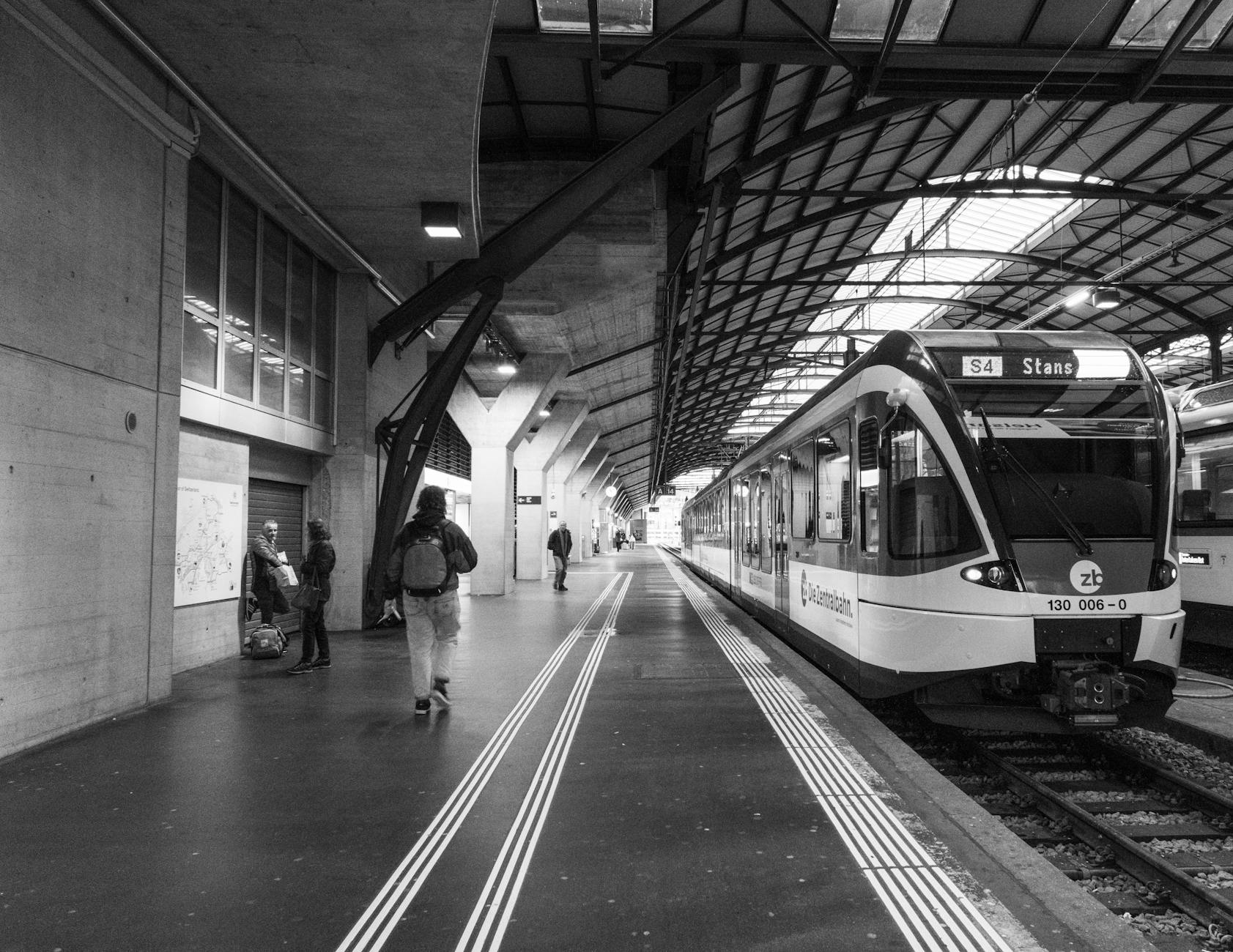
Budget and Costs
Switzerland is expensive. Pretending otherwise helps nobody. The good news is that high costs are predictable and often tied to choices: lodging, restaurants, mountain lifts, scenic trains, and route complexity.
Daily Budget Ranges
| Traveler type | Daily estimate, excluding long-haul flights | What it means |
|---|---|---|
| Shoestring | CHF 90–150 | Hostel dorms, supermarket meals, limited paid mountain lifts, careful train tickets, free hikes/city walks. |
| Budget comfort | CHF 150–250 | Simple hotel/guesthouse, casual meals, Half Fare Card or careful tickets, selective mountain excursions. |
| Mid-range | CHF 250–450 | Good 3-star hotels, restaurant meals, trains, one or two mountain lifts, museums, occasional splurge. |
| Comfortable | CHF 450–750 | Strong locations, scenic passes, better restaurants, lake/mountain hotels, taxis where useful. |
| Luxury | CHF 750+ | High-end hotels, famous resorts, fine dining, first-class rail, spa hotels, private guides, premium rooms/views. |
What Costs More Than Visitors Expect
- Hotels in famous mountain resorts.
- Family rooms and suites.
- Mountain lifts and high-altitude railways.
- Sit-down restaurant meals.
- Bottled drinks, cocktails, and lakefront dining.
- Last-minute peak-season lodging.
- Scenic train reservations/surcharges.
- Parking in cities and resorts.
- Ski passes, rentals, lessons, and resort food.
What Can Be Surprisingly Good Value
- Ordinary public transport quality.
- Supermarket picnics.
- Clean hostels and simple guesthouses.
- Public lake/river swimming areas.
- City walks, old towns, fountains, and viewpoints.
- Half Fare Card when matched to expensive mountain travel.
- Apartment stays for families or longer visits.
- Lunch menus compared with dinner.
Best Value Moves
- Stay near a useful station rather than directly under the most famous view.
- Buy breakfast picnic supplies instead of paying hotel breakfast rates every day.
- Use the Half Fare Card if doing multiple expensive mountain railways/lifts.
- Stay longer in fewer bases.
- Do one or two paid mountain peaks, not every peak.
- Use lake boats and ordinary scenic trains for lower-cost beauty.
- Choose shoulder seasons with care: June/September/early October can be strong.
- Book hotels early for summer, ski season, and holiday periods.
- Use cities as bad-weather days instead of forcing expensive cloudy mountain excursions.
Splurge-Worthy
- A well-located mountain hotel with a real view for two or three nights.
- One famous mountain railway on a clear day.
- A scenic rail reservation if the route itself is a priority.
- A lakefront or vineyard-region meal in good weather.
- A private guide for hiking, skiing, food, or history if you want depth.
- A spa/wellness hotel in winter or shoulder season.
Usually Not Worth It
- Renting a car for a rail-friendly first route.
- Paying for multiple expensive peaks in one region.
- Long day trips to Zermatt or Jungfrau from faraway cities just to tick a box.
- View restaurants when visibility is poor.
- First-class rail if you are trying to control budget and routes are short.
- Staying far outside a region to save money, then losing hours daily.
Safety, Health, Mountains, and Scams
Switzerland is generally a safe and low-friction country for visitors. But the Alps create real risks, and expensive, safe-feeling places can still punish bad planning.
General Safety
- Violent crime risk is low for most visitors.
- Pickpocketing can happen in busy stations, tourist areas, and crowded events.
- Keep valuables secure on trains and in station areas.
- Nightlife areas in major cities still require normal urban judgment.
- Watch luggage around platforms, station cafés, and airport rail links.
Emergency Numbers
Use 112 for general emergency help. Swiss numbers include 117 for police, 118 for fire, 144 for ambulance, and 145 for poison control.[9]
Mountain Safety
The mountains are Switzerland’s biggest safety topic.
Risks include:
- Sudden weather changes.
- Lightning and storms.
- Snowfields lingering into summer.
- Avalanches in winter and spring.
- Rockfall and landslides.
- Flooding and swollen streams.
- Heat and dehydration at lower elevations.
- Sun exposure at altitude.
- Steep descents and knee strain.
- Getting stuck after last cable car or train.
Use official hazard and weather tools: MeteoSwiss, Natural Hazards Portal, SLF avalanche bulletin, local resort/lift pages, swisstopo, SwitzerlandMobility.[12][13][14][15][16]
Hiking Rules That Matter
- Check weather the evening before and morning of.
- Check trail status, not just Google Maps.
- Understand Swiss trail markings and difficulty.
- Do not hike high routes in sneakers unless explicitly easy and conditions are dry.
- Bring layers, rain protection, water, sun protection, snacks, and charged phone.
- Know the last lift/train down.
- Turn back early if weather changes.
- Respect closed trails.
- Do not walk onto snowfields or glaciers without proper knowledge/equipment.
Winter Safety
- Stay on marked/open ski runs unless trained and equipped for off-piste.
- Avalanche danger applies beyond secured areas.
- Check SLF bulletins and resort information.
- Hire qualified guides for off-piste/backcountry.
- Winter hiking and sledding still require proper footwear and awareness.
- Mountain roads may require chains or winter equipment depending conditions.
Water Safety
Swiss lakes and rivers look clean and inviting, but cold water, currents, boat traffic, and sudden depth changes matter.
- Swim only where safe and permitted.
- In cities, follow local river-swimming customs and entry/exit points.
- Never jump into unfamiliar water.
- Avoid swimming alone or after heavy alcohol.
- Watch children near lakes, rivers, and fountains.
Health Practicalities
- Pharmacies are high quality; look for “Apotheke” or “Pharmacie.”
- Travel insurance should cover mountain activities, skiing, hiking, evacuation, and trip interruption.
- Medical care is excellent but expensive.
- Carry prescriptions in original packaging and check controlled-medication rules.
- Sun at altitude is stronger than many visitors expect.
- Tick precautions matter in some lower/forested regions.
Common Scams and Annoyances
Switzerland is not scam-heavy compared with many destinations, but watch for:
- Pickpockets in crowded stations/events.
- Fake or overpriced third-party vignette/pass websites.
- Dynamic currency conversion on card terminals. Pay in CHF.
- Tourist restaurants with poor value in prime-view locations.
- Accommodation listings with misleading location descriptions.
- Overconfident tour claims promising guaranteed views.
- Unclear cancellation terms for mountain excursions or hotels.
The Move
In Switzerland, “safe” does not mean “consequence-free.” The country lowers friction; it does not remove weather, altitude, water, snow, or cost risk.
Accessibility and Mobility
Switzerland can be strong for accessible travel because of its public transport, modern infrastructure, and organized tourism systems. It can also be difficult because of old towns, hills, cobblestones, mountain villages, older hotels, station transfers, and lift/cable-car access issues.
What Helps
- Major rail stations often have elevators, ramps, and assistance services.
- Many museums, modern hotels, and city attractions are accessible.
- Lake boats and newer transport infrastructure may be accessible, though details vary.
- Switzerland Tourism and some route programs include accessibility information.
- City trams and buses can be easier than hilly walks.
- Taxis are reliable, though expensive.
What Is Hard
- Medieval old towns with cobblestones and grades.
- Mountain villages with slopes, stairs, snow, ice, and limited vehicle access.
- Older hotels without elevators or with small lifts.
- Rail transfers requiring long platform changes.
- Cable cars/funiculars with access limits.
- Winter ice and snow.
- Gravel paths, farm tracks, and high-altitude terrain.
Lower-Walking Strategy
- Base in Lucerne, Zürich, Montreux/Vevey, Lausanne, Bern, or Interlaken rather than a steep village.
- Stay very close to the station or lakefront.
- Choose fewer day trips.
- Use taxis for awkward station-to-hotel segments.
- Confirm hotel elevator, shower, step-free entry, and room size directly.
- Use lake boats and scenic trains for big experiences without long hikes.
- Avoid overloading days with station transfers.
Best Accessible-Style Route
Zürich → Lucerne → Montreux/Lausanne → Bern → Zürich/Geneva. This gives cities, lakes, trains, old towns, and scenic travel with fewer high-mountain access complications.
Families, Solo Travelers, LGBTQ+ Travelers, and Special Considerations
Families With Children
Switzerland is excellent for families if the budget works. Trains, boats, cable cars, clean towns, safe-feeling streets, playgrounds, lake swims, chocolate, cows, mountains, and short transfers can make it magical.
Best family bases: Lucerne, Interlaken region, Wengen, Grindelwald, Montreux/Vevey, Zürich, Bern, Ticino lake towns.
Family tips:
- Use the Swiss Family Card benefits when buying eligible passes or Half Fare products; SBB notes children can travel free with parents under qualifying conditions.[5]
- Stay in apartments or family rooms where possible.
- Avoid changing hotels too often.
- Build one major activity per day.
- Check stroller access in mountain villages.
- Bring layers for kids; mountain weather changes fast.
- Supermarkets and bakeries make picnic meals easy.
- Use trains and boats as activities.
Solo Travelers
Switzerland is one of Europe’s easiest solo destinations, especially by train. It is safe-feeling, organized, scenic, and comfortable for independent movement.
Solo tips:
- Use hostels or simple hotels to control costs.
- Join guided hikes, food walks, or day activities for social contact.
- Avoid remote hikes alone unless experienced and prepared.
- Keep someone informed for mountain days.
- Eat at casual restaurants, bakeries, supermarket picnics, and museum cafés without stress.
Women Traveling Solo
Many women find Switzerland low-stress for solo travel. Normal urban and nightlife precautions still apply. The bigger issue is outdoor safety: avoid isolated mountain or forest routes beyond your comfort level and avoid hiking alone in poor weather.
LGBTQ+ Travelers
Switzerland is generally comfortable for LGBTQ+ travelers, especially in cities and established tourism areas. Zürich, Geneva, Lausanne, and Basel are the easiest urban bases. Rural and traditional areas can feel more reserved but are generally professional and discreet.
Older Travelers
Switzerland can be excellent for older travelers because trains, boats, and mountain railways make big scenery accessible. The key is pacing.
Best bases: Lucerne, Montreux/Vevey, Zürich, Bern, Interlaken if using rail/boats, Zermatt only if car-free logistics are comfortable.
Tips:
- Choose hotels near stations.
- Avoid one-night mountain hopping.
- Use luggage services when helpful.
- Take taxis for short awkward transfers.
- Prioritize scenic rail and boats over high-effort hikes.
Remote Workers and Longer Stays
Switzerland is high-quality but expensive. Zürich, Basel, Geneva, Lausanne, Bern, and Lucerne work best for urban infrastructure. Mountain villages can be wonderful for writing or recovery but may have limited winter/summer seasonality, higher costs, and less spontaneous social life.
Shopping and Souvenirs
Switzerland shopping can be excellent, but it is easy to overspend on generic souvenirs. Buy selectively.
Best Things to Buy
- Chocolate from good local makers or reputable Swiss brands.
- Cheese where transport/customs rules allow.
- Swiss wine, especially if you cannot find it easily at home.
- Watches, if you know what you are buying.
- Swiss Army knives, packed in checked luggage.
- Design objects, stationery, and museum-shop items.
- Alpine herbs, teas, jams, honey, and regional foods.
- Textiles, woodwork, cowbells, and craft items from reputable shops.
- Bündner Nusstorte from Graubünden.
- Local ceramics or small objects from regional makers.
Best Shopping Areas
| Area | Best for |
|---|---|
| Zürich | Luxury, design, chocolate, watches, fashion, food halls. |
| Geneva | Watches, luxury, chocolate, international shopping. |
| Basel | Museum shops, design, art books, Christmas markets. |
| Bern | Old-town arcades, local goods, markets. |
| Lucerne | Watches, souvenirs, Swiss classics, old-town shops. |
| Lausanne/Montreux/Vevey | Wine, food, lake-region goods. |
| Ticino | Food, wine, crafts, Italianate markets. |
| Graubünden/Engadin | Nusstorte, mountain goods, local crafts. |
What Not to Buy Thoughtlessly
- Cheap “Swiss” souvenirs made elsewhere.
- Knives if you only have carry-on luggage.
- Large chocolate hauls in hot weather without transport planning.
- Cheese or meat that your home country will not allow.
- Watches from unclear sellers.
- Cowbells or large decor items you will regret carrying.
Tax and Customs Notes
Switzerland is not in the EU customs union. Rules for goods, cash, alcohol, tobacco, food, plants, and animal products can differ from neighboring countries. Swiss customs notes that every person entering Switzerland must clear customs and that goods over allowance thresholds may need declaration.[22] For cash, Swiss customs states there is no obligation to declare cash, but amounts over CHF 10,000 may require accurate disclosure during checks.[23]
Arts, Culture, History, and Context
Switzerland is often marketed through scenery, but its culture is just as important: multilingual federalism, cantonal identity, direct democracy, neutrality, trade routes, religious history, engineering, watchmaking, banking, design, modern art, and alpine agriculture.
Short History for Travelers
Switzerland’s story is less about one centralized capital and more about confederation, cantons, passes, cities, valleys, and negotiated identity. The old Swiss Confederacy emerged in the late medieval period around alliances among alpine communities and towns. Over centuries, it expanded into a multilingual federal state where local autonomy remained unusually important.
The Alps shaped everything: defense, trade, isolation, tourism, engineering, agriculture, and myth. Mountain passes connected northern and southern Europe. Cities such as Zürich, Basel, Geneva, Bern, and Lausanne developed distinct religious, commercial, and intellectual roles. Tourism transformed places like Lucerne, Interlaken, Zermatt, St. Moritz, and Montreux into global destinations.
Modern Switzerland is highly international yet deeply local. Geneva hosts international organizations. Zürich is a financial and cultural center. Basel is a pharmaceutical and art city. Ticino looks south. Graubünden preserves Romansh and high-valley identities. Swiss identity is not one language or one cuisine; it is a political and cultural system for holding difference together.
Language and Identity
Switzerland has four national languages: German, French, Italian, and Romansh. This is not just trivia. It shapes menus, greetings, architecture, newspapers, school systems, city moods, and what “local” feels like from region to region.[17]
The move: Learn the greeting for the region you are visiting. German-speaking areas may use Grüezi; French-speaking areas Bonjour; Ticino Buongiorno or Ciao in casual contexts. English works in many tourist settings, but regional courtesy matters.
Museums and Cultural Institutions
| Place | Best for | Notes |
|---|---|---|
| Kunsthaus Zürich | Art, modern collections, city culture. | Strong for Zürich days. |
| Swiss National Museum, Zürich | Swiss history and culture. | Good orientation museum. |
| Fondation Beyeler, Basel/Riehen | Modern and contemporary art. | Major art destination. |
| Kunstmuseum Basel | Art history and modern art. | Basel is a museum city. |
| Paul Klee Center, Bern | Klee, architecture, art. | Good Bern pairing. |
| Olympic Museum, Lausanne | Sports history, families. | Strong Lake Geneva option. |
| Chaplin’s World, Vevey/Corsier-sur-Vevey | Film, families, popular culture. | Good Lake Geneva rainy-day option. |
| International Red Cross and Red Crescent Museum, Geneva | Humanitarian history. | Makes Geneva more than lakefront. |
| Swiss Museum of Transport, Lucerne | Transport, families, rain day. | One of the easiest family wins. |
| Abbey Library of St. Gallen | Manuscripts, baroque library, UNESCO context. | Excellent eastern Switzerland culture stop. |
UNESCO Context
UNESCO-listed Swiss sites include Old City of Bern, Abbey of St. Gall, Benedictine Convent of St John at Müstair, Lavaux Vineyard Terraces, Jungfrau-Aletsch, Rhaetian Railway in the Albula/Bernina Landscapes, La Chaux-de-Fonds/Le Locle watchmaking urban planning, and others.[19]
Etiquette and Cultural Norms
- Be punctual.
- Keep noise moderate, especially in trains, hotels, apartments, and residential areas.
- Respect quiet hours and Sunday norms.
- Buy and validate/use the correct ticket.
- Do not litter. Public spaces are clean because people participate in keeping them that way.
- Greet staff when entering small shops or restaurants.
- Do not assume everyone speaks English, even if many do in tourism contexts.
- Follow trail closures, farm signs, and protected-area rules.
- Do not walk through high grass/meadows unless the path clearly permits it.
- In apartments, follow trash/recycling rules exactly.
- In saunas/spas, rules vary; check textile/nudity etiquette before entering.
Seasonal and Month-by-Month Guide
Spring
Spring is split by altitude. Lakes and cities can feel fresh and green while higher mountains still hold snow. This is a good time for Zürich, Basel, Geneva, Lausanne, Bern, Lucerne, Ticino, and lower hikes. It is less reliable for high-alpine hiking.
Best experiences: City breaks, lake walks, lower valleys, museums, Ticino, flower blooms, photography of snow peaks above green meadows.
Watch out: Closed lifts, muddy trails, variable weather, off-season hotel/restaurant closures in mountain resorts.
Summer
Summer is high season for hiking, lakes, mountain railways, family travel, and full alpine infrastructure. It is also expensive and busy.
Best experiences: Bernese Oberland, Zermatt, Engadin, lake swimming, boats, hiking, high passes, mountain huts, festivals.
Watch out: Crowds, storms, heat in lower regions, booked hotels, expensive mountain excursions.
Autumn
September is often the best Switzerland month. October is excellent for vineyards, cities, lower hikes, and golden landscapes. November becomes quieter and more transitional.
Best experiences: Hiking, wine regions, Lavaux, Valais, Ticino, city culture, photography, lower crowds.
Watch out: Reduced mountain services later in autumn, shorter days, early snow.
Winter
Winter is both ski Switzerland and city-culture Switzerland. Ski resorts are expensive but atmospheric; cities offer Christmas markets, museums, concerts, and food.
Best experiences: Skiing, winter hiking, sledding, spa hotels, Christmas markets, scenic trains, fondue, mountain villages.
Watch out: Avalanches, short days, fog in lower areas, holiday prices, snow variability at low altitude.
Event Timing to Consider
- Christmas markets: Generally late November through December in many cities.
- Ski season: Often December to March/April depending altitude and resort.
- High hiking season: Roughly July to September for many high routes.
- Montreux Jazz Festival: Summer; book early if attending.
- Basel Fasnacht: Late winter/early spring depending calendar.
- Alpabzug / désalpe: Alpine cattle descents in late summer/autumn, varying by village.
- Wine harvest: Autumn, especially Valais, Vaud/Lavaux, Geneva, Ticino.
- Swiss National Day: August 1.
The Move
Switzerland’s “best time” is not one answer. It is a match between activity and altitude. July can be perfect for hiking and poor for budget. November can be weak for mountain lifts and excellent for museums. December can be magical for winter atmosphere and risky if you expect guaranteed low-altitude snow.
Day Trips and Cross-Border Extensions
Switzerland is compact and well connected, making day trips easy. The danger is doing too many.
Best Day Trips by Base
| Base | Best day trips |
|---|---|
| Zürich | Lucerne, Rhine Falls, St. Gallen, Rapperswil, Appenzell, Basel, Bern. |
| Lucerne | Rigi, Pilatus, Titlis, Stoos, Lake Lucerne boats, Bern, Interlaken route. |
| Interlaken / Bernese Oberland | Jungfrau region villages, Lake Thun, Lake Brienz, Bern, Schilthorn/Jungfraujoch, Grindelwald/Wengen/Mürren. |
| Bern | Thun, Fribourg, Gruyères, Emmental, Basel, Lucerne, Interlaken. |
| Geneva | Lausanne, Montreux, Lavaux, Annecy, Chamonix, Nyon, Yvoire, Gruyères. |
| Lausanne/Montreux | Lavaux, Chillon, Gruyères, Geneva, Vevey, Rochers-de-Naye, Valais. |
| Zermatt | Gornergrat, Matterhorn Glacier Paradise, Sunnegga/Rothorn, Saas-Fee, Valais towns if leaving valley. |
| Lugano/Locarno | Bellinzona, Valle Verzasca, Valle Maggia, Monte Brè/San Salvatore, Como/Milan with care. |
| Basel | Colmar/Alsace, Freiburg im Breisgau, Zürich, Bern, Lucerne, Vitra Design Museum. |
| St. Moritz/Engadin | Bernina route, Swiss National Park, Sils/Silvaplana, Pontresina, Muottas Muragl, Tirano. |
Cross-Border Extensions
| Extension | Best for | Notes |
|---|---|---|
| Northern Italy | Ticino, Bernina route, Lake Como, Milan. | Natural with Lugano/Locarno or Tirano. |
| French Alps | Geneva, Chamonix, Annecy. | Good with Geneva/Lake Geneva; check weather and border logistics. |
| Alsace / Black Forest | Basel, wine villages, Christmas markets, museums. | Strong culture pairing. |
| Austria / Liechtenstein | Eastern Switzerland, St. Gallen, Graubünden. | Good for repeat visitors or road/rail extensions. |
| Germany | Basel/Zürich to Freiburg, Konstanz, Munich. | Useful for rail/open-jaw itineraries. |
The Move
Do not use Switzerland only as a pass-through between Italy and France unless budget forces it. Switzerland is at its best when you give it enough time to slow down between scenic jumps.
What to Skip
This section is not about being cynical. It is about protecting the trip.
Skip: Trying to See Every Famous Place
Zürich, Lucerne, Interlaken, Jungfraujoch, Grindelwald, Lauterbrunnen, Mürren, Zermatt, Glacier Express, St. Moritz, Lugano, Geneva, Montreux, Bern, Basel, and Rhine Falls do not belong in one short itinerary.
Better alternative: Choose one main mountain region, one lake/city region, and one optional scenic transfer.
Skip: Expensive Mountain Excursions in Bad Weather
If webcams show clouds, fog, or whiteout, forcing a peak trip can be an expensive disappointment.
Better alternative: Swap for a lake boat, old town, museum, spa, lower hike, or food experience.
Skip: One-Night Zermatt Unless Route-Bound
The Matterhorn is not guaranteed. One night gives you little weather flexibility.
Better alternative: Stay 3 nights if the Matterhorn matters, or choose Bernese Oberland/Lucerne for a shorter first trip.
Skip: Renting a Car for City-to-City Switzerland
Trains are easier for Zürich, Lucerne, Bern, Basel, Geneva, Lausanne, Montreux, and many mountain bases.
Better alternative: Use rail and rent a car only for a specific rural/road-trip segment.
Skip: Treating Interlaken as the Whole Bernese Oberland
Interlaken is practical, but the emotional payoff is often in the side valleys and mountain villages.
Better alternative: Sleep in Wengen, Mürren, Grindelwald, or Lauterbrunnen if mountain atmosphere matters.
Skip: Overbuying Passes Before Doing the Math
The Swiss Travel Pass is convenient. The Half Fare Card is powerful. Regional passes can be better. Point-to-point can be enough.
Better alternative: Price your actual itinerary and decide.
Skip: Shoulder-Season Mountain Assumptions
May, April, November, and late October can be wonderful for cities and lakes but awkward for high mountain infrastructure.
Better alternative: Check lift, trail, and hotel schedules before choosing a mountain-first route.
Skip: Tourist-Trap Fondue as Your Only Swiss Meal
Fondue is great in the right context. It is not the entire cuisine.
Better alternative: Add regional dishes, bakeries, markets, wine, chocolate, mountain huts, and Ticino/Graubünden specialties.
Common Mistakes
- Trying to do too many regions. Switzerland is small but layered. Fewer bases make better trips.
- Ignoring weather flexibility. Mountain views are not guaranteed.
- Confusing Interlaken with the Jungfrau villages. Base choice matters.
- Doing Zermatt as a rushed day trip. The Matterhorn deserves time or a lower expectation.
- Buying the wrong rail pass. Swiss Travel Pass, Half Fare Card, regional passes, and point-to-point tickets serve different needs.
- Underestimating mountain lift costs. These can exceed ordinary train costs fast.
- Forgetting restaurant and supermarket closures. Sundays and off-season closures matter.
- Renting a car unnecessarily. Public transport is often better.
- Driving without understanding the vignette. Motorway rules are simple but enforced.
- Packing too heavily. Rail transfers and car-free villages punish giant luggage.
- Assuming summer means no snow. High trails can hold snow into summer.
- Assuming winter means snow everywhere. Low-altitude cities may be gray, wet, or foggy.
- Wearing poor shoes. Cobblestones, trails, station corridors, and wet paths add up.
- Ignoring altitude and sun. High mountain sun and temperature swings are serious.
- Treating Swiss cities as boring. They are subtle, expensive, and often excellent.
- Eating only in prime tourist zones. You will overpay and under-experience.
- Not checking last cable car/train down. Mountain days run on schedules.
- Booking nonrefundable mountain plans too early. Weather can ruin the value.
- Expecting late-night spontaneity everywhere. Smaller towns and resorts can quiet down early.
- Forgetting Switzerland’s language regions. Local tone and food change across the country.
Responsible Travel
Switzerland is highly managed, but it still faces overtourism pressure, climate change, glacier retreat, housing pressure in resort towns, trail erosion, waste, and crowding in famous places.
Do
- Stay on marked trails.
- Respect wildlife, livestock, fences, and protected meadows.
- Use public transport when it makes sense.
- Bring reusable water bottles.
- Support local businesses beyond the most famous viewpoints.
- Book legal accommodation and respect apartment rules.
- Travel outside peak hours where possible.
- Use less crowded regions when your interests allow it.
- Follow avalanche, weather, and trail warnings.
- Keep noise low in villages, trains, and shared buildings.
Do Not
- Walk into farm fields for photos.
- Feed animals.
- Fly drones without checking rules.
- Ignore trail closures.
- Litter or leave picnic waste.
- Treat mountain villages as private photo sets.
- Swim in rivers without knowing entry/exit and current rules.
- Block train doors or platforms with luggage.
- Assume every beautiful place is safe to access.
Climate Reality
Switzerland’s glaciers and alpine landscapes are visibly affected by warming. Responsible travel here is not abstract. Use trains where practical, stay longer in fewer places, avoid unnecessary car use, and treat mountains as fragile landscapes rather than backdrops.
Packing List
Essentials
- Comfortable walking shoes.
- Lightweight rain jacket.
- Warm layer even in summer.
- Sun protection: sunglasses, hat, sunscreen.
- Reusable water bottle.
- Type J adapter, plus Type C compatibility if relevant.
- Portable battery pack.
- Daypack.
- Swimwear in summer or for spa hotels.
- Small amount of CHF cash.
- Credit/debit cards with travel notifications.
- Passport/ID and visa/ETIAS/EES-related documents if applicable.
- Travel insurance details.
- Offline maps and hotel addresses.
- SBB Mobile, MeteoSwiss, swisstopo, SwitzerlandMobility, and relevant lift/resort apps.
Hiking Additions
- Proper hiking shoes or boots.
- Moisture-wicking layers.
- Fleece or insulated layer.
- Waterproof shell.
- Trail snacks.
- First-aid basics.
- Trekking poles if helpful.
- Paper or offline map backup.
- Headlamp for longer routes.
- Emergency blanket for serious hikes.
- Hat/gloves for high altitude, even outside winter.
Winter Additions
- Waterproof winter boots.
- Warm coat.
- Gloves, hat, scarf/neck gaiter.
- Thermal layers.
- Sunglasses/goggles.
- High-SPF sunscreen.
- Traction aids for icy town walks if needed.
- Ski/snow gear or rental plan.
What Not to Overpack
- Huge suitcases if traveling by rail.
- Dressy clothes unless fine dining or luxury hotels require them.
- Heavy cotton for hiking.
- Too many shoes.
- Hair tools/appliances that do not work with Swiss voltage/plugs.
- Food items restricted by customs.
The Move
Pack for altitude range, not just season. A July day can be hot in Zürich, cool on a lake boat, windy on a ridge, and cold near a glacier.
Final Planning Shortcuts
Best First-Timer Plan
Zürich arrival → Lucerne 2–3 nights → Bernese Oberland 4–5 nights → Bern or Zürich 1 night → depart.
Best Scenic Rail Plan
Zürich → Lucerne → Interlaken → Montreux → Zermatt → St. Moritz/Chur → Zürich.
Best Alps Plan
Bernese Oberland + Zermatt, with at least 3 nights in each and weather flexibility.
Best Lake-and-Culture Plan
Geneva → Lausanne → Lavaux → Vevey/Montreux → Bern → Basel or Zürich.
Best Italianate Switzerland Plan
Lucerne → Gotthard route → Lugano → Locarno/Ascona → Bellinzona → Milan or Zürich.
Best Family Plan
Lucerne + Bernese Oberland, fewer hotel changes, lots of trains/boats/cable cars, one major mountain day at a time.
Best Budget-Conscious Plan
Zürich or Basel hostels/simple hotels → Lucerne day trip → Bern/Thun base → Bernese Oberland with selective lifts → supermarket picnics → Half Fare Card math.
Best Winter Non-Ski Plan
Zürich/Basel Christmas or museums → Lucerne winter lake/mountain → Zermatt or St. Moritz for scenery/spa/winter walks → scenic train.
FAQ
Is Switzerland worth visiting for a first trip to Europe?
Yes, especially if you value scenery, trains, safety, comfort, hiking, lakes, and mountain infrastructure. It is less ideal if you are trying to stretch a very tight budget across many countries.
How many days do I need in Switzerland?
Seven to ten days is the best first-trip range. Five days is good for one region plus a city. Two weeks lets you include multiple language regions and scenic routes without rushing.
What is the best first-time route?
Zürich or Geneva arrival, Lucerne, Bernese Oberland, Bern, and either Lake Geneva or Zermatt depending time. For most first-timers, Lucerne + Bernese Oberland is the cleanest core.
Is Switzerland expensive?
Yes. Hotels, restaurants, mountain lifts, ski costs, and scenic trains can be expensive. You can reduce costs with hostels, apartments, supermarket meals, careful pass choices, fewer bases, and selective splurges.
Do I need a car?
Usually no. Switzerland is one of the best countries in the world for train-based travel. A car is useful for specific rural stays, road trips, photography routes, and some remote valleys, but can be a liability in cities and car-free mountain villages.
Swiss Travel Pass or Half Fare Card?
It depends. The Swiss Travel Pass favors convenience and frequent travel. The Half Fare Card favors flexible travelers who want reduced fares and will buy individual tickets, especially with expensive mountain excursions. Price your actual route.
What is the best month to visit Switzerland?
September is often the best all-around month. June is beautiful and green. July/August are best for full high-summer hiking infrastructure but busy. December–March is for winter sports and winter atmosphere.
Can I see the Matterhorn on a day trip?
Technically sometimes, but it is not ideal. The Matterhorn can be hidden by clouds, and Zermatt is far enough that a day trip often becomes a gamble. Stay at least two or three nights if it matters.
Is Jungfraujoch worth it?
It can be, especially on a clear day if high-altitude rail experiences matter to you. It is expensive and weather-dependent. Many travelers are happier with a mix of lower-cost hikes, Männlichen/Kleine Scheidegg views, Schilthorn, or lake/valley experiences depending conditions.
Is Switzerland good with kids?
Very. Trains, boats, cable cars, chocolate, cows, clean public spaces, playgrounds, lake swims, and family-friendly infrastructure make it strong. The main challenges are cost, luggage, and overambitious itineraries.
Is Switzerland safe?
Generally yes for urban travel. The main risks are mountain weather, avalanches, water, sun/altitude, winter roads, and normal pickpocketing in crowded areas.
Which city is best: Zürich, Geneva, Basel, Bern, or Lucerne?
Lucerne is best for first-time scenic charm. Zürich is best for arrival, culture, food, and rail access. Geneva is best for international/lake travel and western routes. Basel is best for museums. Bern is best for old-town atmosphere.
Should I stay in Interlaken?
Stay in Interlaken if transport convenience, budget, nightlife, adventure sports, or lake access matter. Stay in Wengen, Mürren, Grindelwald, or Lauterbrunnen if mountain atmosphere matters more.
What should I book ahead?
Peak-season hotels, ski lodging, family rooms, famous panoramic trains, high-demand restaurants, some mountain excursions once weather is clearer, and car-free resort lodging.
What should I leave flexible?
Mountain-view days, expensive peak excursions, hikes, lake boats, and scenic photography plans.
Source Notes
Date-sensitive details in this guide were checked against official or primary sources where possible. Re-check every price, fare, schedule, visa rule, pass validity, lift status, mountain warning, and event date before publication.
- 1. State Secretariat for Migration, “FAQ – Entry,” https://www.sem.admin.ch/sem/en/home/themen/einreise/faq.html
- 2. European Union Travel to Europe, “Entry/Exit System (EES)” and EES FAQ/leaflet, https://travel-europe.europa.eu/en/ees and https://travel-europe.europa.eu/en/ees/faq
- 3. European Union Travel to Europe, “European Travel Information and Authorisation System (ETIAS),” https://travel-europe.europa.eu/en/etias
- 4. SBB, “Buy Swiss Travel Pass online,” https://www.sbb.ch/en/offers/buy-swiss-travel-pass
- 5. SBB, “Swiss Half Fare Card,” https://www.sbb.ch/en/offers/swiss-half-fare-card
- 6. SBB, “SBB Mobile: your personal travel companion,” https://www.sbb.ch/en/travel-information/apps/sbb-mobile.html
- 7. Switzerland Tourism, “Grand Train Tour of Switzerland,” https://www.myswitzerland.com/en-us/experiences/experience-tour/highlights-by-train-bus-and-boat/grand-train-tour-of-switzerland/
- 8. Switzerland Tourism, “Grand Tour of Switzerland,” https://www.myswitzerland.com/en-us/experiences/experience-tour/grand-tour-of-switzerland/
- 9. ch.ch, “Emergencies and danger,” https://www.ch.ch/en/safety-and-justice/emergencies-and-danger/
- 10. Switzerland Tourism, “Currency,” https://www.myswitzerland.com/en-us/planning/about-switzerland/general-facts/money-and-shopping/currency/
- 11. ch.ch, “Motorway vignette,” https://www.ch.ch/en/travel-and-emigrate/holidays-in-switzerland/how-to-behave-in-road-traffic/motorway-vignette/
- 12. MeteoSwiss, “The climate of Switzerland,” https://www.meteoswiss.admin.ch/climate/the-climate-of-switzerland.html
- 13. Natural Hazards Portal Switzerland, https://www.natural-hazards.ch/
- 14. WSL Institute for Snow and Avalanche Research SLF, “Avalanche bulletin and snow situation,” https://www.slf.ch/en/avalanche-bulletin-and-snow-situation/
- 15. Federal Office of Topography swisstopo, “swisstopo app,” https://www.swisstopo.admin.ch/en/swisstopo-application
- 16. SwitzerlandMobility, “Hiking in Switzerland,” https://schweizmobil.ch/en/hiking-in-switzerland
- 17. Presence Switzerland / FDFA, “Language,” https://www.aboutswitzerland.eda.admin.ch/en/language
- 18. Presence Switzerland / FDFA, “Switzerland’s national dishes,” https://www.aboutswitzerland.eda.admin.ch/en/switzerlands-national-dishes
- 19. UNESCO World Heritage Convention, “Switzerland,” https://whc.unesco.org/en/statesparties/ch
- 20. Switzerland Tourism, “Bernese Oberland,” https://www.myswitzerland.com/en-us/destinations/bernese-oberland/
- 21. Switzerland Tourism, “Swiss National Park,” https://www.myswitzerland.com/en-us/destinations/swiss-national-park/
- 22. ch.ch, “Bringing sensitive goods into Switzerland,” https://www.ch.ch/en/customs/bringing-sensitive-goods-into-switzerland/
- 23. Federal Office for Customs and Border Security, “Notes and coins, foreign currencies, bearer negotiable instruments,” https://www.bazg.admin.ch/en/cash-foreign-currency-securities