*A practical analysis for visitors, foreign residents, and local users* Prepared: April 21, 2026
Scope and audience
This paper explains how transportation works in Singapore at both the national and city scale. Singapore is a city-state, so the “national” system and the “urban” system are mostly the same physical network. The first part covers the island-wide transport structure: MRT, LRT, buses, fares, payment, taxis, private-hire cars, private vehicles, road pricing, cycling, walking, airport access, maritime links, cross-border links, accessibility, etiquette, disruptions, and common concerns for locals. The second part applies those principles to the main transport zones and trip types a visitor or resident is likely to use.
Singapore is one of the easiest countries in Asia to navigate without a car. The system is safe, clean, extensive, and unusually integrated. The main challenge is not whether public transport exists; it almost always does. The challenge is choosing the right combination of MRT, bus, walking, taxi/private hire, and occasional specialized services when heat, rain, luggage, peak-hour crowds, late-night hours, or cross-border travel change the calculation.
Contents
- [Executive summary](#executive-summary)
- [Part I — Island-wide transportation in Singapore](#part-i--island-wide-transportation-in-singapore)
- [1. The Singapore transportation model](#1-the-singapore-transportation-model)
- [2. Practical decision framework](#2-practical-decision-framework)
- [3. Governance, operators, and integration](#3-governance-operators-and-integration)
- [4. MRT and LRT](#4-mrt-and-lrt)
- [5. Buses](#5-buses)
- [6. Fares, cards, passes, and payments](#6-fares-cards-passes-and-payments)
- [7. Apps, maps, and real-time information](#7-apps-maps-and-real-time-information)
- [8. Changi Airport access](#8-changi-airport-access)
- [9. Taxis and private-hire cars](#9-taxis-and-private-hire-cars)
- [10. Private vehicles, rental cars, COE, ERP, parking, and driving](#10-private-vehicles-rental-cars-coe-erp-parking-and-driving)
- [11. Walking, weather, sheltered links, and last-mile movement](#11-walking-weather-sheltered-links-and-last-mile-movement)
- [12. Cycling, park connectors, PMDs, PABs, and active mobility](#12-cycling-park-connectors-pmds-pabs-and-active-mobility)
- [13. Ferries, cruises, Sentosa, and cross-border transport](#13-ferries-cruises-sentosa-and-cross-border-transport)
- [14. Accessibility, families, strollers, seniors, luggage, and disabilities](#14-accessibility-families-strollers-seniors-luggage-and-disabilities)
- [15. Rules, etiquette, enforcement, and safety](#15-rules-etiquette-enforcement-and-safety)
- [16. Common disruptions and local concerns](#16-common-disruptions-and-local-concerns)
- [17. Recommended strategies by user type](#17-recommended-strategies-by-user-type)
- [Part II — Singapore area and use-case analysis](#part-ii--singapore-area-and-use-case-analysis)
- [Central Business District, Marina Bay, and Civic District](#central-business-district-marina-bay-and-civic-district)
- [Orchard, Newton, Novena, and the shopping corridor](#orchard-newton-novena-and-the-shopping-corridor)
- [Chinatown, Outram, Tanjong Pagar, and the southern city fringe](#chinatown-outram-tanjong-pagar-and-the-southern-city-fringe)
- [Little India, Bugis, Kampong Glam, Rochor, and Bencoolen](#little-india-bugis-kampong-glam-rochor-and-bencoolen)
- [HarbourFront, VivoCity, and Sentosa](#harbourfront-vivocity-and-sentosa)
- [Changi Airport, Jewel, Expo, and the eastern gateway](#changi-airport-jewel-expo-and-the-eastern-gateway)
- [Katong, Joo Chiat, East Coast, Paya Lebar, and Geylang](#katong-joo-chiat-east-coast-paya-lebar-and-geylang)
- [Tampines, Pasir Ris, Bedok, and the eastern residential towns](#tampines-pasir-ris-bedok-and-the-eastern-residential-towns)
- [Woodlands, Sembawang, Yishun, and the Johor corridor](#woodlands-sembawang-yishun-and-the-johor-corridor)
- [Serangoon, Ang Mo Kio, Bishan, Toa Payoh, and the central-north](#serangoon-ang-mo-kio-bishan-toa-payoh-and-the-central-north)
- [Sengkang, Punggol, Hougang, and the north-east](#sengkang-punggol-hougang-and-the-north-east)
- [Jurong East, Clementi, Bukit Timah, NUS, and the west](#jurong-east-clementi-bukit-timah-nus-and-the-west)
- [Mandai, the Zoo/Night Safari/Bird Paradise area, and nature attractions](#mandai-the-zoonight-safaribird-paradise-area-and-nature-attractions)
- [Pulau Ubin, southern islands, ferry terminals, and cruise terminals](#pulau-ubin-southern-islands-ferry-terminals-and-cruise-terminals)
- [Comparative mode matrix](#comparative-mode-matrix)
- [Practical trip planning examples](#practical-trip-planning-examples)
- [References](#references)
Executive summary
Singapore is a high-functioning, transit-first city-state. A visitor can usually rely on MRT, buses, walking, and occasional taxi or private-hire trips. A local resident can usually live without owning a car, although daily comfort depends heavily on housing location, workplace location, transfer burden, peak-hour crowding, heat, rain, school schedules, family needs, and whether first- and last-mile connections are convenient.
The national travel logic is simple:
The biggest difference between Singapore and many other destinations is that car rental is rarely the premium solution. In Singapore, the best mobility is usually MRT plus bus plus walking, with taxi/private-hire as a tactical supplement. Locals make the same calculation every day, but with more emphasis on commute time, train crowding, bus reliability, construction disruption, COE costs, taxi availability, and the cost of raising a family without a car.
- Use the MRT first for medium and long urban trips, airport access, downtown movement, major shopping districts, interchanges, and most tourist routes.
- Use buses for local access, residential towns, east coast neighborhoods, final legs from MRT stations, and corridors not directly served by rail.
- Use taxis or private-hire cars for late nights, rainstorms, families with young children, heavy luggage, point-to-point comfort, elderly travelers, and destinations where the bus/MRT transfer is inconvenient.
- Avoid renting a car unless the trip specifically requires it. Singapore’s public transport and taxi/private-hire network are good enough that most visitors do not need to drive. Car ownership and driving are intentionally expensive and managed through the Certificate of Entitlement system, vehicle quota controls, Electronic Road Pricing, and constrained parking.
- Use official stands and app pickup points at the airport. Changi is well connected by train, bus, taxi, and private-hire pickup zones. Airport taxis to the city are metered, and Changi publishes an approximate city ride of about 30 minutes and S$25–S$45 before relevant surcharges.
- Use one payment method per journey. Singapore’s public transport system uses distance-based fares, and travelers must tap in and tap out with the same card or device to receive the correct fare and transfers.
- Do not assume the Singapore Tourist Pass is always cheaper. It is convenient and offers unlimited travel on basic buses, MRT, and LRT during the validity period, but many travelers making only a few rides a day will spend less by using a contactless bank card or stored-value card.
- Plan around heat and rain. Distances that look short on a map can feel much longer at midday or during a thunderstorm. Sheltered walkways, underground links, mall connections, and short taxi/private-hire hops are part of practical Singapore mobility.
- Respect transport rules. Singapore’s train and bus systems are orderly because rules are taken seriously. Do not eat or drink on trains or buses, do not block doors, stand on the left side or follow local flow on escalators, move to the center of train cars, queue at platform markings, and give priority seats/spaces to users who need them.
1. The Singapore transportation model
Singapore is a compact island city-state with a strong state-led transport model. The network is designed around a few linked ideas:
The practical result is a system that feels very different from car-oriented countries. Visitors often underestimate how easy it is to move around without a car. Locals, however, know the system’s weak spots: packed peak trains, indirect bus routes, humid walks, long escalator/elevator detours at interchanges, ride-hail surge pricing, train maintenance works, and the high cost of owning a vehicle.
- Rail as the backbone. MRT lines carry large volumes between residential towns, business districts, interchanges, airports, shopping corridors, education hubs, and leisure districts.
- Buses as the coverage layer. Buses connect neighborhoods, estates, hospitals, schools, industrial parks, malls, and rail stations. They are not secondary in importance; they are essential for local mobility.
- Pricing and vehicle controls to manage congestion. Car ownership and road use are deliberately managed through the Vehicle Quota System/Certificate of Entitlement and Electronic Road Pricing.
- Taxis and private-hire cars as regulated point-to-point services. These fill gaps for late-night travel, rain, luggage, disabled or elderly users, and trips where rail/bus travel is too indirect.
- Walking and active mobility as first/last-mile modes. Singapore invests heavily in covered walkways, pedestrian crossings, barrier-free access, cycling paths, park connectors, and town-level mobility improvements.
- Cross-border and regional gateways. Singapore has no domestic intercity rail or domestic flights in the conventional sense. Instead, it connects internationally through Changi Airport, maritime terminals, ferries, cruise facilities, and land crossings to Malaysia.
2. Practical decision framework
Choose MRT when the origin and destination are near stations
The MRT is usually the fastest and easiest mode for:
The MRT is less ideal when:
Choose bus when the rail map does not tell the whole story
Singapore’s buses are excellent, but they are less intuitive to first-time visitors than the MRT. They are best for:
The main visitor challenge is not fare payment; it is knowing which stop to board from, which direction to travel, and when to alight. Use a journey planner, track your location, and press the stop button before your stop.
Choose taxi or private-hire when comfort or timing matters more than cost
Use taxis or private-hire cars for:
Taxi and private-hire availability can deteriorate during rain, peak periods, major events, Friday/Saturday nights, public holidays, and airport arrival waves.
Choose walking when the route is sheltered, short, and pleasant
Walking is central to Singapore travel, especially in the city center. The catch is climate. A 900-metre walk through air-conditioned malls and underground links can be comfortable; a 600-metre unsheltered midday walk can be miserable. Always check whether the route is sheltered and whether the station exit matters.
Avoid driving unless there is a specific reason
Driving is not difficult in the sense of road quality. Roads are excellent, signs are clear, and traffic discipline is generally strong. But for visitors, driving usually adds cost and friction: parking, ERP, unfamiliar road rules, left-side driving, hotel parking, event congestion, and rental insurance. Most tourist trips are better by MRT, bus, taxi, or private hire.
Driving can make sense for residents, business users with complex daily errands, families with young children or elderly relatives, mobility-constrained users, or trips where multiple dispersed stops make public transport inefficient. Even then, cost is a central concern.
- Changi Airport to many central or eastern locations
- Orchard, City Hall, Raffles Place, Marina Bay, Chinatown, Little India, Bugis, HarbourFront, and Botanic Gardens
- inter-town trips that avoid road congestion
- predictable travel during peak road traffic
- shopping, sightseeing, commuting, and event access
- the destination is a long walk from the station
- rain or heat makes the final walk unpleasant
- the trip requires multiple line changes with luggage
- the destination is a nature area, zoo/Mandai area, east coast beach, industrial estate, or far residential address
- the trip is after normal rail operating hours
- final access from MRT stations
- residential estates
- East Coast, Katong, Joo Chiat, Mandai, schools, hospitals, and neighborhood food areas
- trips where a direct bus beats MRT transfers
- scenic rides along surface streets
- late-night trips after trains stop
- airport arrivals with heavy luggage
- rainstorms
- elderly travelers or travelers with mobility constraints
- family travel with tired children
- direct hotel-to-attraction rides
- Mandai attractions if the bus combination is awkward
- early-morning flights
- high-value time windows, such as business meetings
3. Governance, operators, and integration
Singapore’s land transport system is coordinated by the Land Transport Authority (LTA) under the Ministry of Transport. The country’s transport governance is highly integrated compared with many cities. Rail expansion, road pricing, bus contracting, taxi/private-hire regulation, active mobility rules, vehicle registration, and public transport information all sit within a coordinated national framework.
The rail and bus network is operated by multiple companies, but the user experience is meant to feel like one system. On buses, Singapore operates under a Bus Contracting Model. LTA sets service standards and contracts operators to run routes. The four public bus operators are SBS Transit, SMRT Buses, Tower Transit Singapore, and Go-Ahead Singapore, managing 14 bus packages.
The advantage of this model is integration. Riders do not need to understand the operator structure to pay fares, transfer, or plan a trip. The practical downside is that route changes, bus package changes, station works, and operator-specific announcements can still affect daily users. Locals pay attention to service advisories more closely than most visitors do.
4. MRT and LRT
Network role
Singapore’s MRT is the backbone of the country’s public transport system. The current operating rail network includes major MRT lines such as:
Singapore also has LRT systems that function primarily as local feeder rail systems in residential towns, especially Bukit Panjang, Sengkang, and Punggol.
The Ministry of Transport states that the rail network is being expanded toward about 360 km by the early 2030s, with the broader goal of putting about eight in ten households within a ten-minute walk of a train station by the 2030s.
How to use the MRT
The basic use pattern is straightforward:
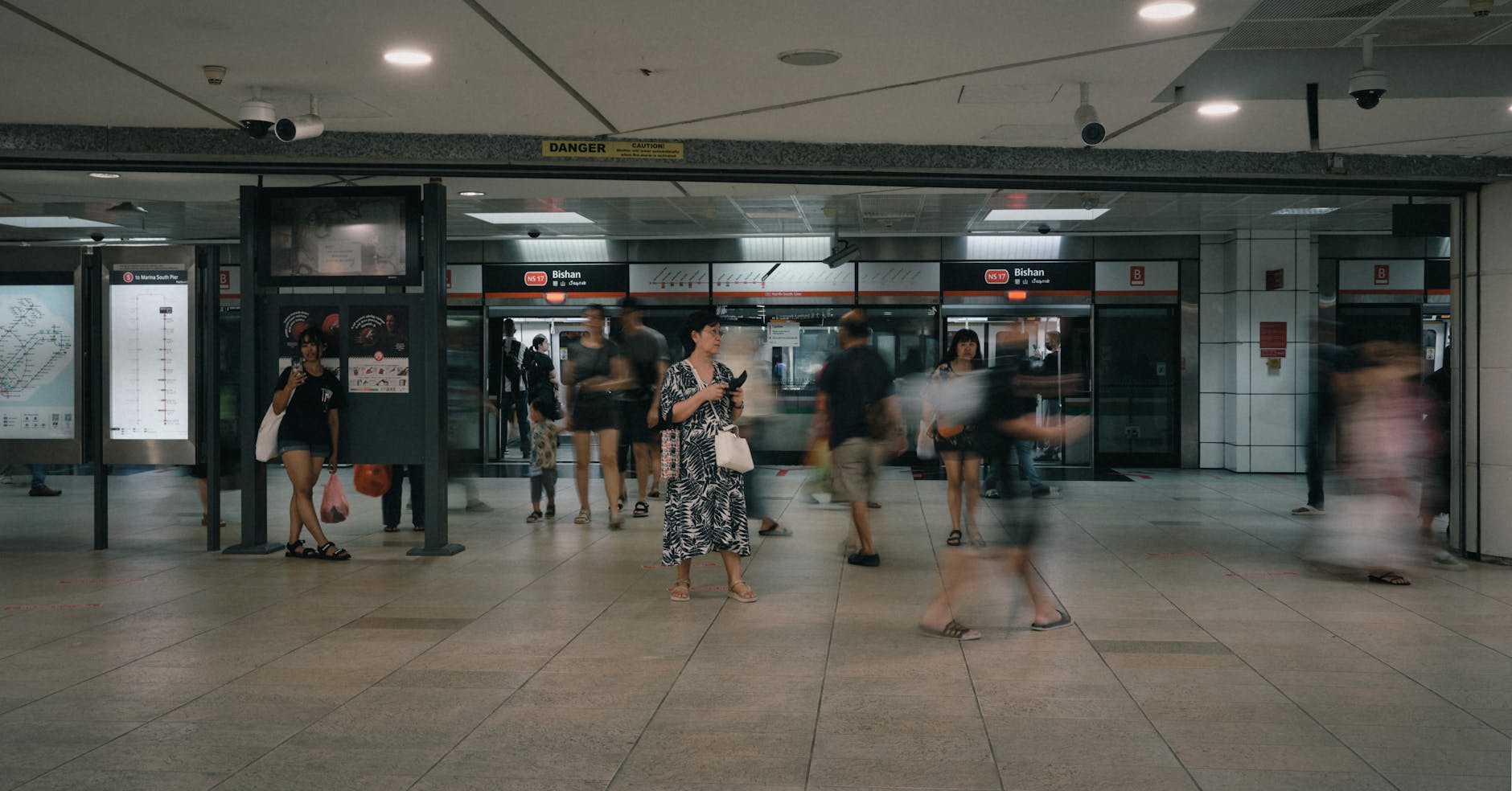
Station exits matter. Many stations have multiple exits that can place you on different sides of a highway, canal, underground mall, or office complex. In the city center, the correct exit can save ten minutes and keep you sheltered. At large stations such as Dhoby Ghaut, City Hall, Raffles Place, Orchard, Outram Park, Paya Lebar, Serangoon, Jurong East, Bishan, and HarbourFront, transfers and exits can involve long underground walks.
Transfers and interchanges
Singapore’s interchanges are generally efficient but not always compact. Some transfers are same-platform or short. Others require long corridors, escalators, or multiple levels. With luggage or mobility limitations, a “short” transfer on a journey planner may feel longer in real life.
For visitors, the main interchange strategy is:
Operating hours and late-night gaps
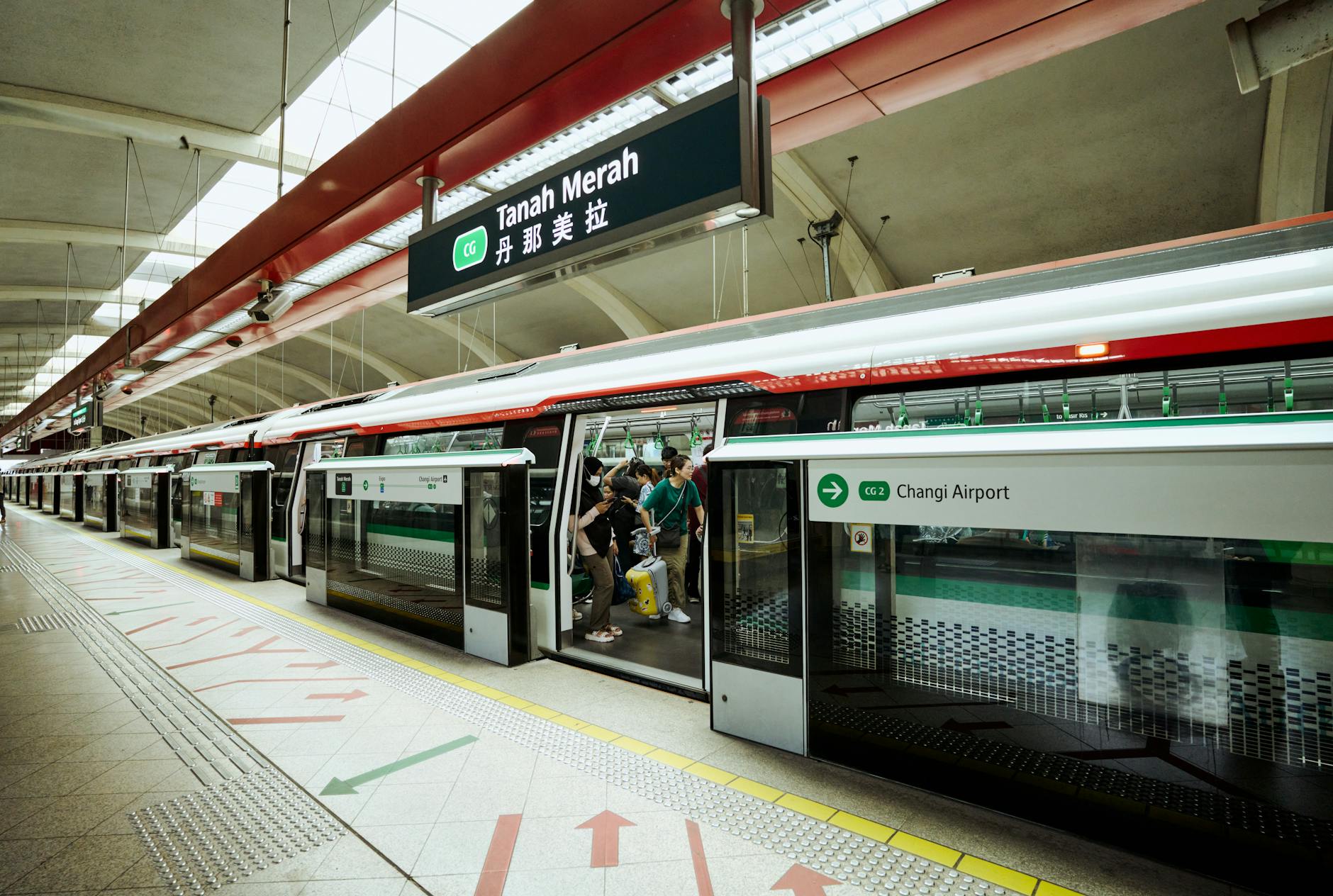
MRT service generally begins early in the morning and ends around midnight, with exact first/last train times varying by station and line. Changi Airport’s own transport page, for example, lists early-morning first trains and late-night last trains for airport connections via Tanah Merah and Expo. For very early flights or late-night arrivals, taxis and private-hire cars are usually the practical solution.
Reliability and disruptions
Singapore’s MRT is generally reliable by global standards, but it is not disruption-free. LTA reports rail reliability using Mean Kilometres Between Failure (MKBF), which measures the average train-kilometres between delays of more than five minutes. Public reporting showed the MRT network at 1.606 million train-km between delays in 2025, still above the stated one-million train-km target, and CNA reported that the figure rose to 1.673 million train-km in January 2026.
For users, the practical lesson is to treat the rail system as highly dependable but not magical. Build extra time for airport trips, exams, medical appointments, business meetings, and cruise departures. When a disruption happens, Singapore’s backup options are usually buses, bridging buses, taxis, private-hire cars, or rerouting through another MRT line.
Expansion and construction
Rail expansion is constant. In March 2026, LTA said it expected to complete and open Circle Line Stage 6, Downtown Line 3 extension, and Thomson-East Coast Line Stage 5 in 2026, while continuing work and studies on other lines and extensions. This is good for long-term connectivity but creates short-term construction impacts: road diversions, station works, bus stop changes, noise, altered pedestrian routes, and temporary crowding.
Locals experience this as a normal part of Singapore life: a better future network, but with years of construction inconvenience around selected corridors.
- North-South Line
- East-West Line
- North East Line
- Circle Line
- Downtown Line
- Thomson-East Coast Line
- Tap in at the fare gate using a contactless bank card, mobile wallet, EZ-Link/SimplyGo card, NETS card, concession card, or tourist pass.
- Follow line colors, platform signs, and destination directions.
- Board behind the queue markings and let passengers alight first.
- Move into the train car rather than standing at the doors.
- Tap out with the same card or device.
- Minimize transfers when carrying luggage.
- Avoid peak-hour transfers at the busiest stations if comfort matters.
- Use station exit maps and platform signs.
- Give yourself extra time for unfamiliar interchanges.
5. Buses
Role of buses
Buses are the most important complement to the MRT. The rail map can make Singapore look fully covered, but many real destinations need a bus connection. Buses are especially important for:
Types of bus services
Singapore’s bus network includes:
The exact route categories matter less than the basic rule: always check the bus direction, stop code, and destination before boarding.
How to ride buses
A typical bus trip works like this:
Forgetting to tap out may result in being charged to the end of the route. This is one of the most common visitor errors.
Bus strengths
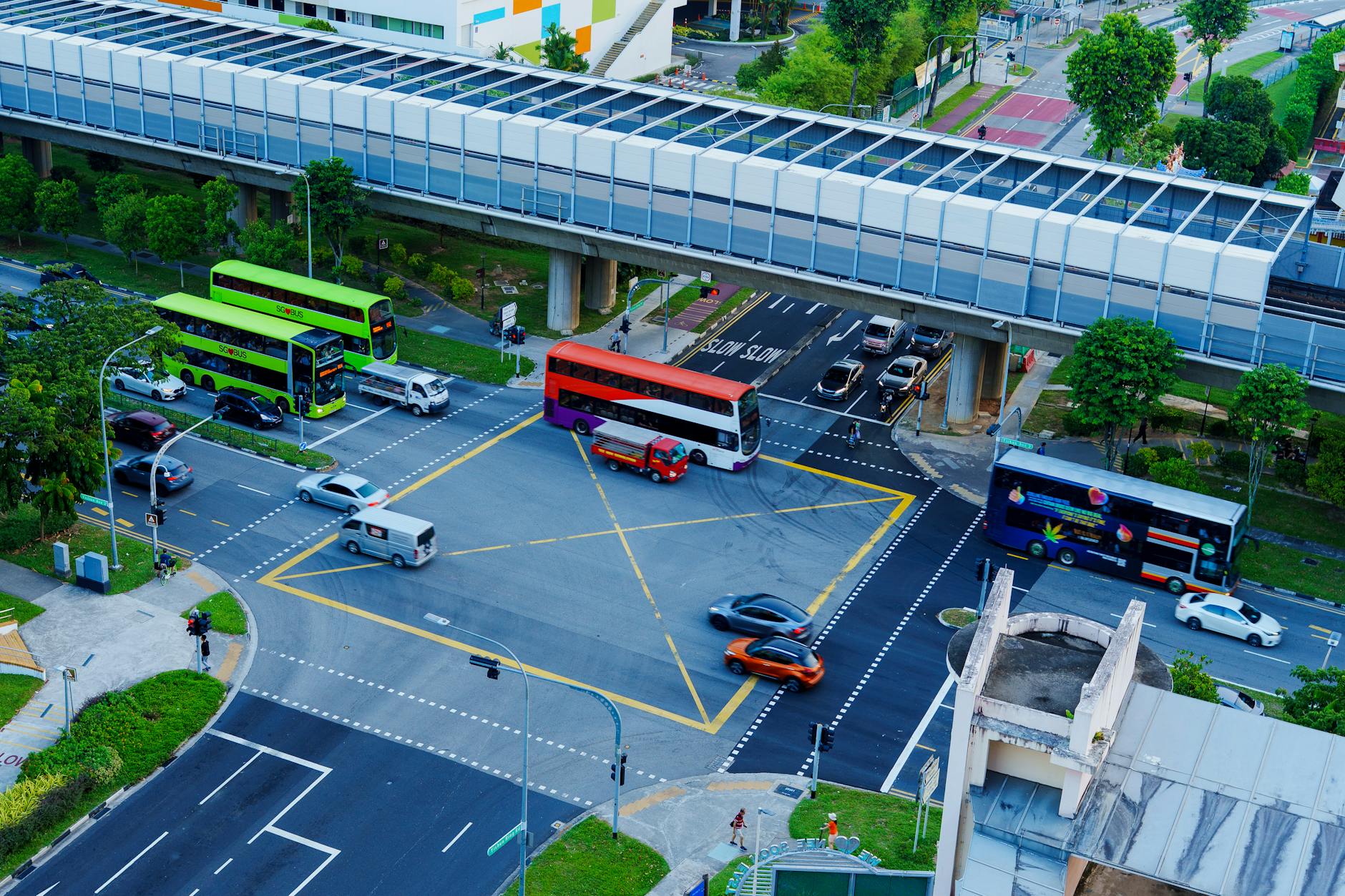
Buses are clean, air-conditioned, frequent on major routes, and integrated into the same basic fare system. Many are double-deckers, and bus interchanges are often connected directly to malls and MRT stations. Bus arrival information is usually available through journey planners and LTA tools.
Bus weaknesses
Buses share the road, so they are more vulnerable to traffic, rain, roadworks, events, and peak-hour congestion. In residential towns, bus stops can be close together and route patterns can be hard to interpret. Some bus rides are slower than expected because they weave through estates before reaching an MRT station.
Locals care deeply about bus frequency, crowding, feeder reliability, wait-time variability, and whether new housing estates receive adequate service quickly enough. LTA continues to modify and add services; for example, in February 2026 it announced seven new bus services, two extensions, and other enhancements under the Bus Connectivity Enhancement Programme.
- residential estates beyond MRT walking distance
- older neighborhoods where rail stations are not directly adjacent
- schools, hospitals, and community facilities
- industrial parks and business parks
- East Coast, Katong, Joo Chiat, Mandai, and nature/leisure destinations
- local feeder movement within towns
- Trunk services connecting towns and major corridors.
- Feeder services connecting residential estates to MRT stations, bus interchanges, and town centers.
- Express and premium services on selected routes, often with different fare treatment.
- Short-working trips that operate over part of a full route to manage demand.
- Cross-border bus services to Johor Bahru, discussed later.
- Use a journey planner to identify the service number and stop.
- Confirm the bus is going in the correct direction.
- Board at the front door.
- Tap in with your card or device.
- Move in, hold on, and keep aisles clear.
- Press the stop button before your stop.
- Exit through the rear door when possible.
- Tap out when alighting.
6. Fares, cards, passes, and payments
Distance fares
Singapore uses a distance-based fare structure for basic bus and train journeys. SimplyGo explains that bus and train fares are charged according to total distance traveled under the Distance Fares system, allowing transfers without paying a new boarding charge every time when transfer rules are met.
In practice, this means:
Payment options
Visitors and residents can pay using several methods:
LTA states that contactless credit/debit cards can be used through SimplyGo without registration, and mobile wallets such as Apple Pay, Google Pay, Samsung Pay, Fitbit Pay, Garmin Pay, and Singtel Dash are supported for fare payment. SimplyGo also states that commuters can use American Express, Mastercard, NETS, and Visa contactless cards or those cards in supported mobile wallets.
Foreign bank cards
Foreign-issued bank cards are convenient but may carry administrative or bank fees. Changi Airport’s transport information explicitly notes that admin fees apply for payments with foreign-issued bank cards on public transport.
For a short visitor trip, a foreign contactless card is usually the simplest. For a longer stay or cost-sensitive traveler, compare card fees against using a stored-value card.
Stored-value cards
Stored-value travel cards, including EZ-Link and SimplyGo EZ-Link options, remain useful for residents, children, concession users, and travelers who prefer not to use a foreign bank card. SimplyGo states that adult stored-value travel cards such as EZ-Link and NETS FlashPay cost S$10, consisting of S$5 travel value and a S$5 non-refundable card cost, and that a S$5 minimum card balance is needed before starting a trip.
Singapore Tourist Pass
The Singapore Tourist Pass provides unlimited travel on basic public bus services, MRT, and LRT within the pass validity period. It excludes premium services such as Sentosa Express, RWS8, express buses, and other premium or niche bus services. As listed by SimplyGo, pass options include fixed daily costs, with 1-day, 2-day, 3-day, 4-day, and 5-day passes priced at S$17, S$24, S$29, S$37, and S$45 respectively at the time accessed.
The pass is worth considering if:
It may not be worth it if:
Cash
Cash is a fallback on buses only. Use exact fare; no change is provided, and cash fares are usually less convenient and often higher. Do not expect cash to work for MRT fare gates.
- Use the same payment card/device throughout the journey.
- Tap in and tap out properly.
- Avoid mixing a physical card and the same card loaded into a phone wallet unless you know exactly how they are treated.
- Keep transfer timing within the system’s rules.
- Do not use one card to pay for multiple people on MRT fare gates.
- Contactless bank cards
- Mobile wallets
- SimplyGo EZ-Link cards
- EZ-Link cards
- NETS cards
- Concession cards
- Singapore Tourist Pass
- Cash on buses only, with exact fare and usually higher fare treatment
- you will take many rides per day
- you want predictable costs
- you do not want to use your own bank card
- you are teaching a family or group to use the system
- convenience is more important than optimizing every dollar
- you only take two or three rides per day
- you are staying centrally and walking often
- you use taxis/private-hire cars for many trips
- your trip includes Sentosa Express or premium services not covered by the pass
7. Apps, maps, and real-time information
The core digital tools are:
For visitors, the most important habit is to compare MRT-only routes with bus-plus-MRT routes. Singapore’s bus network is good enough that the fastest route is not always the one that uses rail the longest.
For locals, real-time bus information is not optional; it shapes daily choices. A resident may decide whether to walk to another stop, take a different bus, change MRT stations, book a ride-hail car, or delay departure based on arrival predictions.
- LTA journey planner / MyTransport.SG for public transport planning, bus arrivals, train operating times, station exits, public bus services, and bus arrival times.
- SimplyGo app for registered cards, trip history, stored-value card services, and fare tracking.
- Google Maps / Apple Maps / Citymapper-type tools for point-to-point planning, though local transit nuance can vary.
- Grab, Gojek, Zig, TADA, Ryde for private-hire and taxi booking.
- Parking.sg for short-term parking at coupon-based car parks.
- Changi Airport app/website for airport-specific transport, terminal, and flight information.
8. Changi Airport access
Changi Airport is one of the best-connected airports in the world for public transport. The main options are MRT, bus, taxi, private-hire car, hotel shuttle/private transfer, and car.
MRT to/from Changi
Changi Airport MRT Station is connected directly to Terminal 2 and Terminal 3. To reach the airport by train, Changi’s official instructions say to take the East West Line to Tanah Merah and transfer to Changi Airport Station, or take the Downtown Line to Expo and transfer to Changi Airport Station.
For many travelers, MRT is the best option when:
MRT is less ideal when:
Public buses to/from Changi
Changi lists public bus services serving Terminals 1, 2, 3, and 4, including services 24, 27, 34, 36, 53, 110, and 858 for Terminals 1–3, and 24, 34, 36, and 110 for Terminal 4.
Buses are useful for airport workers, residents, and visitors staying in eastern areas. For first-time visitors with luggage, MRT or taxi/private-hire is usually simpler.
Taxi from Changi
Taxis are available at official taxi stands in the Arrival areas of Terminals 1, 2, 3, and 4. Changi states that a taxi ride to the city takes about 30 minutes and costs between S$25 and S$45, with an additional airport surcharge of S$8 from 5:00 PM to 11:59 PM and S$6 at other times. Midnight and peak-hour surcharges also apply.
Taxis are often the best choice when:
Private-hire cars from Changi
Changi states that passengers can book private-hire cars from Grab, Gojek, Zig, TADA Mobility, or Ryde and proceed to the Arrival and Ride-Hailing pickup points at Terminals 1–4.
Private-hire is useful, but check the pickup point carefully. Airport pickup mistakes waste time. During surge periods, taxi queues may be cheaper or faster than app rides, and app rides may be cheaper or faster than taxi queues. Compare both.
- arriving during rail operating hours
- staying near an MRT station
- traveling light
- avoiding road traffic
- cost matters
- arriving late at night
- traveling with heavy luggage
- staying far from a station
- traveling with small children after a long flight
- your hotel is a long unsheltered walk from a station
- arriving at night
- traveling with luggage
- traveling in a group
- going to a hotel not near MRT
- needing a predictable, official queue system
9. Taxis and private-hire cars
Taxis
Singapore taxis are regulated, metered, air-conditioned, and generally safe. Taxi companies determine fares independently, while LTA and the Public Transport Council work with operators to keep certain fare aspects standardized and understandable.
Common taxi issues include:
Visitors should use official taxi stands at the airport, malls, and hotels. Street hailing can work but is less dependable in dense or restricted pickup areas.
Private-hire cars
Private-hire platforms are central to Singapore travel. Changi names Grab, Gojek, Zig, TADA Mobility, and Ryde as private-hire options to and from the airport. LTA regulates point-to-point transport, including ride-hail operators that meet licensing thresholds.
Private-hire is best for:
Common concerns include:
Taxi vs private-hire
Use this practical comparison:
| Situation | Usually best |
|---|---|
| Airport arrival with normal queue | Taxi or private hire; compare queue and app price |
| Rainstorm | Whichever is available first at tolerable price |
| Hotel with taxi stand | Taxi may be simplest |
| Residential pickup | Private-hire often easier |
| Need fixed upfront fare | Private-hire |
| Need metered official street-hail | Taxi |
| Going to Malaysia | Licensed cross-border taxi/bus/train, not ordinary private hire |
- peak-hour surcharges
- midnight surcharges
- location surcharges, including airport surcharges
- booking fees
- ERP charges
- queue length at malls, hotels, events, and the airport
- availability during rain
- door-to-door travel
- groups
- heavy luggage
- late nights
- rain
- neighborhoods with weaker taxi supply
- trips involving children or elderly users
- surge pricing
- driver cancellations
- confusing pickup points
- platform differences
- limited child-seat availability
- waiting restrictions at some buildings
- heavy demand after events or during storms
10. Private vehicles, rental cars, COE, ERP, parking, and driving
Car ownership and COE
Singapore deliberately controls vehicle growth. The Vehicle Quota System caps the number of new vehicles that can be registered, and the Certificate of Entitlement system is one of the pillars of traffic management together with Electronic Road Pricing.
For locals, this means car ownership is a major financial decision. COE prices, vehicle taxes, insurance, parking, ERP, fuel, maintenance, and depreciation make cars expensive. Families may still choose cars for childcare, elderly care, multi-stop errands, late shifts, or mobility reasons, but the cost is high by design.
For visitors, the conclusion is simple: do not rent a car just because you normally rent cars in other countries. Singapore is one of the places where public transport plus taxi/private-hire is usually better.
Driving rules and foreign licences
Singapore drives on the left side of the road, and vehicles are right-hand drive. Roads are well maintained, signs are clear, and enforcement is serious.
The Singapore Police Force states that foreigners residing in Singapore for less than 12 months generally need a valid foreign driving licence plus an International Driving Permit, or an official English translation if an IDP is unavailable. Foreigners from ASEAN member states do not need an IDP if they have a valid foreign driving licence.
Rental cars
Rental cars may make sense for:
They rarely make sense for a first-time visitor staying in central Singapore.
Electronic Road Pricing and ERP 2.0
ERP is Singapore’s road pricing system for managing congestion. LTA states that as Singapore transitions to ERP 2.0, the older in-vehicle unit will be phased out by end-2026. For foreign-registered vehicles after that transition, foreign vehicles entering Singapore without an on-board unit will need to pay a flat-rate ERP fee of S$3 for motorcycles and S$10 for all other vehicles for every ERP operational day they travel on Singapore roads.
For rental car users, ERP charges are usually handled through the rental arrangement, but the user should confirm how charges are billed.
Parking
Parking is available but not always cheap or simple in dense districts. Malls, hotels, office buildings, HDB car parks, URA car parks, roadside coupon areas, and private car parks all have different pricing and rules.
Parking.sg allows motorists to pay for parking by mobile phone at car parks that accept coupons, calculate charges, extend remotely, and receive refunds when ending a session early. HDB has also been rolling out Parking@HDB as a smart parking system for selected HDB car parks.
For visitors renting cars, parking is often the hidden friction. A taxi or private-hire ride may be cheaper than paying central parking plus ERP plus rental charges.
Foreign-registered vehicles
Foreign vehicles entering Singapore must comply with LTA rules. For non-Malaysia foreign passenger cars and motorcycles, LTA states that vehicles must have valid documents such as an Autopass card, insurance, Visitor’s Permit or International Circulation Permit, LTA approval, and proper licence plates before entry.
Travelers entering from Malaysia by car should check current entry rules before arrival. Border rules and fees change, and checkpoint congestion can be severe during weekends and holidays.
- a resident family’s weekend errands
- mobility-impaired users who need point-to-point control
- business users visiting dispersed sites
- a self-drive day with specific stops and parking plans
- drivers continuing to/from Malaysia with proper documents, insurance, and border planning
11. Walking, weather, sheltered links, and last-mile movement
Walking is a major transport mode in Singapore. The city center is designed around MRT exits, bus stops, malls, office towers, covered walkways, underground links, pedestrian crossings, and sheltered access to stations.
What makes walking easy
What makes walking hard
The station-exit problem
In Singapore, “near the MRT” can still mean different things. A building may be near a station but connected only by a long underground corridor or across a large road. The correct exit can be the difference between a comfortable sheltered walk and an exposed, confusing detour.
For visitors, always check exit letters and walking instructions. For locals, station exits are part of daily route optimization.
- clean sidewalks
- good lighting
- pedestrian crossings
- safe street environment
- many sheltered walkways
- air-conditioned mall connections
- underground networks in the CBD, Orchard, City Hall, and Marina Bay
- barrier-free access at many transport nodes
- heat and humidity
- sudden heavy rain
- large road junctions
- construction hoardings
- elevated expressways or canals that limit crossing points
- long station exits or interchanges
- crowding at malls and events
- confusing underground mall networks
12. Cycling, park connectors, PMDs, PABs, and active mobility
Cycling and active mobility are growing but are not uniformly convenient across the island.
Cycling paths and park connectors
LTA has been expanding the Islandwide Cycling Network and stated that the government will expand cycling paths island-wide to around 1,300 km by 2030. NParks also manages the Park Connector Network and the Round Island Route. The Round Island Route is planned as a continuous 150 km park connector and is part of NParks’ broader plan for a 360 km island-wide network of recreational routes.
Cycling is best for:
Active mobility devices
Singapore has detailed rules for bicycles, personal mobility devices, power-assisted bicycles, and personal mobility aids. LTA’s active mobility rules state that from July 1, 2025, bicycles and non-motorized PMDs are no longer allowed on footpaths converted to Pedestrian-Only Paths next to dedicated cycling paths.
The practical advice is:
Biking as a visitor
Visitors should treat cycling as a leisure activity rather than a primary citywide transport method unless they are experienced urban cyclists and know the route. East Coast Park, Marina Bay, park connectors, and selected scenic routes are much better than trying to cycle through dense central traffic.
- recreation
- East Coast Park
- park connectors
- short town-level trips where cycling paths exist
- local residents who know safe routes
- leisure rides, not necessarily point-to-point visitor commuting
- Do not ride wherever you feel like riding.
- Check whether the path permits your device.
- Slow down around pedestrians.
- Use lights and follow path markings.
- Avoid nature reserves and prohibited boardwalks unless cycling is explicitly permitted.
- Use MyTransport.SG or NParks guidance for current cycling-route information.
13. Ferries, cruises, Sentosa, and cross-border transport
Sentosa
Sentosa is a special transport case. The usual access points are HarbourFront MRT/VivoCity, Sentosa Express monorail, cable car, walking via the Sentosa Boardwalk, taxis/private-hire, resort shuttles, and on-island buses/beach trams.
Important points:
Ferries to Indonesia and regional islands
Singapore has ferry links to nearby Indonesian destinations such as Batam and Bintan, generally from ferry terminals such as HarbourFront and Tanah Merah, depending on operator and destination. Ferry schedules, immigration rules, baggage policies, and terminal locations should be checked directly with the ferry operator before travel.
Transport planning matters because ferry check-in times are less forgiving than a casual bus ride. For Tanah Merah Ferry Terminal, taxi/private-hire or local bus connections may be more practical than MRT alone. For HarbourFront, MRT access is excellent.
Cruise terminals
The Marina Bay Cruise Centre Singapore is a major marine gateway and is open on days when a cruise ship is at berth. The nearest MRT access is generally via Marina South Pier, but luggage-heavy cruise passengers often use taxis/private-hire cars because cruise terminals involve bags, timing, and check-in stress.
Cross-border travel to Malaysia
Singapore’s land border with Malaysia is a major transport corridor. Options include:
LTA states that cross-border bus services operate between Singapore and Johor Bahru, intercity express bus services operate between Singapore and destinations in Malaysia beyond Johor Bahru, and cross-border point-to-point services are limited to licensed Singapore-registered and Malaysia-registered taxis. Private-hire cars are not allowed to provide cross-border point-to-point services for hire and reward.
Licensed cross-border taxis are available at the designated terminal at Ban San Street in Singapore and Johor Larkin Sentral in Malaysia, with LTA listing a fare from Ban San Street Terminal to Malaysia of S$60 per taxi or S$15 per person.
For visitors, the key warning is that “Singapore to Johor Bahru” can be geographically short but operationally slow. Immigration queues, school holidays, weekends, public holidays, evening returns, and checkpoint congestion can dominate the trip.
- HarbourFront is served by the North East Line and Circle Line.
- Sentosa Express is convenient but is excluded from Singapore Tourist Pass coverage according to SimplyGo’s pass conditions.
- Taxis and private-hire cars may be easiest for families, beach equipment, late nights, or resort check-ins.
- Walking from VivoCity can be pleasant if the weather is reasonable.
- Traffic can build around Resorts World Sentosa and major events.
- cross-border buses
- train shuttle services via Woodlands/Johor Bahru arrangements
- licensed cross-border taxis
- private cars with proper documents
- intercity express buses to Malaysian destinations beyond Johor Bahru
14. Accessibility, families, strollers, seniors, luggage, and disabilities
Singapore is one of the easier large urban systems for users with mobility needs, but practical planning still matters.
Accessibility infrastructure
The Ministry of Transport states that all MRT and LRT stations are barrier-free, around 98% of bus stops are barrier-free, and many crossings have accessibility features such as Green Man Plus and audio-tactile signals. LTA also states that 98% of bus stops are barrier-free accessible and that wheelchair logos can be checked at stops or through the MyTransport app.
PMAs and strollers
LTA states that strollers and personal mobility aids within specified dimensions can be brought on board public transport, including a total PMA weight including user of 300 kg, length of 120 cm, width of 70 cm, and height of 150 cm. Designated spaces should be used, stroller restraints should be secured when available, and wheelchair users take priority when space is constrained.
For families:
For wheelchair or PMA users:
Luggage
Singapore’s public transport handles luggage better than many systems, but luggage still changes the best route. MRT from Changi is easy if the hotel is near a station. It is not ideal if the destination requires multiple transfers and a long unsheltered walk. During peak hours, large suitcases are a burden to both traveler and other commuters.
- Use lifts instead of escalators with strollers.
- Avoid peak-hour trains if possible.
- Fold strollers if buses are crowded or if directed.
- Use taxis/private-hire for tired children, late nights, or multi-stop days.
- Bring rain protection and water, but do not drink inside train paid areas or vehicles.
- Check station lift availability when possible.
- Build extra time for lift queues.
- Use larger interchange stations thoughtfully; some are long.
- For buses, wait for the captain to deploy the ramp.
- Taxis/private-hire may still be necessary for trips where the final pedestrian route is difficult.
15. Rules, etiquette, enforcement, and safety
Singapore’s transport system is safe partly because the public culture is orderly and enforcement is credible.
Core rules and habits
Safety profile
Singapore is generally safe for public transport users at most hours. The bigger practical risks are not crime in the usual sense, but:
Enforcement culture
Rules in Singapore are not decorative. Visitors should assume that posted transport rules are real. Locals may debate the strictness of particular rules, but the everyday system depends on predictable behavior.
- Queue where platform markings indicate.
- Let passengers alight before boarding.
- Do not eat or drink on trains, buses, or inside paid rail areas.
- Keep doors clear.
- Move into the train car.
- Give priority seats and spaces to seniors, pregnant passengers, wheelchair users, PMA users, and people who need them.
- On escalators, follow local flow and do not block the walking side.
- Tap in and tap out correctly.
- Press the bus stop button early.
- Do not sit on floors or block passageways with luggage.
- Do not bring durians or strong-smelling items onto public transport.
- Keep volume low and phone calls discreet.
- road safety at crossings
- slipping during rain
- heat exhaustion while walking
- crowd pressure at events
- missing last trains
- overpaying due to wrong tap behavior
- scams or unofficial transport offers around borders or tourist areas
- child separation in crowded interchanges
16. Common disruptions and local concerns
Peak-hour crowding
Peak-hour trains and buses can be crowded, especially on major commuter corridors into the CBD and at interchange stations. Locals care about not just total journey time, but whether they can board the first train/bus, whether transfers are crowded, whether lifts are overloaded, and whether air-conditioning or platform flow is adequate.
Rain
Rain changes everything. A five-minute unsheltered walk becomes a problem. Ride-hail prices surge. Taxi queues grow. Bus speeds fall. People crowd under shelters and station exits. A practical traveler carries a compact umbrella and knows when to switch from walking to taxi/private-hire.
Heat and humidity
Singapore’s climate makes walking a transport issue. Visitors often overestimate how much they can walk in one day. Locals choose routes that pass through malls, underground links, shaded paths, and covered walkways.
Construction
Rail expansion and road works can change pedestrian routes, bus stops, and traffic patterns. This is especially relevant around future rail corridors, new towns, and central redevelopment areas.
Taxi/private-hire availability
Availability is generally good, but demand spikes during rain, Friday evenings, late nights, major concerts, F1/event periods, airport arrival waves, and public holidays. Locals often open multiple apps, compare prices, or walk to a better pickup point.
Car costs
For residents, transport stress often centers on the cost of cars, COE, parking, and family logistics. Singapore’s system is excellent for many trips, but households with children, elderly relatives, shift work, or dispersed activities may still feel pressure to own or access a car.
Last-mile gaps
Even with extensive rail and bus service, last-mile gaps remain. A trip may be easy on paper but frustrating if the final 700 metres are exposed, hilly, crowded, under construction, or poorly sheltered.
17. Recommended strategies by user type
First-time tourist staying in the city center
Use a contactless bank card or tourist pass, ride MRT for most trips, use taxis/private-hire for airport luggage and late nights, and avoid renting a car. Pay attention to station exits.
Budget traveler
Use MRT and buses almost exclusively. Choose accommodation near a useful MRT line rather than simply near a famous district. Consider stored-value cards if foreign-card fees are annoying. Eat and explore around MRT-accessible neighborhoods.
Family with children
Use MRT for simple routes, but do not be stubborn. Taxis/private-hire cars are worth it for late nights, rain, Mandai, heavy luggage, and nap-sensitive children. Avoid peak-hour interchanges with strollers when possible.
Elderly traveler or traveler with mobility limits
Use MRT where lifts and station access are convenient, but check walking distances carefully. Taxis/private-hire may be appropriate for door-to-door comfort. Choose hotels with step-free access near MRT and covered walkways.
Business traveler
Use MRT for CBD/Marina Bay/Orchard/Raffles Place/Tanjong Pagar trips if station proximity is good. Use taxis/private-hire for meetings in business parks, industrial estates, or during rain. Build buffer time for peak hours and security check-in.
Local commuter
Optimize by line, transfer, walking shelter, bus arrival reliability, and commute resilience. Register cards in SimplyGo for trip history and card management. Watch LTA advisories and operator announcements. Consider cycling or walking only when the infrastructure and weather support it.
Because Singapore is a city-state, a city-by-city section would be artificial. The more useful local analysis is by district, corridor, and transport use case.
Central Business District, Marina Bay, and Civic District
What matters
This is Singapore’s most transit-rich area. Raffles Place, City Hall, Esplanade, Promenade, Bayfront, Downtown, Telok Ayer, Shenton Way, Tanjong Pagar, Marina Bay, and Marina South Pier form a dense rail-and-walk network.
Best modes
Unique transport features
The CBD is full of underground and sheltered links. The shortest route on a map may not be the most comfortable route. Office towers, malls, MRT stations, and hotels are often connected indirectly through basements or podiums.
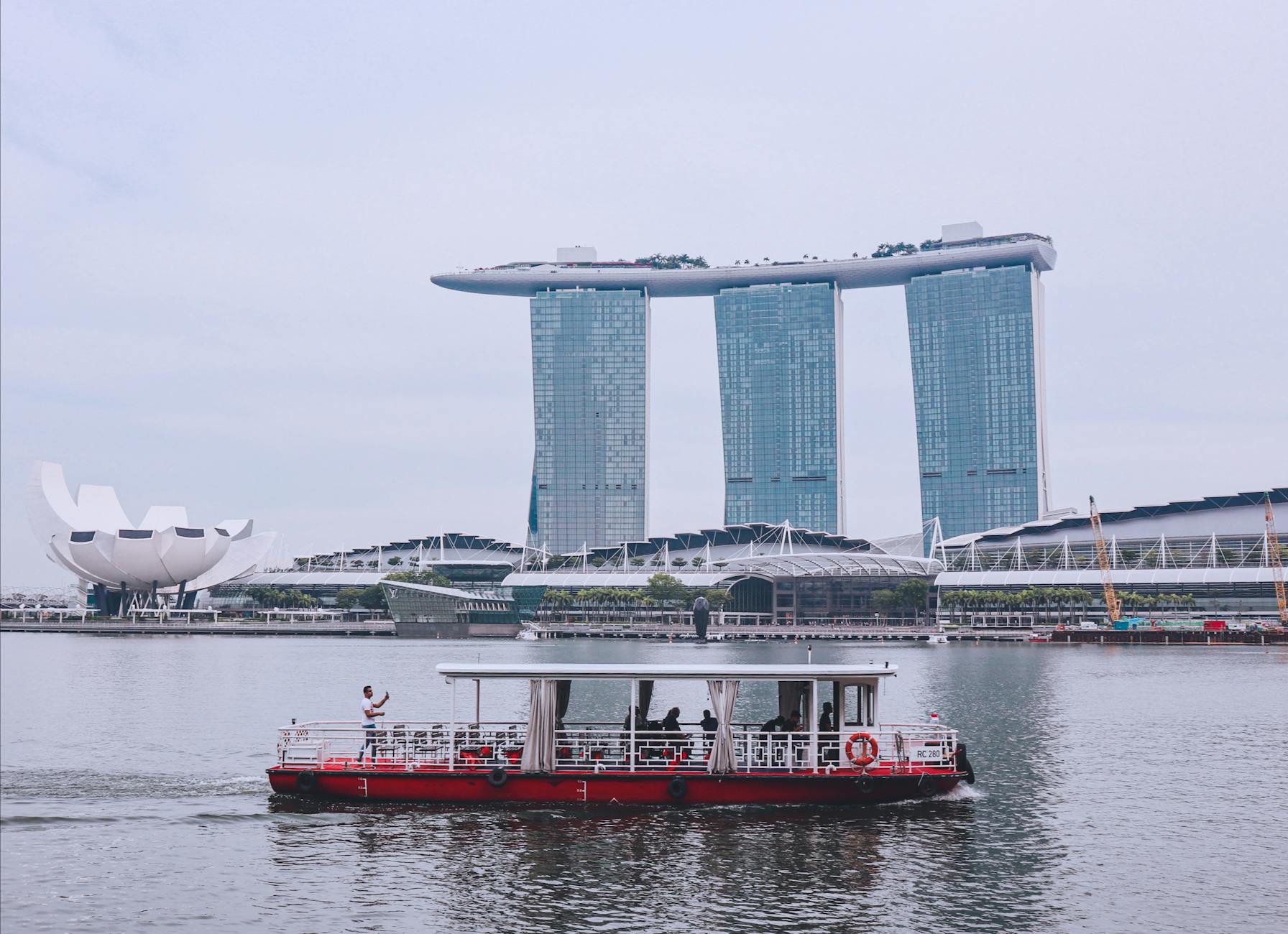
Marina Bay can be deceptively spread out. Marina Bay Sands, Gardens by the Bay, the financial district, the Merlion, Esplanade, Marina Bay MRT, Bayfront MRT, and Marina South Pier are not all the same place. Check the exact station and exit.
Common mistakes
Local concerns
CBD workers care about peak-hour crowding, escalator flow, lunchtime traffic, building-specific pickup restrictions, and the reliability of air-conditioned underground routes during rain.
- MRT for most access
- walking through underground links and malls
- buses for specific surface corridors
- taxis/private-hire for late-night, rain, hotels, and business schedules
- Taking the wrong exit at City Hall, Raffles Place, or Bayfront.
- Assuming Marina Bay MRT is the best station for every Marina Bay destination.
- Underestimating event crowds after concerts, National Day-related events, F1 periods, fireworks, and large conventions.
- Booking a ride-hail pickup at a building entrance where stopping is restricted.
Orchard, Newton, Novena, and the shopping corridor
What matters
Orchard is Singapore’s major retail corridor. It is heavily served by MRT, buses, taxis, and private-hire cars, but it is also one of the easiest places to get disoriented underground.
Best modes
Unique transport features
Orchard has layered movement: street level, underpasses, mall basements, hotel driveways, taxi stands, and MRT exits. A destination can be close by distance but awkward by pedestrian routing.
The Thomson-East Coast Line adds useful north-south connectivity through Orchard, but users still need to choose exits carefully.
Common mistakes
Local concerns
Locals care about taxi queues at malls, ride-hail pickup restrictions, weekend crowds, and the time penalty of crossing Orchard Road when not using the right underpass.
- MRT to Orchard, Somerset, Dhoby Ghaut, Newton, or Novena depending on destination
- walking through malls and underpasses
- taxi/private-hire for shopping bags, rain, or hotel returns
- buses along Orchard Road and Scotts Road when routes are direct
- Exiting the wrong side of Orchard Road.
- Trying to ride-hail from a random curb instead of a designated pickup point.
- Assuming a taxi will be quick during Friday evening rain.
- Walking too far with shopping bags in humid weather.
Chinatown, Outram, Tanjong Pagar, and the southern city fringe
What matters
This area combines heritage streets, offices, nightlife, hotels, hospitals, food streets, and residential districts. It has strong rail access but complex walking conditions due to hills, shophouse streets, and busy roads.
Best modes
Unique transport features
Outram Park is a major interchange and useful for Singapore General Hospital, Chinatown fringe, and Tanjong Pagar. Chinatown station is convenient but crowded. Maxwell and Telok Ayer can be better for food streets and shophouse areas.
Common mistakes
Local concerns
Locals focus on lunchtime crowding, evening nightlife pickups, hospital access, limited roadside stopping, and rain routing through older streets.
- MRT to Chinatown, Outram Park, Maxwell, Telok Ayer, Tanjong Pagar, or Havelock depending on destination
- walking for short heritage-area trips
- buses for corridors not well aligned with MRT
- taxi/private-hire late at night or after meals
- Using “Chinatown” as a single transport point when the destination is actually closer to Maxwell, Telok Ayer, or Outram.
- Underestimating hills around Ann Siang, Club Street, Duxton, and Pearl’s Hill.
- Taking taxis/private-hire from narrow shophouse streets where pickup is awkward.
Little India, Bugis, Kampong Glam, Rochor, and Bencoolen
What matters
This is one of Singapore’s richest visitor areas for food, heritage, shopping, religious sites, budget hotels, and nightlife. It is also dense, walkable, and well served by the Downtown Line, North East Line, East West Line, and many buses.
Best modes
Unique transport features
Stations are close together, but street-level walking can be crowded. Bugis has mall and street-market traffic. Little India can be busier on weekends and holidays. Kampong Glam and Haji Lane are easiest on foot once nearby.
Common mistakes
Local concerns
Residents and workers care about bus stop crowding, pedestrian flow, loading/unloading, weekend congestion, and parking pressure.
- MRT to Little India, Rochor, Jalan Besar, Bugis, Bencoolen, Bras Basah, or Farrer Park
- walking for heritage clusters
- buses for short north-south/east-west hops
- taxi/private-hire late at night or in rain
- Taking a taxi for a trip that is faster by MRT plus a short walk.
- Choosing the wrong station for Haji Lane, Arab Street, or Mustafa Centre.
- Underestimating pedestrian crowding during festivals or weekend evenings.
HarbourFront, VivoCity, and Sentosa
What matters
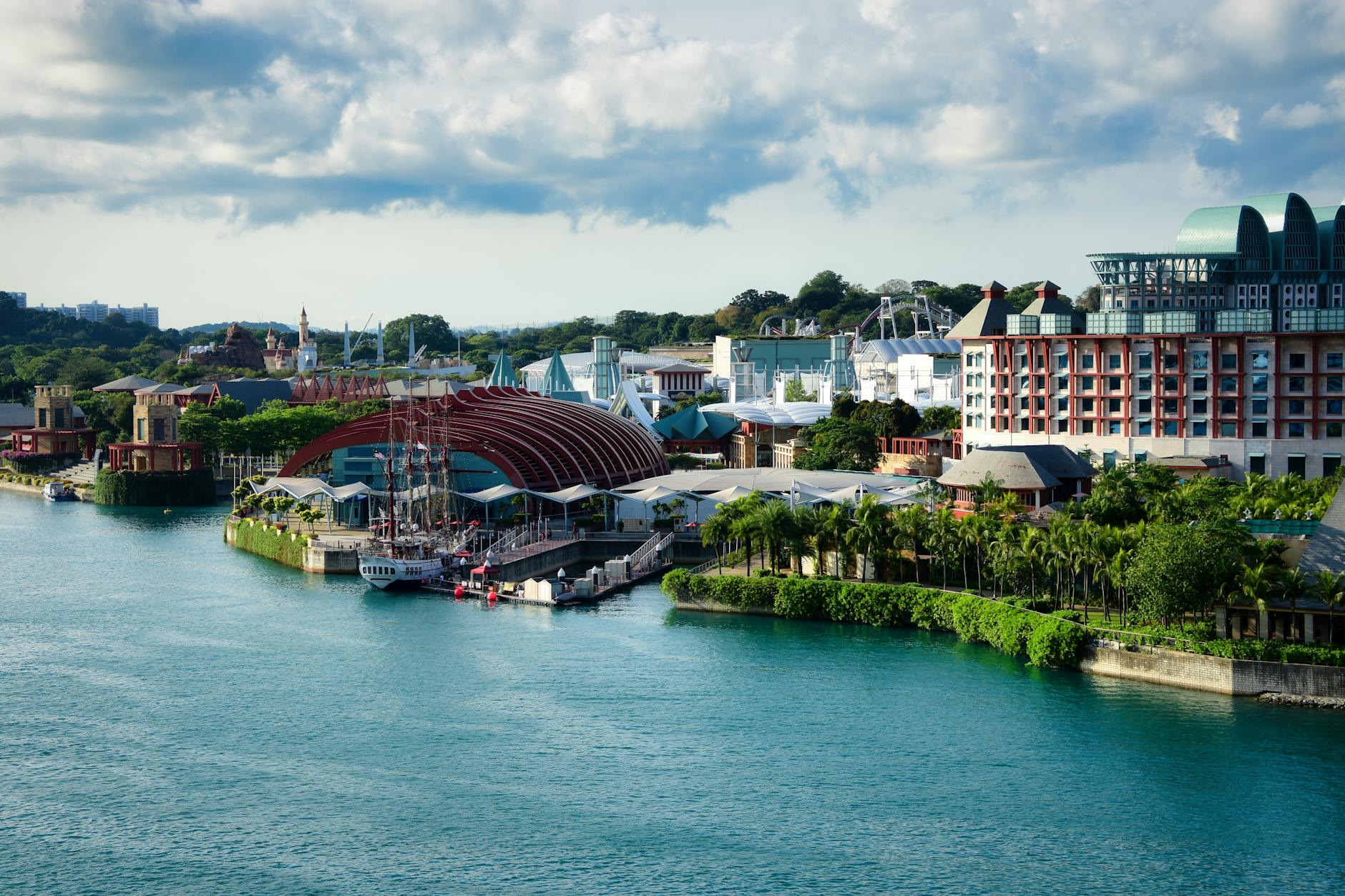
HarbourFront is the mainland gateway to Sentosa, VivoCity, cruise/ferry access, the cable car, and southern waterfront attractions.
Best modes
Unique transport features
Sentosa has its own internal transport pattern. A trip to Universal Studios, a beach club, a hotel, Fort Siloso, or the casino may require different on-island movement. The Singapore Tourist Pass does not cover Sentosa Express, so check separate costs.
Common mistakes
Local concerns
Workers and visitors deal with weekend traffic, event surges, resort pickup rules, and the limited capacity of specific gateways.
- MRT to HarbourFront via North East Line or Circle Line
- Sentosa Express for quick access into Sentosa
- walking via Sentosa Boardwalk when weather allows
- taxi/private-hire for resort hotels, families, beach gear, or late-night returns
- cable car for sightseeing rather than pure utility
- Assuming all Sentosa destinations are near the first monorail stop.
- Trying to leave Sentosa by taxi/private-hire immediately after major events without expecting queues or surge pricing.
- Confusing HarbourFront ferry/cruise functions with Marina Bay Cruise Centre.
Changi Airport, Jewel, Expo, and the eastern gateway
What matters
Changi is not just an airport; it is also a major employment zone, shopping/leisure destination, and transport gateway.
Best modes
Unique transport features
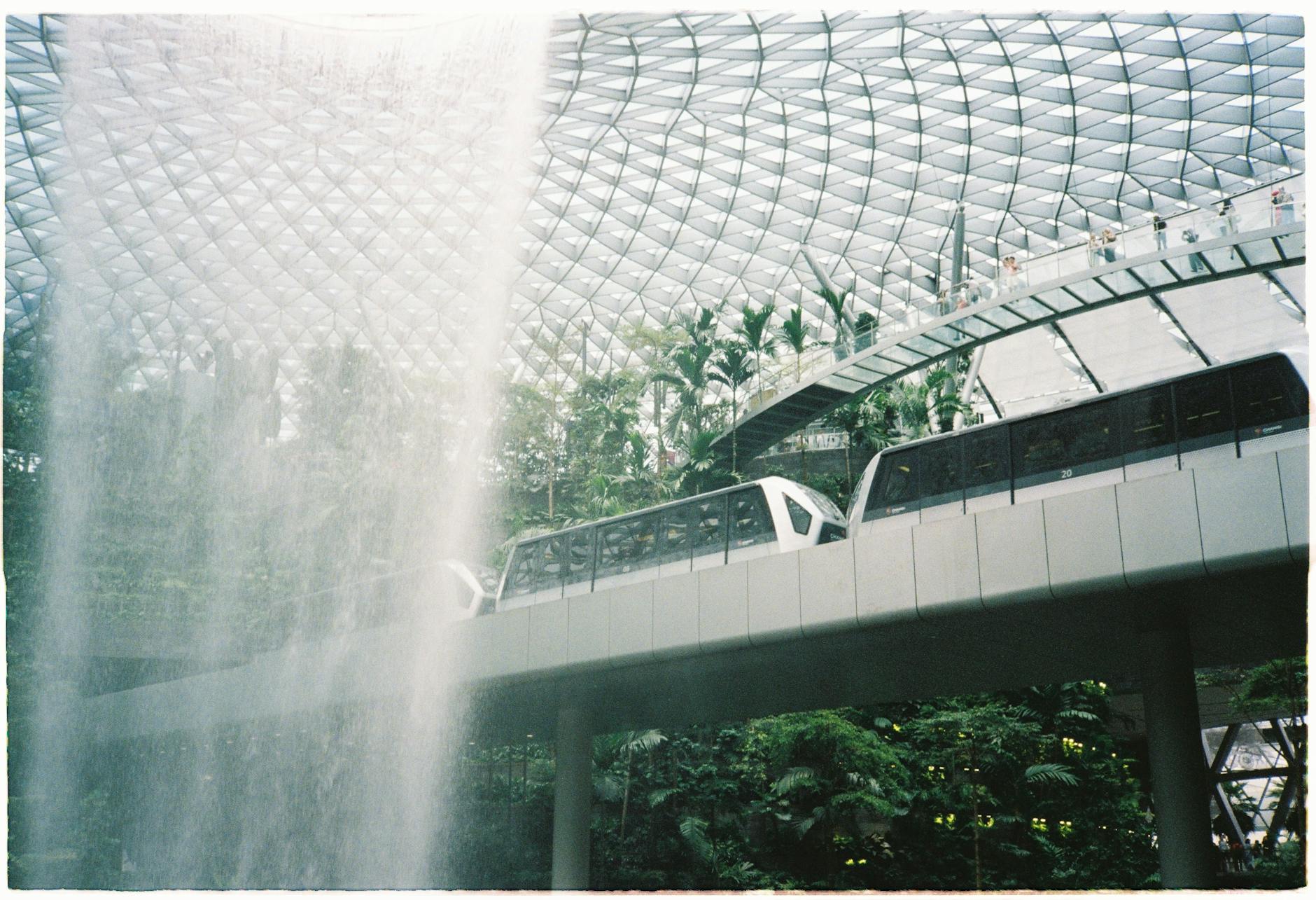
Changi Airport Station connects directly to Terminals 2 and 3. Terminal 1 and Jewel are connected through airport pedestrian systems, while Terminal 4 requires separate airport transfer arrangements. For rail, travelers transfer via Tanah Merah or Expo as described by Changi.
Expo is a useful interchange for the Downtown Line and Changi Airport branch. It is also important for conventions and events.
Common mistakes
Local concerns
Airport workers and residents care about early/late shift access, bus frequency, first/last train times, and congestion around major travel periods.
- MRT for city/east access during rail operating hours
- taxis/private-hire for luggage, late nights, families, and hotels far from stations
- buses for airport workers and eastern residents
- shuttle/terminal transfer services within the airport complex
- Assuming the MRT runs all night.
- Underestimating the time needed to reach Terminal 4.
- Booking a private-hire car and waiting at the wrong pickup point.
- Using MRT with too much luggage during peak periods.
Katong, Joo Chiat, East Coast, Paya Lebar, and Geylang
What matters
This area combines heritage food districts, residential neighborhoods, nightlife, East Coast Park access, and improving rail connectivity. It is a classic example of why buses still matter in Singapore.
Best modes
Unique transport features
The East Coast is long and linear. Rail access has improved, but many destinations still need buses or walking. East Coast Park is best treated as a recreational corridor, not a single point.
Common mistakes
Local concerns
Residents care about bus frequency, parking pressure, nightlife noise, road congestion, and the balance between new rail access and neighborhood traffic.
- MRT to Paya Lebar, Dakota, Marine Parade/Marine Terrace/Katong Park areas depending on current line access
- buses for Katong, Joo Chiat, East Coast Road, and East Coast Park
- taxi/private-hire for late-night food trips and beach access
- cycling or walking in East Coast Park and park connector areas
- Assuming “East Coast” is one destination.
- Walking long unsheltered distances from MRT stations to beach areas.
- Underestimating late-night ride demand in food/nightlife zones.
Tampines, Pasir Ris, Bedok, and the eastern residential towns
What matters
Eastern towns are large residential and commercial centers with MRT, bus interchanges, malls, schools, parks, and airport-related access.
Best modes
Unique transport features
Tampines is a major regional center with multiple malls, bus interchange functions, and MRT access. Pasir Ris is important for parks, chalets, and connections toward Pulau Ubin access via Changi Village indirectly. Bedok is an older, bus-rich town with strong local food and residential movement.
Common mistakes
Local concerns
Residents care about feeder reliability, school commute crowding, cycling safety, and transfers between bus and rail.
- MRT East-West Line and Downtown Line where available
- feeder buses for town-level movement
- cycling paths and park connectors for local trips
- taxis/private-hire for late-night or family errands
- Thinking the MRT station is automatically close to every destination in a large town.
- Ignoring feeder buses.
- Underestimating bus interchange complexity.
Woodlands, Sembawang, Yishun, and the Johor corridor
What matters
The north is strategically important because of the Woodlands border crossing to Malaysia, residential towns, industrial areas, and expanding rail connectivity.
Best modes
Unique transport features
Woodlands is a border gateway. Cross-border travel can be efficient at quiet times and extremely slow during peak periods. The physical distance to Johor Bahru is short, but immigration and road congestion dominate travel time.
Common mistakes
Local concerns
Cross-border workers and shoppers care about checkpoint congestion, bus queues, train ticket availability, immigration processing, and the future impact of cross-border rail improvements.
- MRT for city access
- buses for town and checkpoint connections
- licensed cross-border buses/taxis/trains for Johor Bahru
- private car only with proper border documents and patience
- Planning a Johor day trip without checking holiday/weekend traffic.
- Assuming private-hire cars can legally perform ordinary cross-border paid trips.
- Underestimating queues at checkpoints.
Serangoon, Ang Mo Kio, Bishan, Toa Payoh, and the central-north
What matters
This is a heavily residential and interchange-rich region. It connects north-south, north-east, circle, and bus corridors.
Best modes
Unique transport features
Bishan and Serangoon are significant interchanges. Toa Payoh and Ang Mo Kio are mature towns where bus networks are essential. Many daily trips involve a bus-to-MRT transfer.
Common mistakes
Local concerns
Residents focus on feeder bus reliability, school commuting, interchange crowding, lift/escalator availability, and ongoing town cycling improvements.
- MRT for inter-town travel
- buses for local estates and schools
- walking/cycling for short town trips where paths exist
- taxi/private-hire for multi-stop family errands
- Underestimating interchange crowding at Bishan and Serangoon.
- Assuming mature towns are fully rail-covered.
- Choosing MRT-only routes when a direct bus is easier.
Sengkang, Punggol, Hougang, and the north-east
What matters
The north-east combines dense residential new towns, LRT feeder systems, the North East Line, bus interchanges, young families, and growing commercial nodes.
Best modes
Unique transport features
The LRT systems are local feeders. They are useful but can feel confusing to first-time users because loops and directions matter. Punggol and Sengkang have many young families, so strollers, school commutes, and peak crowding are daily realities.
Common mistakes
Local concerns
Residents care about LRT capacity, feeder bus reliability, crowding, stroller access, school commute timing, and resilience when LRT or NEL disruptions occur.
- North East Line for city access
- Sengkang/Punggol LRT for local distribution
- feeder buses for estates beyond LRT convenience
- cycling paths and park connectors where available
- taxis/private-hire for family logistics
- Boarding the wrong LRT loop direction.
- Assuming LRT is as fast and simple as MRT.
- Ignoring buses that may be more direct.
Jurong East, Clementi, Bukit Timah, NUS, and the west
What matters
The west is a major education, residential, industrial, and commercial region. Jurong East is a large interchange and regional center; Clementi and Buona Vista serve education and business corridors; Bukit Timah has strong Downtown Line access but still needs buses for many destinations.
Best modes
Unique transport features
Jurong Region Line construction and future rail expansion are important long-term west-side issues. LTA announced in 2026 that Stage 1 of the Jurong Region Line would open around mid-2028, about six months later than the initial end-2027 timeline.
NUS and nearby institutions have internal mobility patterns, campus shuttles, and bus-heavy access. Visitors going to a specific faculty, lab, or residence should not simply route to “NUS” generically.
Common mistakes
Local concerns
Residents and workers care about interchange crowding, west-side construction, industrial-park first/last-mile gaps, and the eventual relief future rail lines may bring.
- MRT East-West Line, North-South Line, Circle Line, Downtown Line depending on corridor
- buses for NUS, Science Park, industrial estates, and Bukit Timah destinations
- campus shuttles where applicable
- taxi/private-hire for dispersed business parks or late nights
- Treating Jurong East as a single small station area; it is large and crowded.
- Underestimating bus dependence for NUS and Science Park.
- Ignoring construction detours in the west.
Mandai, the Zoo/Night Safari/Bird Paradise area, and nature attractions
What matters
Mandai attractions are not in the dense central rail grid. Public transport is possible, but many visitors will find taxi/private-hire, shuttle services, or bus connections more practical depending on time and group size.
Best modes
Unique transport features
The Night Safari creates a late-evening return problem. After a long day, families often prefer direct rides. Budget travelers can use public transport but should plan last bus/train timing carefully.
Common mistakes
Local concerns
Locals consider whether the cost of a taxi/private-hire ride is worth the time saved, especially for family outings.
- MRT plus connecting bus/shuttle for budget travelers
- taxi/private-hire for families, evening Night Safari returns, and time-sensitive itineraries
- private coach or tour transport for groups
- Assuming every major attraction is MRT-adjacent.
- Failing to plan the return trip from Night Safari.
- Waiting until closing time with thousands of other people before booking a ride.
Pulau Ubin, southern islands, ferry terminals, and cruise terminals
What matters
Singapore’s maritime edges matter for leisure, regional travel, and cruises.
Pulau Ubin
Pulau Ubin is usually accessed by bumboat from Changi Point Ferry Terminal near Changi Village. The approach may involve MRT plus bus or taxi/private-hire to Changi Village. This is a case where public transport is possible but a taxi/private-hire ride may save substantial time.
Southern islands
Trips to islands such as St John’s, Lazarus, and Kusu typically use ferry services from Marina South Pier. MRT access to Marina South Pier is useful, but ferry schedules must be checked carefully.
Cruise terminals
Marina Bay Cruise Centre and HarbourFront-related cruise/ferry functions are different. Cruise passengers should confirm terminal names carefully. A wrong terminal can be a costly mistake.
Common mistakes
| Mode | Best for | Strengths | Weaknesses | Visitor advice | Local concerns |
|---|---|---|---|---|---|
| MRT | Most city and inter-town trips | Fast, clean, predictable, integrated fares | Crowded peaks, station walks, not everywhere | Default first choice | Crowding, disruptions, long transfers |
| LRT | Local feeder movement in selected towns | Connects estates to MRT | Loop directions can confuse visitors | Use only when route is clear | Capacity, reliability, stroller crowding |
| Bus | Neighborhoods, final legs, direct surface routes | Dense coverage, air-conditioned, integrated fares | Traffic delays, route complexity | Use journey planner and tap out | Frequency, bunching, feeder reliability |
| Taxi | Airport, luggage, rain, late nights | Safe, official, metered | Surcharges, queues, availability | Use official stands | Cost, availability during rain |
| Private-hire | Door-to-door trips | Upfront fare, app booking, residential pickup | Surge, cancellations, pickup confusion | Compare apps and pickup points | Driver supply, pricing, platform rules |
| Walking | Central areas, short transfers | Free, often sheltered | Heat, rain, large junctions | Check exits and shelter | Comfort, accessibility, construction |
| Cycling | Recreation, park connectors, local trips | Good in selected corridors | Rules/path limits, climate, traffic | Treat as leisure unless experienced | Safety, path sharing, PMD conflicts |
| Rental car | Special needs, dispersed errands | Door-to-door control | Cost, parking, ERP, left-side driving | Usually unnecessary | COE, parking, family logistics |
| Ferry | Regional islands, leisure, cruises | Essential for specific destinations | Schedules, terminals, immigration | Confirm terminal and check-in time | Terminal access, luggage, holiday demand |
| Cross-border bus/taxi/train | Johor/Malaysia trips | Practical for Malaysia access | Immigration queues, holidays | Use licensed/authorized services | Checkpoint congestion, reliability |
- Confusing Tanah Merah Ferry Terminal, HarbourFront, Marina South Pier, and Marina Bay Cruise Centre.
- Arriving too close to ferry check-in time.
- Assuming MRT is always easiest with cruise luggage.
Changi Airport to a central hotel
Best default: MRT if the hotel is close to a station and luggage is manageable; taxi/private-hire if arriving late, carrying large bags, traveling as a family, or staying far from a station. Changi’s official guidance supports train access through Tanah Merah or Expo and official taxi/private-hire pickup from the terminals.
Orchard shopping day
Use MRT to Orchard/Somerset/Dhoby Ghaut and walk through malls. Use taxi/private-hire only after shopping bags accumulate or during rain. Confirm pickup points.
Gardens by the Bay and Marina Bay Sands
Use Bayfront or Gardens by the Bay-area rail access depending on exact destination. Walks can be hot despite being scenic. After major evening light shows or events, expect private-hire surge and taxi queues.
Sentosa day
Use MRT to HarbourFront, then Sentosa Express, boardwalk, cable car, taxi/private-hire, or resort shuttle. For families or beach gear, direct taxi/private-hire may be worth it. Remember Sentosa Express is not covered by the Singapore Tourist Pass.
Zoo/Night Safari/Bird Paradise
Public transport is possible, but many visitors should consider taxi/private-hire, especially for the return from Night Safari. If using public transport, plan the return before going.
East Coast food and beach evening
Use MRT plus bus or taxi/private-hire. East Coast is long; choose the destination precisely. Cycling is pleasant in park areas, not necessarily as a citywide transport strategy.
Johor Bahru day trip
Use authorized cross-border buses, train arrangements, licensed taxis, or a properly documented private car. Do not assume ordinary private-hire cars can take you across for paid service. Build large time buffers around weekends and holidays.
Cruise departure
Confirm the exact terminal. Use MRT only if luggage is light and the walk is manageable. Otherwise use taxi/private-hire. Arrive early enough for cruise check-in and security.
Singapore rewards practical transport behavior. Use the MRT as the backbone, buses as the coverage layer, walking as the connector, and taxi/private-hire as the comfort and resilience layer. Do not overuse cars, but do not be stubborn about public transport when luggage, heat, rain, children, late nights, or mobility constraints make a direct ride the smarter choice.
For visitors, the main skill is learning payments, station exits, and when to switch modes. For locals, the main concern is optimizing a high-performing but still imperfect system around crowding, commute time, household needs, costs, and last-mile gaps.
The most efficient Singapore traveler is not the one who uses only one mode. It is the one who uses the right mode for the trip.
: SimplyGo, “Public Transport Fares in Singapore,” accessed April 21, 2026. https://simplygo.com.sg/travel-fares/
: SimplyGo, “Cards to Use for Public Transport in Singapore,” accessed April 21, 2026. https://simplygo.com.sg/travel-cards/
: SimplyGo / EZ-Link, “Singapore Tourist Pass,” accessed April 21, 2026. https://ezlink.simplygo.com.sg/card-charm/for-tourists/
: SimplyGo, “FAQs for Contactless Bank Cards,” accessed April 21, 2026. https://simplygo.com.sg/faqs/cards-and-charms/simplygo/contactless-bank-cards/
: Land Transport Authority, “Plan Your Journey,” accessed April 21, 2026. https://www.lta.gov.sg/content/ltagov/en/getting_around/public_transport/plan_your_journey.html
: Land Transport Authority, “Plan Your Journey — SimplyGo with Contactless Bank Cards,” accessed April 21, 2026. https://www.lta.gov.sg/content/ltagov/en/getting_around/public_transport/plan_your_journey.html
: Land Transport Authority, “Plan Your Journey,” including MyTransport app information, accessed April 21, 2026. https://www.lta.gov.sg/content/ltagov/en/getting_around/public_transport/plan_your_journey.html
: Changi Airport, “Getting To Changi Airport: Transport Options & Directions,” accessed April 21, 2026. https://www.changiairport.com/en/at-changi/transport-and-directions/getting-to-changi-airport.html
: Changi Airport, “Leaving Changi Airport: Transport Options,” accessed April 21, 2026. https://www.changiairport.com/en/at-changi/transport-and-directions/leaving-the-airport.html
: Singapore Ministry of Transport, “Train,” accessed April 21, 2026. https://www.mot.gov.sg/what-we-do/public-transport/train/
: Land Transport Authority, “Factsheet: The Next Phase of Rail Development,” March 4, 2026. https://www.lta.gov.sg/content/ltagov/en/newsroom/2026/3/news-releases/next-phase-of-rail-development.html
: The Straits Times, “MRT reliability down in 2025, driven by poorer performance of four MRT lines,” January 2026. https://www.straitstimes.com/singapore/transport/mrt-reliability-down-in-2025-driven-by-poorer-performance-of-four-mrt-lines
: Channel NewsAsia, “MRT reliability up for all lines except Circle Line in first monthly report of 2026,” February 13, 2026. https://www.channelnewsasia.com/singapore/lta-mrt-rail-reliability-monthly-report-january-2026-5928641
: Land Transport Authority, “Bus Contracting Model,” accessed April 21, 2026. https://www.lta.gov.sg/content/ltagov/en/who_we_are/our_work/public_transport_system/bus/bus_contracting_model.html
: Land Transport Authority, “More Improvements Under the Bus Connectivity Enhancement Programme in 2026,” February 9, 2026. https://www.lta.gov.sg/content/ltagov/en/newsroom/2026/2/news-releases/more-improvements-under-bcep-2026.html
: Land Transport Authority, “Taxi & Private Hire Cars,” accessed April 21, 2026. https://www.lta.gov.sg/content/ltagov/en/industry_innovations/industry_matters/regulations_licensing/taxi_private_hire_cars.html
: Land Transport Authority, “Taxi Fares & Payment Methods,” last updated November 10, 2025. https://www.lta.gov.sg/content/ltagov/en/getting_around/point_to_point_transport_and_cross_border_services/taxi_fares_payment_methods.html
: OneMotoring / Land Transport Authority, “Certificate of Entitlement (COE),” accessed April 21, 2026. https://onemotoring.lta.gov.sg/content/onemotoring/home/buying/upfront-vehicle-costs/certificate-of-entitlement--coe-.html
: OneMotoring / Land Transport Authority, “Electronic Road Pricing (ERP),” accessed April 21, 2026. https://onemotoring.lta.gov.sg/content/onemotoring/home/driving/ERP/ERP.html
: Singapore Police Force, “Singapore Driving Licence,” accessed April 21, 2026. https://www.police.gov.sg/Knowledge-Hub/Traffic/Traffic-Matters/Singapore-Driving-Licence
: Urban Redevelopment Authority, “Parking.sg Mobile Application,” accessed April 21, 2026. https://www.ura.gov.sg/Corporate/Car-Parks/Short-Term-Parking/Parkingsg-Mobile-Application
: Housing & Development Board, “Parking@HDB,” accessed April 21, 2026. https://www.hdb.gov.sg/parking/other-parking-matters/shortterm-parking/parkinghdb
: OneMotoring / Land Transport Authority, “Foreign Passenger Cars and Motorcycles not Registered in Malaysia,” accessed April 21, 2026. https://onemotoring.lta.gov.sg/content/onemotoring/home/driving/entering_and_exiting_singapore/foreign-vehicles-not-registered-in-malaysia.html
: Land Transport Authority, “Rules & Code of Conduct,” accessed April 21, 2026. https://www.lta.gov.sg/content/ltagov/en/getting_around/active_mobility/rules_and_public_education/rules_and_code_of_conduct.html
: Land Transport Authority, “Improved Active Mobility Connectivity with New Cycling Paths in Ang Mo Kio, Bishan and Toa Payoh,” October 1, 2022. https://www.lta.gov.sg/content/ltagov/en/newsroom/2022/10/news-releases/improved-active-mobility-connectivity-with-new-cycling-paths.html
: NParks, “Round Island Route,” accessed April 21, 2026. https://pcn.nparks.gov.sg/know-our-pcn/rir/
: NParks, “Using Our Routes and Trails Safely,” accessed April 21, 2026. https://pcn.nparks.gov.sg/sharingpcn/
: Singapore Ministry of Transport, “Inclusive transport infrastructure,” accessed April 21, 2026. https://www.mot.gov.sg/what-we-do/motoring-road-network-and-infrastructure/inclusive-transport-infrastructure/
: Land Transport Authority, “An Inclusive Public Transport System,” accessed April 21, 2026. https://www.lta.gov.sg/content/ltagov/en/getting_around/public_transport/a_better_public_transport_experience/an_inclusive_public_transport_system.html
: Land Transport Authority, “Cross-Border Services,” accessed April 21, 2026. https://www.lta.gov.sg/content/ltagov/en/getting_around/point_to_point_transport_and_cross_border_services/cross-border-services.html
: Marina Bay Cruise Centre Singapore, accessed April 21, 2026. https://mbccs.com.sg/