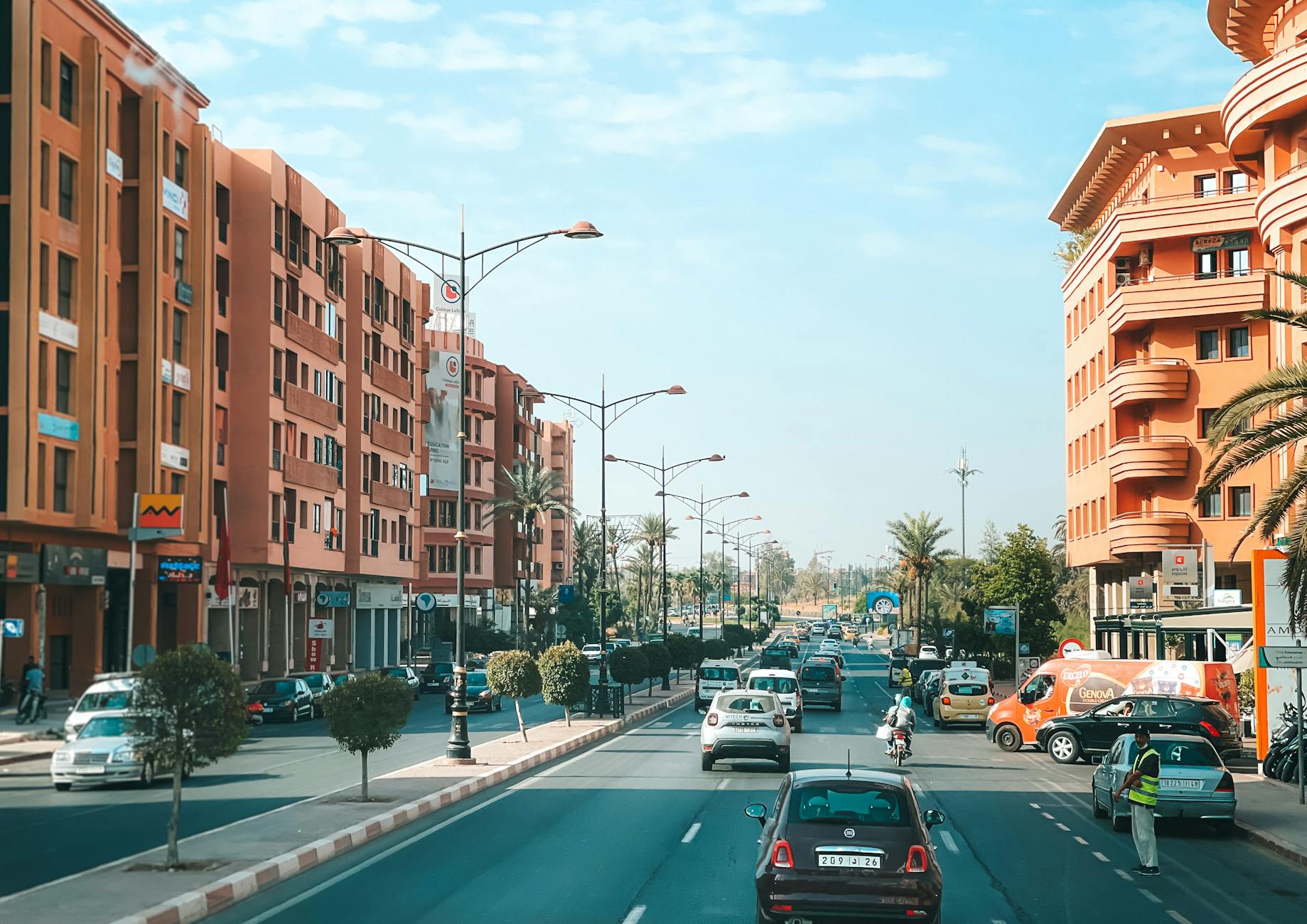
*A practical analysis for visitors, foreign residents, and local users* Prepared: April 22, 2026
Scope and audience
This paper explains how transportation in Morocco works in practice. It is written for travelers planning a trip, foreign residents settling into daily life, and local users comparing the tradeoffs between trains, intercity coaches, urban buses, trams, taxis, ride-hailing, private drivers, rental cars, walking, and ferry links.
The first part covers national-scale transportation patterns that apply across Morocco. The second part focuses on the requested city systems:
Morocco is easier to move around than many first-time visitors expect, but it is not a single integrated transport system. Trains are strong on the Atlantic and imperial-city corridors; coaches fill the gaps; grand taxis are an essential semi-formal intercity layer; petit taxis dominate short urban trips; and walking is unavoidable inside medinas. Casablanca and Rabat have the country’s strongest urban rail-style systems, while Marrakech, Fez, Tangier, and Essaouira depend much more on taxis, buses, walking, and private transfers.
Operational details change often. Urban bus operators, route numbers, airport shuttles, fares, app availability, and construction projects should be checked on the day of travel. This paper uses official and operator sources where available and treats specific fares as planning references rather than guarantees.
- Marrakech
- Casablanca
- Rabat
- Fez
- Tangier
- Essaouira
Contents
- [Executive summary](#executive-summary)
- [Part I — National-scale transportation in Morocco](#part-i--national-scale-transportation-in-morocco)
- [1. The Moroccan transportation model](#1-the-moroccan-transportation-model)
- [2. The practical decision framework](#2-the-practical-decision-framework)
- [3. National rail and ONCF](#3-national-rail-and-oncf)
- [4. Intercity coaches and Supratours/CTM](#4-intercity-coaches-and-supratoursctm)
- [5. Grand taxis and intercity shared taxis](#5-grand-taxis-and-intercity-shared-taxis)
- [6. Urban transit: trams, busways, city buses, and medina walking](#6-urban-transit-trams-busways-city-buses-and-medina-walking)
- [7. Petit taxis, ride-hailing, private drivers, and transfers](#7-petit-taxis-ride-hailing-private-drivers-and-transfers)
- [8. Private vehicles, rental cars, toll roads, and parking](#8-private-vehicles-rental-cars-toll-roads-and-parking)
- [9. Airports and airport access](#9-airports-and-airport-access)
- [10. Ferries and ports](#10-ferries-and-ports)
- [11. Tickets, payment, apps, language, and navigation](#11-tickets-payment-apps-language-and-navigation)
- [12. Accessibility, luggage, families, and older travelers](#12-accessibility-luggage-families-and-older-travelers)
- [13. Safety, scams, bargaining, enforcement, and passenger behavior](#13-safety-scams-bargaining-enforcement-and-passenger-behavior)
- [14. Weather, Ramadan, holidays, festivals, and disruption planning](#14-weather-ramadan-holidays-festivals-and-disruption-planning)
- [15. Main concerns for residents and locals](#15-main-concerns-for-residents-and-locals)
- [16. Recommended strategies by traveler type](#16-recommended-strategies-by-traveler-type)
- [Part II — City-by-city analysis](#part-ii--city-by-city-analysis)
- [Marrakech](#marrakech)
- [Casablanca](#casablanca)
- [Rabat](#rabat)
- [Fez](#fez)
- [Tangier](#tangier)
- [Essaouira](#essaouira)
- [Comparative city matrix](#comparative-city-matrix)
- [Practical itineraries and modal choices](#practical-itineraries-and-modal-choices)
- [References](#references)
Executive summary
Morocco’s transportation system is best understood as a set of overlapping layers rather than one unified national network. ONCF trains connect many major cities, including Tangier, Rabat, Casablanca, Fez, Marrakech, Meknes, and Oujda. Al Boraq, Morocco’s high-speed rail service, connects Tangier with Casablanca via Kenitra and Rabat Agdal, while conventional ONCF trains continue to Marrakech, Fez, Meknes, and other cities.
For most visitors, the strongest rule is simple: use trains where they exist, use CTM or Supratours where trains do not, use petit taxis inside cities, and do not rent a car for medina-based city stays. A rental car becomes useful for rural flexibility, Atlantic-coast road trips, Atlas mountain routes, desert approaches, scattered riads outside cities, or families carrying substantial luggage. It is rarely useful inside Marrakech medina, Fez medina, Casablanca center, or Rabat’s densest districts.
Morocco’s best national transport corridors are:
Morocco’s strengths are meaningful. Rail stations in major cities are modernizing, long-distance coaches are widespread, Casablanca’s tram/busway network is increasingly useful, Rabat–Salé has a clean and practical tram, and Tangier has become a much easier rail gateway because Al Boraq terminates at Tanger Ville. Casablanca Mohammed V Airport has a direct rail station in Terminal 1’s basement, which is a major advantage over many regional airports.
The main frictions are equally predictable. Urban fare systems are fragmented. Bus routes can be hard for visitors to understand. Taxi meters may be refused, especially in tourist districts. Grand taxis often leave only when full unless you buy extra seats. Medina streets are often inaccessible to cars. Railway websites and payment systems can be inconsistent for foreign cards. Some transport information online is outdated because Morocco has been modernizing quickly ahead of major events and the 2030 FIFA World Cup. Marrakech is a good example: urban buses were associated with ALSA for many years, but Supratours took over Marrakech urban transport in late 2025, creating a transition period in which old references can still circulate.
For locals, transportation concerns are less about sightseeing and more about affordability, commute time, overcrowding, route coverage, reliability, road safety, access to jobs and schools, and the cost of taxis relative to wages. Casablanca residents face heavy congestion and long cross-city commutes. Rabat residents care about tram reach and bus integration. Marrakech residents are dealing with the effects of operator transition and network redesign. Fez residents need better bus quality and better medina-to-new-town connections. Tangier residents experience fast modernization but still rely heavily on taxis and buses outside the Al Boraq corridor. Essaouira residents live in a smaller, walkable city but depend on road connections for nearly all intercity travel.
A practical rule set for Morocco is:
- Tangier – Rabat – Casablanca by Al Boraq or conventional rail.
- Casablanca – Marrakech by conventional train, coach, or motorway.
- Rabat/Casablanca – Fez/Meknes by conventional rail.
- Marrakech – Essaouira by coach, taxi, transfer, or rental car, because Essaouira has no railway.
- Marrakech – Agadir by coach or car, because there is no current passenger rail link.
- Tangier – Chefchaouen/Tetouan by coach, grand taxi, or car, because rail does not reach Chefchaouen.
- Use Al Boraq for Tangier–Rabat–Casablanca when the timetable and fare work.
- Use standard ONCF trains for Casablanca–Marrakech, Casablanca–Fez, Rabat–Fez, Rabat–Meknes, and similar rail corridors.
- Use CTM or Supratours for routes outside rail coverage, especially Marrakech–Essaouira, Marrakech–Agadir, Fez–Chefchaouen, and many southern routes.
- Use Casablanca Tramway/Busway and Rabat–Salé Tramway where they serve your origin and destination.
- Use petit taxis for short urban trips, but insist on the meter where legally applicable or agree clearly before departure.
- Use grand taxis for suburban and intercity gaps, understanding that shared seating is normal.
- Use ride-hailing as a supplement, not a total replacement. Uber officially relaunched in Marrakech and Casablanca in late 2025, while other apps such as inDrive, Careem, Heetch, Roby, and local services vary by city and legal/operational status.
- Use rental cars for rural and coastal flexibility, not for old medinas or dense city centers.
- Build extra time into airport transfers, Friday travel, Ramadan evenings, public holidays, football-event periods, beach weekends, and summer heat.
1. The Moroccan transportation model
Morocco’s transportation system reflects the country’s geography, colonial-era rail corridors, coastal economic axis, historic medinas, modern urban growth, and a very practical culture of shared road transport. The system has seven main layers:
This layered model makes Morocco flexible but sometimes confusing. A route may have three reasonable options — train, coach, and grand taxi — with different tradeoffs in speed, price, comfort, luggage handling, and door-to-door convenience. The correct answer depends less on the map distance and more on where the station is, whether the route is rail-served, whether you have luggage, and whether your accommodation is in a medina.
What makes Morocco different from many European systems
Morocco has good national rail in selected corridors, but it does not have dense railway coverage everywhere. Important tourist destinations such as Essaouira, Chefchaouen, Agadir, Ouarzazate, Merzouga, and many Atlas or desert locations require road transport. A visitor coming from France, Germany, Japan, or the Netherlands may overestimate train coverage. A visitor coming from a car-oriented country may underestimate the usefulness of rail and coaches.
Medinas are another defining feature. In Marrakech, Fez, Rabat, Tangier, and Essaouira, the old city may be partially or entirely impractical for cars. Even when taxis can approach the gates, the final walk to a riad can involve narrow lanes, steps, cobblestones, uneven pavement, crowds, scooters, handcarts, and luggage porters.
Transportation hierarchy for a first-time visitor
For a first Morocco trip, this hierarchy usually works:
Locals use all of these systems more fluidly. Visitors should start with the easier layers and add local methods as confidence grows.
- National rail, operated by ONCF. This includes Al Boraq high-speed services, conventional long-distance trains, regional trains, and Casablanca airport rail service.
- Intercity coaches, especially CTM and Supratours, plus other private bus companies. CTM sells online tickets and operates a large national coach network; Supratours is an ONCF subsidiary and is especially useful for train-connected onward journeys to towns without rail.
- Grand taxis, the shared intercity and suburban taxi layer. They can be economical and fast, but they are less comfortable and less predictable than trains or premium coaches.
- Urban rail-style systems, currently concentrated in Casablanca and Rabat–Salé. Casablanca has an integrated tramway and busway network; Rabat–Salé has a two-line tram system connecting the capital with Salé.
- Urban buses, which vary widely by city. Casablanca’s Casabus network is operated by ALSA; Rabat has ALSA urban buses; Tangier has ALSA buses; Marrakech shifted urban bus operations to Supratours in late 2025; Fez has been modernizing its bus fleet; Essaouira has minimal city-bus relevance for most visitors.
- Petit taxis and ride-hailing, used for short city trips. Petit taxi colors vary by city and they generally cannot leave city limits.
- Private vehicles, including rental cars, private drivers, tour vans, scooters, and motorcycles. Road infrastructure is strong on major routes but can be challenging in old cities, mountain passes, and rural areas.
- Train for rail-served major-city transfers.
- Premium coach for non-rail cities.
- Petit taxi for city hops beyond walking range.
- Walking inside old medinas.
- Private driver or transfer for early/late airports, Atlas/desert routes, or families.
- Rental car only when the itinerary genuinely needs self-driving flexibility.
- Grand taxi when you understand the shared-taxi system or when no better option exists.
2. The practical decision framework
When to use rail
Use rail when both the origin and destination are on ONCF’s strong corridors:
Rail is best when you value predictability, assigned seating on many long-distance services, air conditioning, toilets, station amenities, and avoiding road traffic. It is especially good for first-time visitors moving between major cities with luggage.
Rail is weaker when:
When to use intercity coaches
Use CTM or Supratours when rail does not serve the destination, or when the coach is more direct. Common examples include:
Premium coaches are usually easier for visitors than ordinary local buses. They tend to have clearer stations, scheduled departures, luggage procedures, and online or office ticketing. CTM’s official site sells tickets online and advertises different comfort categories and onboard services such as reclining seats, Wi-Fi, USB charging, and entertainment on selected services.
When to use grand taxis
Use grand taxis when you need a flexible regional connection, when coaches are infrequent, when you are traveling between nearby towns, or when you are comfortable with shared travel. Grand taxis are a core Moroccan transport layer, but they require more local awareness.
A grand taxi may be the best option for:
The main rule: a shared grand taxi normally waits until seats are filled. If you want to leave immediately or travel more comfortably, you can pay for multiple seats or hire the whole vehicle. This is normal, but it must be negotiated clearly.
When to use petit taxis
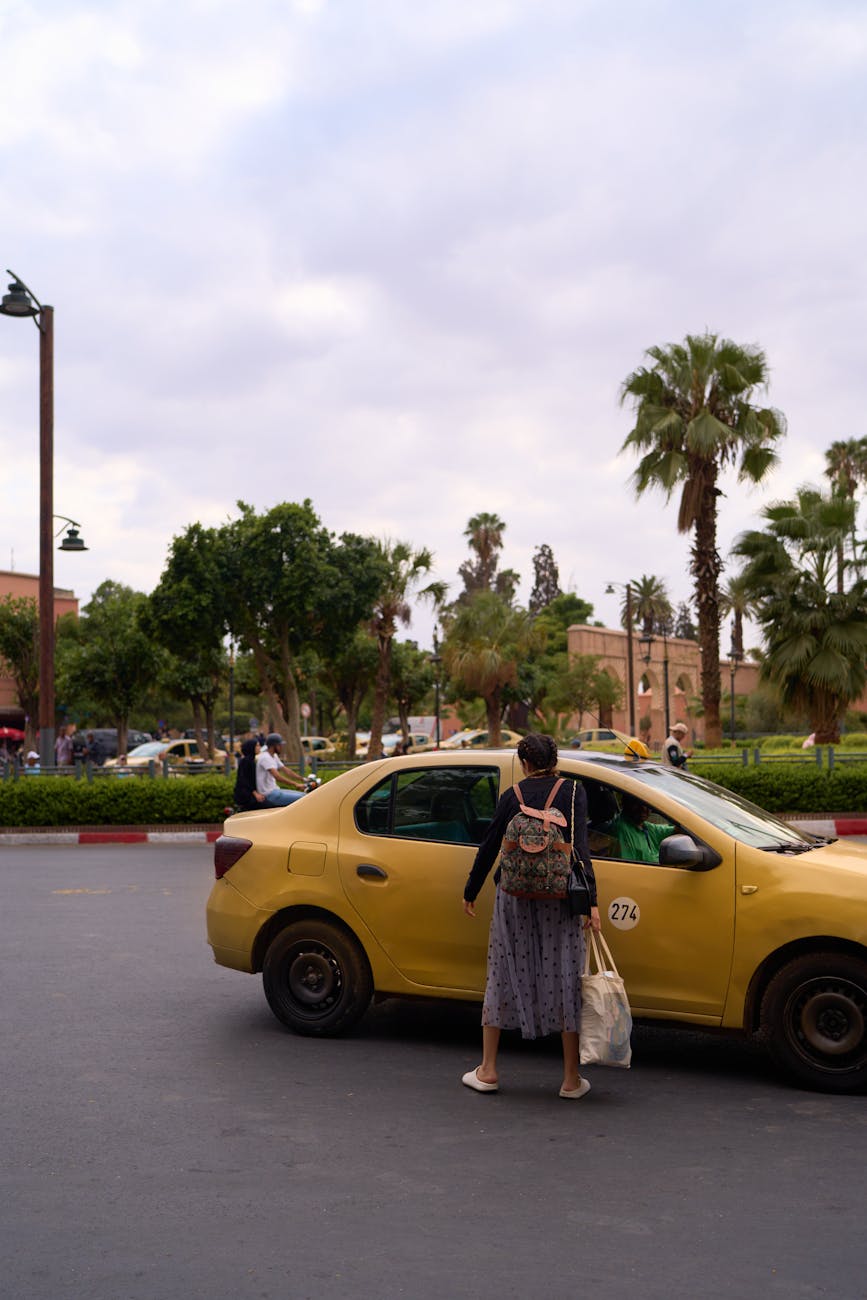
Use petit taxis for short city trips when walking is too far, it is too hot, you have luggage, or the bus/tram is inconvenient. Petit taxis generally operate only within city limits and normally carry up to three passengers. They are city-specific in color: red in Casablanca and Fez, blue in Rabat and Tangier, ochre/tan in Marrakech, and blue or light-colored variations in some coastal towns.
The key issue is the meter. In many cities, taxis are supposed to use meters. In tourist districts, drivers may refuse, quote a fixed price, or claim the meter is broken. For locals, this is a daily irritation. For visitors, it can become one of the most common avoidable frustrations.
When to use ride-hailing
Ride-hailing in Morocco is useful but uneven. Uber officially relaunched in Marrakech and Casablanca in November 2025, operating with licensed transportation vehicles and offering UberX and UberXL. Other apps may exist in major cities, including inDrive, Careem, Heetch, Roby, inToura, or local taxi apps, but availability, legality, pricing, and driver behavior vary by city and over time.
Use ride-hailing when:
Do not assume ride-hailing is universal or frictionless. Some drivers may ask to renegotiate, request cash, or meet away from official taxi queues. At airports and stations, taxi rules and pickup locations can be sensitive.
When to rent a car
Rent a car when the trip is about rural access, not city convenience. Good car use cases include:
Avoid a car when:
- Tangier – Rabat – Casablanca
- Casablanca – Marrakech
- Casablanca – Fez
- Rabat – Fez
- Rabat – Meknes
- Tangier – Kenitra/Rabat/Casablanca
- Casablanca airport – central Casablanca and onward connections
- the city has no station, such as Essaouira;
- the station is far from your hotel or medina gate;
- the route requires a long indirect connection;
- you are traveling to villages, beaches, desert camps, Atlas trailheads, or rural riads;
- you arrive very late and onward local transport is uncertain.
- Marrakech – Essaouira
- Marrakech – Agadir
- Marrakech – Ouarzazate
- Fez – Chefchaouen
- Tangier – Chefchaouen
- Casablanca – Chefchaouen
- Casablanca/Marrakech – southern destinations
- Rabat to nearby suburbs or smaller towns not directly served by tram/train.
- Tangier to nearby coastal or mountain destinations.
- Fez to surrounding villages or certain day-trip points.
- Essaouira to nearby beaches, villages, or airport transfers.
- Marrakech to areas just outside the city when buses are inconvenient.
- you want a price estimate before committing;
- you need a cashless option;
- you are arriving at night;
- you are going to a destination where street taxis are hard to find;
- you want a larger car or scheduled pickup.
- Essaouira and nearby Atlantic beaches.
- Atlas Mountains, Ourika Valley, Imlil access, Ouirgane, or mountain lodges.
- Desert approaches when not using an organized tour.
- Coastal itineraries with multiple stops.
- Family trips with luggage and child seats.
- Rural riads or resorts outside city centers.
- staying inside Marrakech medina or Fez medina;
- spending most days in Casablanca/Rabat centers;
- you are uncomfortable with assertive traffic;
- you cannot manage parking guardians and narrow streets;
- you plan to drive at night on rural roads.
3. National rail and ONCF
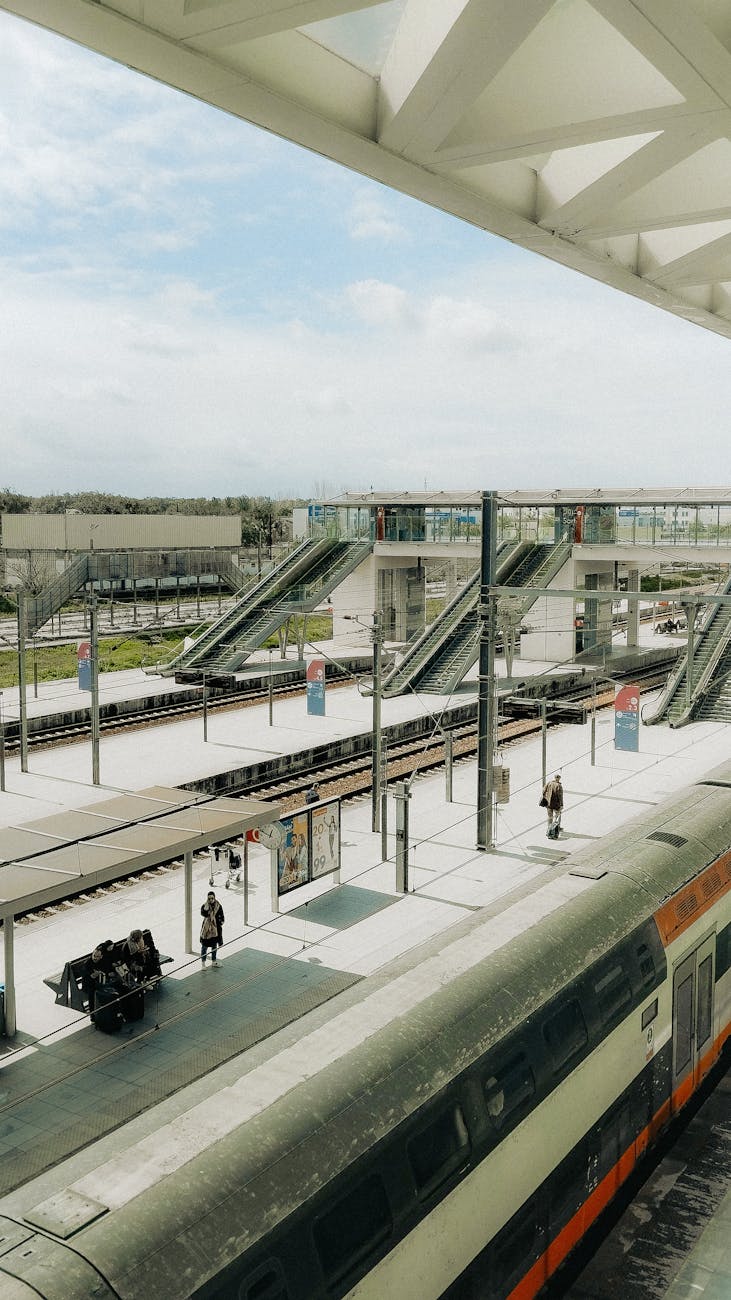
ONCF is the national railway operator and the backbone of long-distance public transport where rail exists. It operates the online ticketing site ONCF Voyages, where passengers can check schedules and buy Al Boraq and conventional train tickets.
Al Boraq high-speed rail
Al Boraq is Morocco’s premium rail product. It runs between Tangier and Casablanca, stopping at Tanger Ville, Kenitra, Rabat Agdal, and Casa Voyageurs according to ONCF’s published destination information. It is the best choice for Tangier–Rabat, Tangier–Casablanca, Rabat–Tangier, and Casablanca–Tangier if the fare is acceptable.
The main visitor benefits are:
The main limitations are:
Conventional ONCF trains
Conventional trains connect major cities beyond the Al Boraq corridor. For the cities in this paper, conventional rail is important for:
Trains are generally more comfortable than ordinary buses and easier than grand taxis for travelers with luggage. First class can be worth it on longer routes because assigned seating and lower crowding reduce stress. Second class is widely used by locals and can be perfectly adequate, but on busy departures it may feel crowded.
Station choice matters
A common visitor error is choosing the wrong station. Morocco’s major rail cities can have more than one important station:
A station that looks “close” on a map can still mean a taxi ride if you have luggage, heat, or a medina riad.
Buying rail tickets
The safest approach is:
For high-demand travel days — school holidays, Eid periods, summer weekends, football tournaments, and long weekends — buy earlier. Morocco is expanding rail capacity, but high-demand corridors can still become crowded.
Rail expansion context
Morocco is investing heavily in rail. In 2025, Reuters reported a major expansion plan including a Kenitra–Marrakech high-speed line intended to serve Rabat and Casablanca, with completion planned before the 2030 World Cup; ONCF also announced train purchases from France, Spain, and South Korea as part of broader capacity expansion.
For travelers in 2026, this matters because construction, station works, and route changes may affect mobility over the coming years. Do not assume older guides remain accurate.
- faster travel than road on the north Atlantic corridor;
- modern trains and stations;
- less exposure to traffic;
- easier luggage handling than buses or taxis;
- reliable connections to the largest cities.
- it does not currently extend to Marrakech or Fez;
- the Casablanca endpoint is Casa Voyageurs, not every Casablanca station;
- advance booking can be useful during weekends, holidays, and large events;
- foreign-card payment issues can occur on some Moroccan transport websites, so backup plans matter.
- Casablanca – Marrakech
- Casablanca – Fez
- Rabat – Fez
- Rabat – Casablanca
- Tangier – Fez via the rail network
- Casablanca airport – Casablanca city stations
- Casablanca: Casa Voyageurs is the main long-distance rail hub; Casa Port is more central for the old port/business area; the airport train also serves key Casablanca stations. Casablanca Mohammed V Airport’s train station is located beneath Terminal 1 and provides direct service to Bouskoura, Ennassim, Facultés, L’Oasis, Casa Voyageurs, and Casa Port.
- Rabat: Rabat Ville is central; Rabat Agdal is important for Al Boraq and long-distance service.
- Tangier: Tanger Ville is the main modern passenger station and Al Boraq terminus, but it is not inside the old medina.
- Marrakech: the ONCF station is in Guéliz/Hivernage area, west of the medina.
- Fez: Fès Ville station is in the Ville Nouvelle, not inside the medina.
- Check schedules and fares on ONCF Voyages or the ONCF app.
- Buy online when the website/app accepts your card and the route is high-demand.
- Use station ticket counters or machines as backup.
- Consider first class for long trips or peak periods.
- Arrive early enough to find platforms, validate/scan as needed, and handle luggage.
4. Intercity coaches and Supratours/CTM
Intercity coaches are essential in Morocco. They serve major cities, towns without rail, beach destinations, mountain gateway towns, and long-distance southern routes.
CTM
CTM is one of Morocco’s best-known coach companies. Its official site sells schedules and tickets online, and the company advertises service categories such as CTM Premium, Comfort Plus, and Comfort, with features such as reclining seats, Wi-Fi, USB charging, and onboard entertainment depending on bus/service.
CTM is usually a good first choice when:
Practical tips:
Supratours
Supratours is an ONCF subsidiary and is especially important for “train plus bus” logic. Its official site describes Supratours as an ONCF subsidiary providing coach continuations to cities not served by train. This makes it especially useful for routes such as Marrakech–Essaouira, Marrakech–Ouarzazate, and other destinations beyond rail.
Supratours is often convenient because stations may be near ONCF train stations. In Marrakech, the Supratours station is near the railway station, making it easier to connect from trains to coaches. In Essaouira, Supratours is often more convenient for visitors staying near the medina than some other bus drop-off points.
Ordinary local buses
Ordinary buses can be cheaper but are harder for visitors. They may stop frequently, depart from less tourist-friendly bus stations, have less predictable comfort, and be harder to book online. Locals use them because they are affordable and reach places premium buses may not. Visitors can use them successfully, but they should expect slower travel and more uncertainty.
Coach travel concerns
Common issues include:
- the route is not rail-served;
- you want an established coach operator;
- the city has a clear CTM station;
- you value scheduled departures and luggage handling;
- you need routes such as Fez–Chefchaouen, Casablanca–Agadir, Marrakech–Agadir, or Casablanca–Essaouira.
- CTM stations are sometimes separate from the main public bus station.
- Luggage may require a small checked-bag process or fee.
- Arrive early enough to check luggage and find the bay.
- Keep your ticket and baggage receipt.
- Do not assume the CTM station is in the medina.
- Stations outside historic centers.
- Confusing station names.
- Need to check luggage separately.
- No toilets on many coaches, though longer routes may include rest stops.
- Air conditioning varies by operator and vehicle.
- High-demand tourist routes can sell out.
- Night buses save hotel nights but can be tiring and less comfortable.
- Arrival after dark may require a taxi or prearranged pickup.
6. Urban transit: trams, busways, city buses, and medina walking
Urban public transport varies sharply by city.
Casablanca
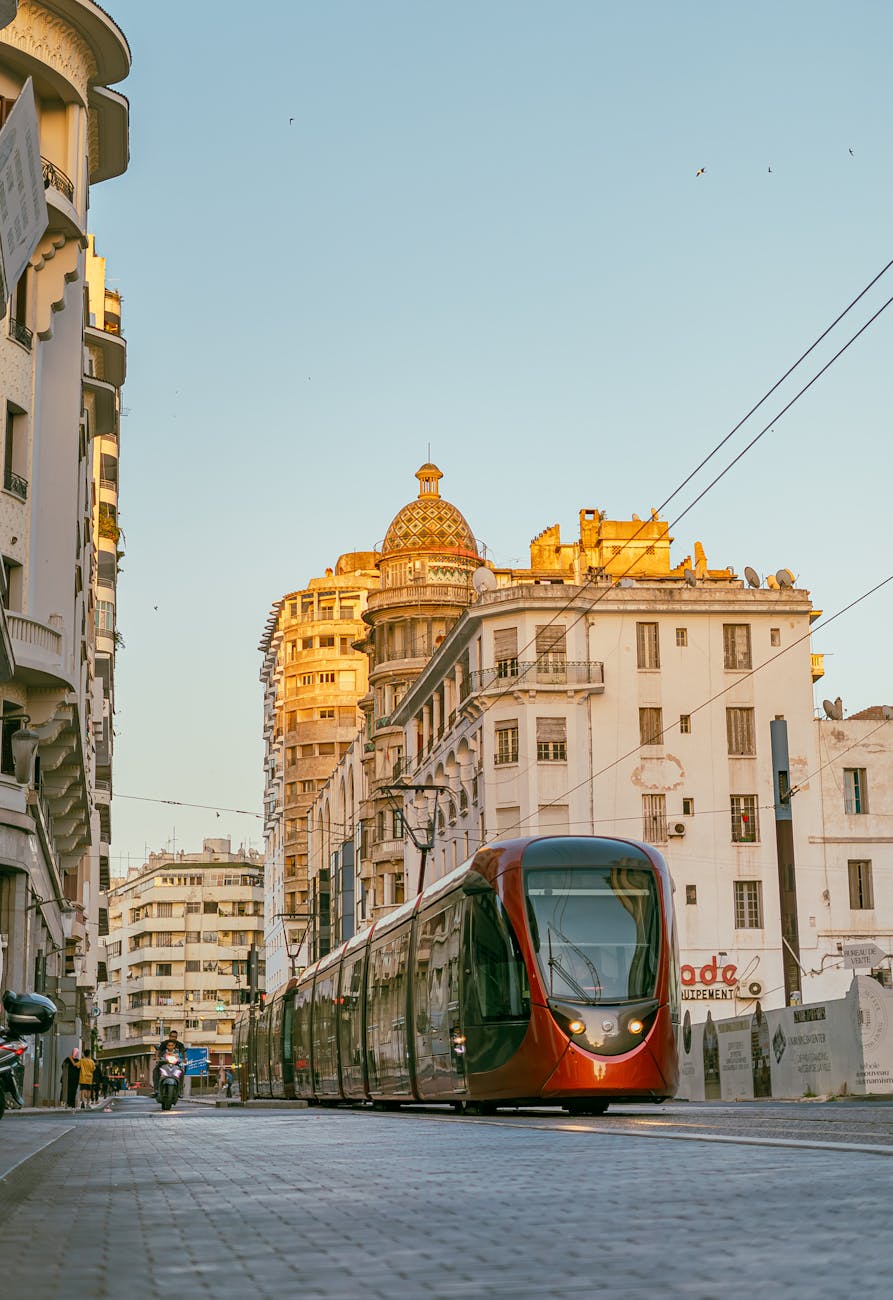
Casablanca has Morocco’s most developed urban mass-transit network. The Casatramway and Casabusway official site presents tramway and busway as a single network with the same ticket/subscription, 151 stations, and average tramway/busway frequency around every 8 minutes. Casabus, operated by ALSA, serves Casablanca, Mohammedia, and surrounding municipalities; the official site lists many bus lines, with many urban fares around 5–6 DH and an airport bus line from Casa Port to Mohammed V Airport at 50 DHS in its fare table.
For visitors, the tramway is often more understandable than buses. For locals, buses and tram/busway integration matter because Casablanca is large, congested, and economically central.
Rabat–Salé
Rabat–Salé has one of Morocco’s easiest urban rail systems for visitors. The tram connects Rabat and Salé and serves central districts, medina access points, university areas, and stations. The official tram fare page lists a single ticket at 7 MAD, valid for one hour from first validation with transfers between lines, and requires validation each time you board.
Rabat also has urban buses and a newer bus station for intercity coaches. Visit Rabat describes the tram as two main lines over roughly 20 km with 31 stations, plus urban buses across the region.
Marrakech
Marrakech does not have a metro or tram. Urban transport depends on buses, taxis, walking, horse carriages for tourist use, private transfers, and organized tours. A major recent change is that Supratours replaced ALSA as Marrakech’s urban bus operator in late 2025, ending a long ALSA period. That means old guides, maps, and blog posts may still mention ALSA routes and airport buses even where operator arrangements are changing.
The medina is mostly a walking environment. Taxis can reach many gates but not most riad doors. Travelers with luggage should arrange the final transfer with the riad.
Fez
Fez has no tram or metro. It has buses, petit taxis, grand taxis, and extensive walking inside the medina. Fez launched 154 new buses in late 2025 as part of Morocco’s urban transport modernization effort, but visitors should still treat city buses as more local-oriented than tourist-friendly.
The medina of Fez is a defining transport constraint: much of it is pedestrian, and even luggage movement may involve porters or handcarts.
Tangier
Tangier has modern rail access through Tanger Ville, urban buses, taxis, ferry-port transport, and airport buses/taxis. ALSA has operated buses in Tangier as part of its Morocco urban transport presence. Tangier is much easier than it used to be for intercity arrivals because of Al Boraq, but the station is still outside the old medina.
Essaouira
Essaouira is small and walkable. For most visitors, city transit is less important than intercity arrival. There is no train. Coaches, private transfers, rental cars, and taxis dominate. The medina and waterfront are walkable, while surrounding beaches and villages may require taxis, tours, or rental vehicles.
7. Petit taxis, ride-hailing, private drivers, and transfers
Petit taxis
Petit taxis are the default urban taxi. They are cheap by international standards, widely used by locals, and often the most convenient way to connect between train stations, bus stations, medina gates, hotels, restaurants, and modern districts.
Key rules:
Visitor strategy:
Ride-hailing and taxi apps
Digital mobility is changing quickly. Uber’s official Morocco relaunch in November 2025 began in Marrakech and Casablanca, with UberX and UberXL offered through licensed transportation vehicles. Other apps may include inDrive, Careem, Heetch, Roby, inToura, and city-specific services, but availability can change and some services operate in legal gray zones.
Ride-hailing is most helpful for:
But it is not a magic fix. Expect city-by-city differences, pickup-point issues, and occasional attempts to renegotiate.
Private drivers and transfers
Private drivers are common in Moroccan tourism. They are more expensive than taxis or buses but useful for:
The quality difference between a licensed professional transfer and a random unofficial driver is significant. For important trips, use accommodation recommendations, reputable agencies, or platforms with clear reviews and pricing.
- Petit taxis generally operate within city limits.
- They normally carry up to three passengers.
- They may pick up additional passengers traveling in the same direction, depending on city practice.
- Meters should be used where required, but refusal is common in tourist zones.
- Night surcharges or higher night rates may apply.
- Cash is the standard payment method.
- Small bills are important.
- Ask for the meter politely: “compteur, s’il vous plaît.”
- If the driver refuses and quotes a high price, walk away if practical.
- For short tourist-zone rides, agree a price before entering if the meter will not be used.
- Use your hotel/riad as a price reference.
- Carry 5, 10, 20, and 50 dirham notes.
- Avoid starting negotiations while already seated with luggage loaded.
- airport transfers;
- late-night rides;
- foreign visitors who want a fare estimate;
- groups needing larger vehicles;
- avoiding street-hailing friction.
- families with children;
- older travelers;
- travelers with limited mobility;
- late-night airport arrivals;
- Atlas or desert routes;
- multi-stop day trips;
- carrying luggage from medina gates to road-accessible pickup points.
8. Private vehicles, rental cars, toll roads, and parking
Morocco is a strong road-trip country outside the most congested urban cores. Major highways connect the Atlantic corridor and important city pairs. Autoroutes du Maroc (ADM) operates the toll motorway network and publishes route toll tariffs; its toll table includes examples such as Casablanca–Rabat at 25 DH for class 1 vehicles.
Toll roads and Jawaz
ADM offers the Jawaz electronic toll pass, described as a remote payment method allowing users to pass toll stations without stopping, through dedicated lanes marked with the Jawaz symbol. For short-term visitors, a rental car may or may not come with Jawaz. Ask the rental company how tolls are handled.
Practical toll advice:
Road rules and driving culture
Morocco drives on the right. Road signage is often in Arabic and French. Major roads are generally good; city driving and rural/mountain roads require more attention. Police checkpoints and speed controls are common.
Common planning assumptions:
Rental cars
Rental cars are useful for:
Rental cars are inconvenient for:
Before accepting a car:
Parking
Parking is one of Morocco’s most underestimated travel frictions. In cities, there may be official parking lots, street meters, private garages, hotel parking, and informal parking guardians. A guardian may guide you into a space and expect a small payment. This is normal, but the boundaries between official and informal can be unclear.
For medina stays, ask your accommodation:
- Carry cash, especially small notes and coins.
- Ask whether your rental includes Jawaz or if tolls are billed later.
- Keep toll receipts if using cash.
- Do not enter a Jawaz-only lane unless your vehicle has a working pass.
- Expect holiday and weekend queues at toll plazas.
- Motorways are usually the easiest long-distance driving environment.
- City traffic can be assertive, especially Casablanca and Marrakech.
- Scooters, pedestrians, carts, animals, and informal parking behavior require defensive driving.
- Night driving outside cities is best avoided where possible because of lighting, animals, pedestrians, and slower vehicles.
- Mountain roads can be scenic but tiring.
- Atlas Mountains;
- coastal routes beyond rail;
- Essaouira plus surrounding beaches;
- rural riads;
- family travel;
- travelers who want flexible photo stops.
- Marrakech medina;
- Fez medina;
- Casablanca center;
- short city-only trips;
- travelers uncomfortable with negotiation or police stops.
- photograph all damage;
- check tires, spare tire, lights, and fuel policy;
- verify insurance excess and deposit;
- clarify whether driving on unpaved roads is allowed;
- confirm whether crossing borders or ferry travel is allowed;
- get a contact number for breakdowns.
- which gate to use;
- where the nearest secure parking is;
- whether someone can meet you;
- whether luggage can be carried by cart/porter;
- whether the road to the parking area is affected by market closures or construction.
9. Airports and airport access
Morocco has multiple international airports relevant to the requested cities: Casablanca Mohammed V, Marrakech Menara, Rabat–Salé, Fez–Saïss, Tangier Ibn Battouta, and Essaouira-Mogador.
Casablanca Mohammed V Airport
Casablanca has Morocco’s best airport rail connection. The official airport information page states that the airport is connected to the rail network, with the station in the basement of Terminal 1 and direct access to the airport concourse; direct destinations include Bouskoura, Ennassim, Facultés, L’Oasis, Casa Voyageurs, and Casa Port.
This matters nationally because many visitors enter Morocco through Casablanca and continue to Rabat, Marrakech, Fez, or Tangier. The practical choice is often:
Marrakech Menara Airport
Marrakech airport is close to the city but can still be stressful because taxi negotiation is common and medina access is indirect. The airport bus historically known as Line 19/L19 has been widely used to connect the airport with Guéliz, the train station, Koutoubia/Jemaa el-Fnaa area, and tourist districts; many sources cite a fare around 30 MAD. However, because Marrakech’s urban bus operations changed to Supratours in late 2025, travelers should verify the current operator, stop, route, and fare on arrival rather than relying on old ALSA-only references.
For riads inside the medina, a prearranged transfer can be worth the cost because the driver or riad porter can coordinate the final walk.
Rabat–Salé Airport
Rabat–Salé Airport is closer to Rabat than Casablanca airport is to Casablanca. Taxi or shuttle/bus options can work, but exact route details and fares should be checked for the current season. Rabat is also commonly reached from Casablanca airport by train via Casablanca stations or by private transfer.
Fez–Saïss Airport
Fez airport access is usually by taxi, bus, or private transfer. Visitors staying inside the medina should think in terms of reaching a gate such as Bab Boujloud, R’cif, or another agreed meeting point, not the exact riad door. Line 16 airport bus has historically been cited as a budget link toward the city/train station, but timetables and stop locations should be confirmed locally.
Tangier Ibn Battouta Airport
Tangier airport is outside the city. Since 2024/2025, airport bus references cite an AE/Aerobus-type route between the airport and railway station, often around 40 MAD, with schedules needing verification. Taxis remain common and more direct. Travelers connecting to Al Boraq should leave time to get from the airport to Tanger Ville station.
Essaouira-Mogador Airport
Essaouira airport is small and limited. Transport is usually by taxi, accommodation transfer, shuttle service, or rental car. Flight schedules are thinner than Marrakech or Casablanca, so many visitors still arrive by coach or private transfer from Marrakech.
- train to Casa Voyageurs, then onward train;
- airport train to Casa Port for central Casablanca;
- taxi/private transfer for late arrivals, groups, or hotels not near rail;
- domestic flight only if the onward city is far and timing makes sense.
10. Ferries and ports
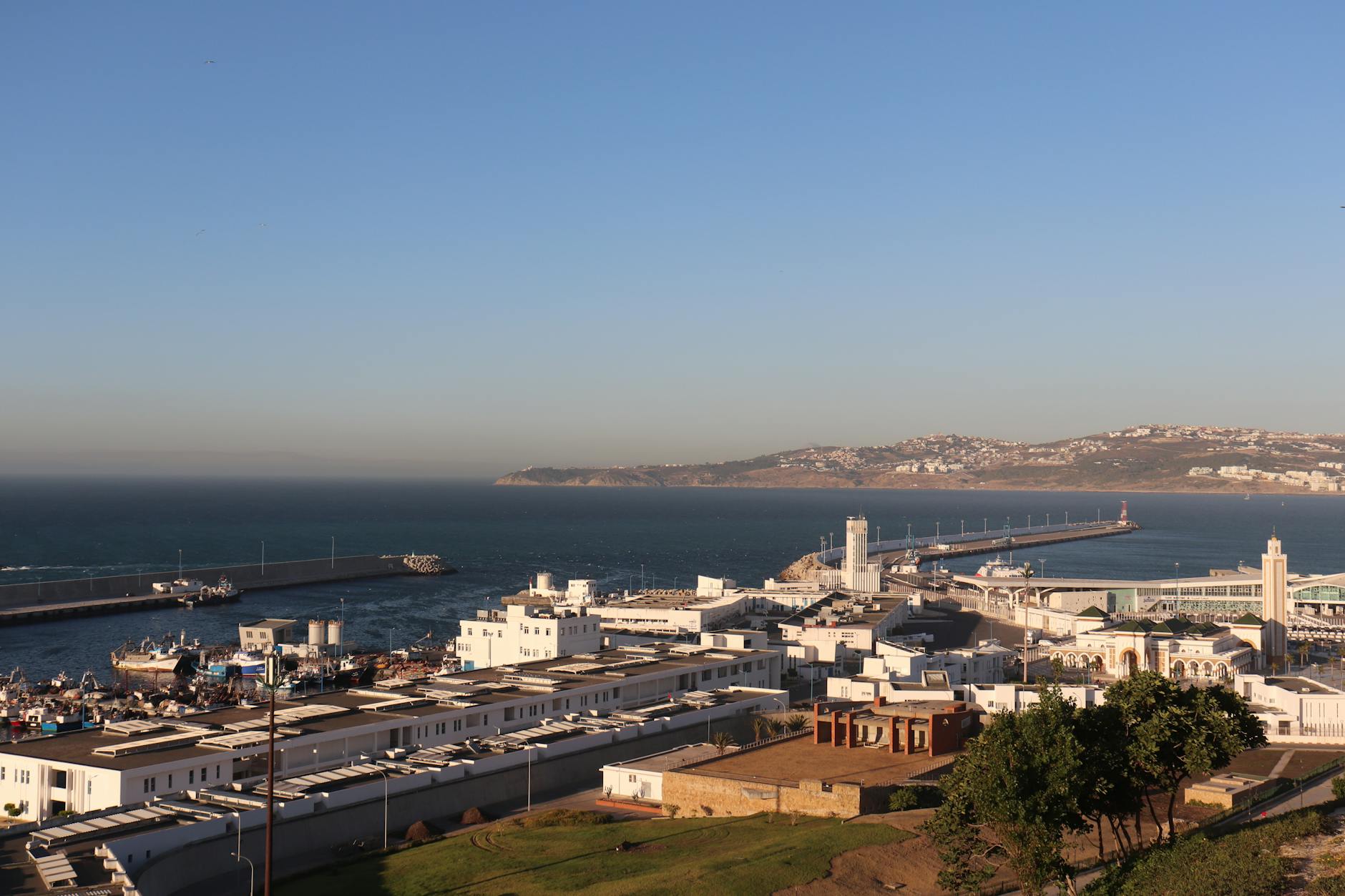
Ferries matter most for Tangier and northern Morocco. Travelers arriving from Spain need to distinguish between Tangier Ville and Tanger Med.
Tangier Ville
Tangier Ville port is in the city and is the most convenient ferry terminal for foot passengers visiting Tangier itself. The Tangier City port site states that the Tangier City–Tarifa route is operated by Africa Morocco Link and Baleària, with crossings taking less than an hour and arriving near the old city.
For visitors, Tangier Ville is ideal for:
Tanger Med
Tanger Med is a major port complex located far outside Tangier city. It is better for many vehicle ferries, freight, and longer-distance ferry connections. The Tanger Med passenger site states that access from Tangier city is available by urban transport bus from Tangier train station, provided by ALSA, or by taxi; it also lists motorway access times from nearby points.
For visitors, the key point is: do not assume Tanger Med is in Tangier city. It is roughly a separate transfer problem. If arriving late, carrying luggage, or catching an early ferry, plan carefully.
- day trips from Tarifa;
- walking into the medina;
- quick taxi access to hotels;
- connecting to Tanger Ville train station by taxi.
12. Accessibility, luggage, families, and older travelers
Morocco can be rewarding but physically demanding. Accessibility varies strongly by mode and city.
Luggage
Luggage is easy on trains and premium coaches, moderate in taxis, and difficult in medinas. The biggest issue is not intercity transport; it is the final 300 meters to a riad. Fez and Marrakech are especially important here.
Recommendations:
Families
Families often benefit from private transfers for airports and medina arrivals. Child seats are not always available unless requested in advance. Trains are good for children because they allow movement and toilets. Grand taxis can be uncomfortable for families if shared and crowded.
Older travelers and mobility limitations
Older travelers should be realistic about:
A well-located hotel outside the deepest medina lanes may improve the entire trip.
Wheelchair users
Casablanca and Rabat’s modern tram systems are more promising than most older Moroccan urban environments, but street access, curb ramps, station approaches, medina surfaces, and taxis can still be major obstacles. Contact operators and accommodations in advance. Do not assume “accessible” means the whole door-to-door journey is accessible.
- Pack smaller bags rather than one huge suitcase.
- Ask riads where to be dropped off.
- Arrange porter help for late arrivals.
- Avoid tight same-day transfers with luggage through medinas.
- On coaches, keep valuables with you and check large bags properly.
- uneven paving;
- steep or crowded medina lanes;
- lack of elevators in some accommodations;
- boarding steps on buses/coaches;
- heat;
- long walks inside stations or terminals;
- difficulty reaching riad doors by car.
13. Safety, scams, bargaining, enforcement, and passenger behavior
General safety
Moroccan public transport is widely used and generally safe, but visitors should protect against petty theft, overcharging, and confusion. Crowded buses, stations, medina gates, and taxi ranks require normal urban awareness.
Taxi overcharging
Taxi overcharging is the most common visitor issue. It is not usually dangerous, but it is tiring. Best practices:
Faux guides and medina pressure
In medinas, people may offer directions, then ask for money. This overlaps with transportation because travelers often need help finding riads. Arrange arrival instructions and avoid following random guides unless you are comfortable paying.
Station and coach scams
At bus stations and taxi stands, ignore anyone who claims your bus is canceled unless confirmed by the operator. Buy tickets from official counters, machines, apps, or known operators.
Road safety
Road safety is a real concern. Pedestrians, scooters, cars, donkey carts, buses, and taxis all share space in ways that may feel chaotic to visitors. Defensive behavior matters whether walking, driving, or riding.
Gender and harassment concerns
Women travelers may experience unwanted attention in public spaces and transit areas. Choosing well-lit routes, using trusted taxis/transfers at night, sitting near families or other women, and avoiding isolated stops can reduce stress. ALSA Morocco has publicized safety and social initiatives including awareness around violence against women and girls in public transport contexts.
- Ask for the meter.
- Agree before departure if no meter.
- Know a rough price from your hotel.
- Do not let luggage be loaded before the price is clear.
- Avoid arguing over tiny differences; walk away from obviously bad quotes.
- Use official airport taxi stands or prearranged transfers.
14. Weather, Ramadan, holidays, festivals, and disruption planning
Heat
Summer heat affects mobility in Marrakech, Fez, and inland areas. Walking distances that seem short on a map can become exhausting. Use taxis earlier, carry water, and plan medina walking for morning or late afternoon.
Rain and coastal wind
Rain can disrupt medina walking because old streets become slick. Essaouira’s wind is part of daily life; it can make cycling or beach walking harder. Ferry operations can be affected by weather in the Strait of Gibraltar.
Ramadan
During Ramadan, daytime transport still operates, but schedules, driver energy, restaurant access, and evening congestion can change. Around iftar, cities may become unusually quiet and then suddenly busy. Plan airport and train transfers with a cushion.
Eid and holidays
Eid, school holidays, summer weekends, and major events create heavy demand for trains, coaches, taxis, and motorways. Buy tickets earlier, avoid last-minute intercity bus dependence, and expect traffic leaving major cities.
Construction and 2030 preparation
Morocco is investing heavily in transport ahead of major international events. Construction can improve networks but create temporary disruption. Casablanca and Marrakech are especially likely to see changing traffic patterns, station works, and public-transport adjustments.
15. Main concerns for residents and locals
Travelers often focus on how to get from sight to sight. Locals experience transportation as a daily affordability and reliability question.
Cost of mobility
A taxi may feel cheap to a visitor but expensive as a daily habit for residents. Monthly passes, bus fares, and tram subscriptions matter. Casablanca and Rabat’s stronger networks help residents who live near lines; those outside corridors still face expensive or slow commutes.
Reliability and coverage
Residents care whether buses run frequently, whether lines reach workplaces, whether transfers are realistic, and whether public transport works late enough. Tourist districts are not always the same as commuter corridors.
Congestion
Casablanca and Marrakech suffer especially from congestion. Buses and taxis can be slow when road space is saturated. Casablanca’s tram and busway network is important because it offers a more reliable alternative to mixed traffic on key axes.
Accessibility and dignity
Older vehicles, crowded buses, poor sidewalks, missing curb cuts, and inconsistent driver behavior make daily mobility harder for people with disabilities, older residents, parents with strollers, and workers carrying goods.
Safety and gender
Women and girls’ comfort on buses, at stops, and in taxis is a real issue. Lighting, crowding, driver training, and complaint systems matter.
Urban change
Transport modernization can disrupt existing habits. Marrakech’s switch from ALSA to Supratours, Casablanca’s tram/busway expansion, and Fez’s new bus fleet all create transition periods: new routes, old habits, changed stops, and information gaps.
16. Recommended strategies by traveler type
First-time visitor with 7–10 days
Use trains between Tangier/Rabat/Casablanca/Fez/Marrakech when possible. Use a coach or transfer for Essaouira. Avoid renting a car unless adding Atlas or rural stops. Book medina riads that give precise arrival instructions.
Budget traveler
Use second-class trains, CTM/Supratours coaches, local buses where practical, and petit taxis only when needed. Carry cash and book popular coach routes ahead. Grand taxis can save money but require patience and local confidence.
Comfort-focused traveler
Use first-class trains, private transfers for airports and medina arrivals, reputable coach operators, and carefully chosen hotels with vehicle access. Avoid deep-medina stays unless you actively want that experience.
Family traveler
Use trains for long city pairs, private transfers for airports, and hotels/riads that confirm child-friendly access. Avoid cramming into shared grand taxis. Request child seats early, but do not assume availability.
Traveler with limited mobility
Favor Casablanca and Rabat modern districts over deep medina accommodations. Use hotels with elevators and vehicle access. Arrange transfers. Check accessibility for tram stations and final walking paths, not just vehicles.
Road-trip traveler
Use rental cars for countryside, coast, mountains, and remote stays. Park outside medinas. Avoid night driving where possible. Carry cash for tolls and parking. Ask rental agencies about Jawaz and insurance.
Marrakech
City transportation character
Marrakech is one of Morocco’s most visited cities and one of its most transport-sensitive. The city is divided in practical terms between the old medina, Jemaa el-Fnaa/Koutoubia area, Guéliz, Hivernage, Palmeraie, airport zone, resort districts, and surrounding excursions. The transport system is not rail-based inside the city. There is no metro or tram. Movement depends on walking, taxis, buses, private transfers, tour vehicles, horse carriages, and occasional cycling/scooters.
The medina defines the visitor experience. Many streets are too narrow for cars. Taxis may drop you at a gate, square, or near a mosque, but not at the riad door. If arriving after dark or with luggage, the correct strategy is to ask your riad for a meeting point and porter help.
What is unique and important
Marrakech’s most important recent transport fact is that urban bus operations changed in late 2025. Supratours replaced ALSA as the Marrakech bus operator, ending ALSA’s 26-year management of the city’s bus network. This matters because older blog posts, maps, and travel advice may still refer to ALSA routes and old bus branding. During transition, verify route information locally.
For visitors, taxis and walking remain more important than city buses. For locals, buses matter much more because they connect residential districts, universities, workplaces, and suburbs.
Arrival by train
Marrakech is the southern end of one of Morocco’s most important conventional rail corridors. The train station is in the modern city, near Guéliz/Hivernage, not inside the medina. From the station:
Arrival by coach
Marrakech is a major coach hub. CTM and Supratours are both important. Supratours is especially useful for onward travel to Essaouira, Ouarzazate, Agadir, and southern routes. The practical concern is station location: know whether your bus arrives at CTM, Supratours, the main gare routière, or another stop.
Airport access
Marrakech Menara Airport is close to the city, but arrival friction can be high because of taxi negotiation and medina access. The airport bus historically known as L19/Line 19 has been a budget option to Guéliz, the train station, Koutoubia/Jemaa el-Fnaa area, and tourist zones, but visitors should verify current route/operator/fare because the broader Marrakech bus system changed operator in late 2025.
Recommended arrival strategies:
City buses
Buses are useful for locals and budget travelers but less intuitive for first-time visitors. Route redesign under Supratours may improve service, but transition periods create uncertainty. Use current stop information, ask hotel staff, and expect limited English.
Petit taxis
Marrakech petit taxis are often ochre/tan. They are useful for short trips between medina gates, Guéliz, Majorelle Garden, Hivernage, Menara, train station, and restaurants. Tourist-zone overcharging is common. Ask for the meter or agree a price before entering. Night rates and peak tourist periods can increase friction.
Grand taxis and excursions
Grand taxis are useful for nearby destinations, but many visitors prefer private day-trip drivers for Ourika Valley, Imlil, Ouzoud, Ait Ben Haddou, or desert transfers. Be careful with street offers for distant excursions; vehicle condition, itinerary, stops, and return time matter.
Walking and medina navigation
Walking is essential. The medina is fascinating but confusing. GPS can drift. Lanes may be blocked by carts, motorcycles, market stalls, or construction. For accommodation, save the nearest gate and ask for a pinned location.
Horse carriages and tourist transport
Horse-drawn carriages are a tourist mobility product rather than a core transport system. Agree price and duration before boarding. Consider animal welfare and heat.
Private vehicles and parking
Do not drive into the medina. If renting a car, stay in Guéliz/Hivernage or confirm secure parking near your riad’s gate. For day trips, a private driver is often easier than self-driving from a medina base.
Local concerns
Marrakech residents care about bus reliability, fare affordability, congestion, air quality, safety, and whether the new Supratours system improves daily life. Tourism adds taxi demand and can distort prices in central areas.
Best practical strategy for Marrakech
- Taxi to Guéliz/Hivernage hotels is short.
- Taxi to medina gates is common.
- Walking to Jemaa el-Fnaa is possible for light travelers but not ideal with luggage or heat.
- Supratours coach connections are nearby for onward routes such as Essaouira and southern destinations.
- Solo budget traveler, daytime: airport bus if operating conveniently, or negotiated taxi.
- Riad guest, first visit: prearranged transfer through the riad.
- Family or heavy luggage: private transfer.
- Late night: prearranged transfer or official taxi, not improvised medina navigation.
- Stay near where you will spend evenings.
- Arrange medina arrival with your riad.
- Use taxis for cross-city hops.
- Use trains/coaches for intercity moves.
- Use private transfers for airport arrivals with luggage.
- Do not rent a car unless leaving the city for rural routes.
Casablanca
City transportation character
Casablanca is Morocco’s largest economic city and the country’s most urban-transport-intensive destination. It is not the easiest tourist city, but it has the most developed modern public transport network in Morocco. The key systems are ONCF rail, Casablanca airport rail, Casa Tramway, Casa Busway, Casabus, taxis, ride-hailing, and private cars.
Casablanca is large, traffic-heavy, and spread out. Walking works only within specific districts. A visitor who tries to treat Casablanca like a compact medina city will waste time. A local resident’s day is shaped by commute distance and congestion.
What is unique and important
Casablanca’s key advantage is its tramway and busway network. The official Casatramway/Casabusway site presents the system as one network with a single ticket or subscription and 151 stations, with average tramway or busway frequency around every 8 minutes. This is a major asset in a city where road congestion is severe.
Casablanca also has the best airport rail link in Morocco. Mohammed V Airport’s rail station is under Terminal 1 and connects directly to city rail stations.
Arrival by air
Casablanca Mohammed V Airport is the country’s main international gateway. Options:
The airport is far enough from the city that traffic matters. Do not schedule a tight train connection after landing unless you have buffer time.
Arrival by train
Casablanca has multiple rail stations:
For Al Boraq, Casa Voyageurs is the main Casablanca endpoint. For central hotels, check which station is actually closer.
Tramway and Busway
The tramway and busway are the best public transport tools for many visitors and residents. They are useful for:
Practical points:
Casabus
Casabus, operated by ALSA, serves a wide area including Casablanca, Mohammedia, and many surrounding municipalities. It is more important for locals than most tourists, but it can be useful for budget travelers or destinations not on tram/busway corridors. The official fare table lists many urban routes around 5–6 DH, with higher fares on some longer routes and an airport route at 50 DHS.
Taxis and ride-hailing
Casablanca petit taxis are red. They are everywhere but can be frustrating in traffic. Meter use is expected, but tourist and station contexts may produce negotiation. Grand taxis are useful for airport and suburban travel.
Uber officially relaunched in Casablanca and Marrakech in November 2025 through licensed transportation vehicles. Other apps may also operate. For visitors, app-based rides can reduce negotiation stress, but pickup zones and availability may vary.
Private vehicles and parking
Driving in Casablanca is not recommended for casual visitors. Traffic is heavy, parking can be difficult, and local driving style can feel aggressive. A car makes sense only if Casablanca is a stop within a wider road trip or if your hotel has parking and you are leaving the city quickly.
Local concerns
Casablanca residents face some of Morocco’s toughest urban mobility problems: long commutes, congestion, bus reliability, crowding, road safety, and unequal access between tram-served and non-tram-served neighborhoods. The tramway and busway are important not because they are tourist-friendly, but because they offer a partial solution to daily mobility pressure.
Best practical strategy for Casablanca
- Train: usually best for solo travelers and those going to Casa Voyageurs/Casa Port or onward by rail.
- Taxi/private transfer: better for late arrivals, groups, lots of luggage, or hotels far from rail.
- Aero-bus or bus service: check current airport bus information; Casabus fare tables list an airport line from Casa Port to Mohammed V Airport at 50 DHS.
- Casa Voyageurs: primary long-distance and Al Boraq hub.
- Casa Port: useful for the central business/port area.
- L’Oasis and other suburban stations: useful for specific districts.
- Mohammed V Airport station: airport rail link.
- Casa Voyageurs connections;
- central districts;
- universities and residential corridors;
- Ain Diab/coastal areas depending on line;
- reducing taxi dependence.
- Buy or recharge tickets/cards at machines or points of sale.
- Validate correctly.
- Use the official app or network map.
- Beware that a tram route can still require a long walk to the exact destination.
- During peak times, expect crowding.
- Use the airport train when your destination connects well to rail.
- Use Casa Voyageurs for long-distance rail and Al Boraq.
- Use tram/busway for line-served trips.
- Use taxis or Uber/app rides for gaps.
- Avoid self-driving unless necessary.
- Build traffic buffers into airport and business appointments.
Rabat
City transportation character
Rabat is Morocco’s capital and one of the easiest Moroccan cities for visitors to navigate. It is calmer than Casablanca, more orderly than Marrakech in many districts, and better served by modern public transport than Fez or Essaouira. The main layers are ONCF rail, Rabat–Salé Tramway, buses, petit taxis, grand taxis, walking, and private cars.
Rabat’s transport system is also tied to Salé and Temara. Many daily movements are metropolitan rather than purely within Rabat city.
What is unique and important
The Rabat–Salé Tramway is the city’s defining transport asset. It connects Rabat and Salé across the Bou Regreg and serves central stations, medina access, universities, residential districts, and commercial zones. The official tram ticket page lists a 7 MAD single ticket valid across the network for one hour from first validation, with transfers between lines, and requires validation on each boarding.
Compared with many Moroccan systems, this is straightforward for visitors.
Arrival by train
Rabat has two important stations:
Do not choose automatically. Rabat Ville may be more convenient for the old center; Rabat Agdal may be better for Al Boraq, modern districts, or certain hotels.
Tramway
The tram is useful for:
Practical rules:
Urban buses
Rabat’s urban bus network is important for residents and reaches areas beyond tram coverage. Visit Rabat describes urban buses as available throughout the region and references the Alsa network in the Rabat–Salé metropolitan area. Fares and subscriptions changed in 2025, so confirm current prices on ALSA Rabat or local points of sale.
Taxis
Rabat petit taxis are blue. They are generally useful and less chaotic than in Marrakech or Casablanca, though meter refusal can still happen. For Salé, taxi rules and colors can differ. For intercity or airport trips, grand taxis and private transfers are common.
Airport access
Rabat–Salé Airport is relatively close. Taxi or shuttle options are typical. If arriving internationally, compare Rabat airport arrival with Casablanca airport plus train; Casablanca often has more flight options, while Rabat may be easier once landed.
Walking and cycling
Rabat is more walkable than Casablanca across central districts. The Kasbah of the Udayas, medina, Hassan Tower area, Bou Regreg waterfront, and central avenues can be combined with tram/taxi rides. Cycling is possible in some areas but not yet a universal visitor solution.
Private vehicles and parking
Driving is easier than Casablanca or Marrakech but still not necessary for most visitors. A car is useful for regional exploration, not central sightseeing.
Local concerns
Residents care about tram crowding, bus integration, fare increases, connections to Salé and Temara, access to new residential areas, and commute reliability. The tram is a success, but it cannot serve every corridor.
Best practical strategy for Rabat
- Rabat Ville: central, convenient for the medina, Hassan district, and many hotels.
- Rabat Agdal: important for Al Boraq and long-distance services, located in a modern district.
- Rabat–Salé movement;
- Rabat Ville area;
- university districts;
- medina access;
- avoiding traffic on key corridors.
- Buy ticket/card before boarding.
- Validate each boarding, including transfer.
- Keep ticket until exit.
- Use Tram Mobile/digital ticketing where convenient.
- Understand that transfers are line-specific and time-limited.
- Use Rabat Ville or Rabat Agdal intentionally.
- Use the tram for Rabat–Salé and central movements.
- Use petit taxis for gaps.
- Use train for Casablanca/Tangier/Fez/Marrakech connections.
- Avoid renting a car unless doing regional trips.
Fez
City transportation character
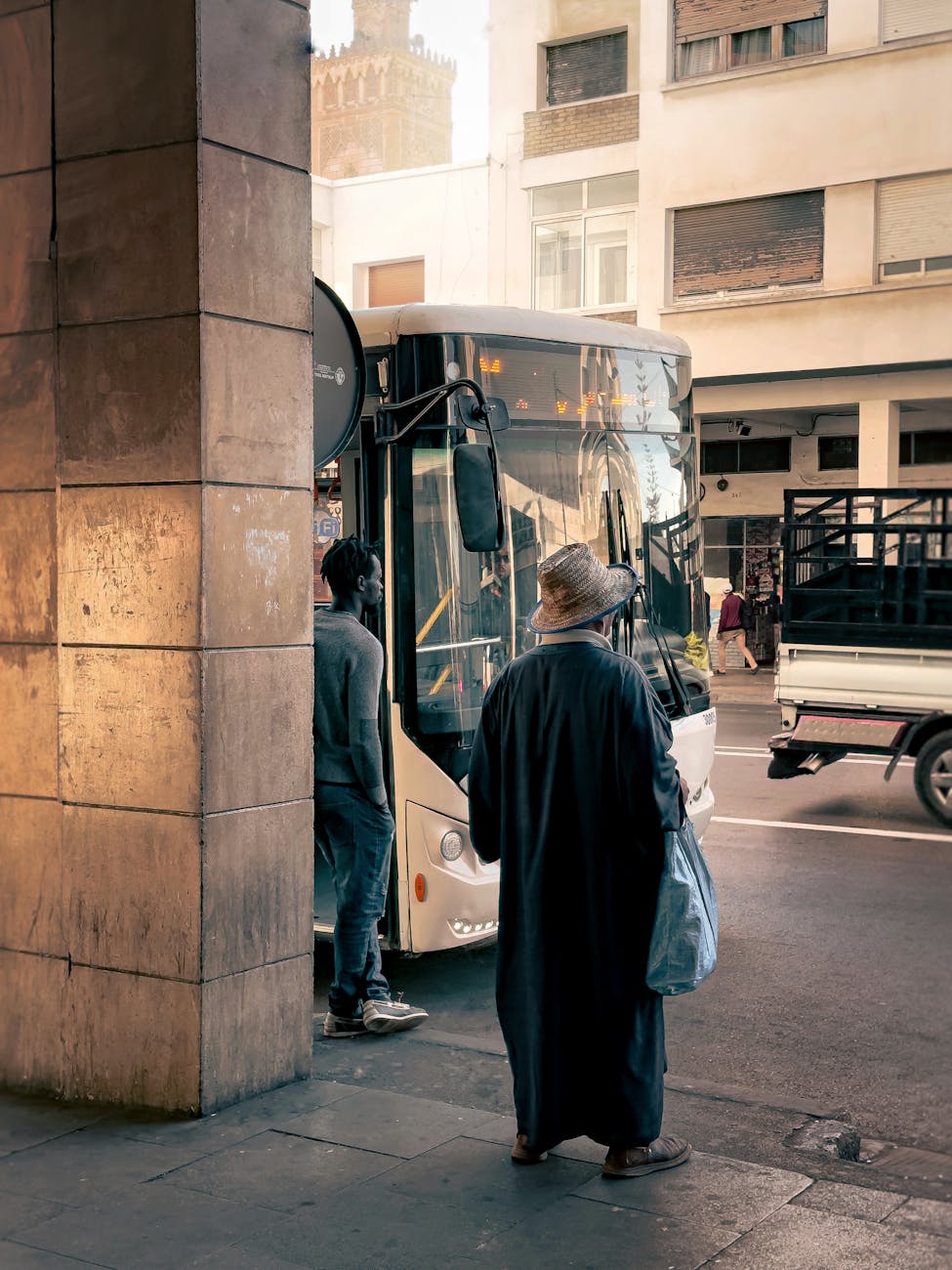
Fez is one of Morocco’s most historically important cities and one of the most challenging for mobility. The old medina is vast, dense, and largely car-free. The Ville Nouvelle, train station, CTM station, hotels, restaurants, and airport lie outside the deepest historic core. The result is a city where the critical transport issue is not just getting to Fez, but getting between the modern city and the medina gates.
There is no metro or tram. Transport depends on ONCF rail, coaches, buses, petit taxis, grand taxis, walking, and porters.
What is unique and important
Fez medina is the core challenge. A taxi can take you to a gate, square, or road-accessible edge, but the final approach may be on foot. This is not a minor detail; it can define whether arrival feels magical or miserable.
Fez has also been part of Morocco’s bus modernization effort. In December 2025, Morocco World News reported that Fez launched 154 modern buses as part of a broader urban transport modernization program. This may improve local mobility, but visitors should still expect buses to be less intuitive than taxis.
Arrival by train
Fès Ville station is in the modern part of the city. It has onward connections to Casablanca, Rabat, Meknes, Tangier, and Marrakech via ONCF routes. From the station:
Arrival by coach
Fez has CTM and other bus station options. CTM’s station is not inside the medina. If arriving by coach, plan the taxi connection to your accommodation. Do not assume a bus station arrival means you are walkable to your riad.
Airport access
Fez–Saïss Airport is outside the city. Taxi and bus options exist, and line 16 has long been cited as a low-cost link, but visitors should verify current stops and hours. A prearranged transfer is often best for late arrivals or medina stays.
Taxis
Fez petit taxis are red. They are the main visitor tool for station–medina–new-town trips. Meter use can be inconsistent; agree price if the meter is refused. Short trips within the new city are usually inexpensive. Medina gate destinations should be named clearly: Bab Boujloud, R’cif, Batha, or another exact drop-off.
City buses
Buses can be useful for locals and budget travelers, especially as the fleet modernizes. However, route information, crowding, language, and stop locations make them harder for short-stay visitors. If you are staying longer, learning a few bus routes can save money.
Walking
Inside the medina, walking is the main mode. Expect:
Use a guide for orientation if you feel overwhelmed, but choose licensed or recommended guides rather than random street offers.
Private vehicles and parking
A rental car is not useful inside Fez medina. If road-tripping, park outside and arrange accommodation access. Driving from Fez to Meknes, Volubilis, Middle Atlas towns, or onward routes can be useful, but city parking and medina access remain constraints.
Local concerns
Fez residents need better bus reliability, cleaner vehicles, connections between old and new city, affordable taxi access, and safe pedestrian conditions. For many residents, the medina’s beauty is also a mobility burden.
Best practical strategy for Fez
- Petit taxi to the medina gates is common.
- Walking to the old medina is not practical with luggage.
- Hotels in Ville Nouvelle may be close.
- Ask your riad which gate to use.
- steep or uneven lanes;
- pack animals and carts;
- scooters in some areas;
- confusing navigation;
- limited signage;
- crowds near markets and gates.
- Arrive by train or CTM/Supratours.
- Pre-plan your medina gate.
- Use petit taxis between station/new town and medina.
- Pack lightly.
- Use a riad porter if arriving with luggage.
- Do not self-drive into historic areas.
Tangier
City transportation character
Tangier is a northern gateway city shaped by rail, ferries, ports, hills, beaches, modernization, and international crossings. It is one of Morocco’s most important transport nodes because it connects Al Boraq high-speed rail, Tanger Ville station, Tangier Ibn Battouta Airport, Tangier Ville ferry port, Tanger Med port, urban buses, taxis, and road routes to Tetouan, Chefchaouen, and the Mediterranean coast.
What is unique and important
Tangier’s unique feature is the combination of Al Boraq rail and ferry/port access. It is one of the easiest Moroccan cities to enter from Europe by sea and one of the fastest to reach from Casablanca/Rabat by train.
But the port distinction is critical:
Tanger Med’s passenger site explicitly lists access by ALSA urban transport bus from Tangier City train station, taxi from the train station, road RN16, and motorway.
Arrival by train
Tanger Ville station is the northern terminus for Al Boraq. It is modern and useful, but it is not inside the medina. From Tanger Ville:
Arrival by ferry
For foot passengers from Tarifa, Tangier Ville is ideal. The port is close to the old city, and crossings are advertised as taking less than an hour on the Tangier City–Tarifa route operated by AML and Baleària.
For vehicle ferries from Algeciras or longer routes, you may arrive at Tanger Med. Plan onward transport before arrival.
Airport access
Tangier Ibn Battouta Airport is outside the city. Options include taxi, private transfer, and airport bus services. Recent traveler and airport-transfer sources commonly cite a dedicated Aerobus/AE-style service between the airport and Tangier railway station around 40 MAD, but timetables should be verified locally.
Urban buses
ALSA has operated urban buses in Tangier as part of its Morocco presence. Buses can be useful for residents and some visitors, but taxis are simpler for short stays.
Taxis
Tangier petit taxis are generally light blue. Taxis are useful because the city is hilly and spread out between station, beachfront, medina, new districts, and hotels. Agree/meter clearly.
Grand taxis and regional trips
Grand taxis and coaches are important for:
For tourist day trips, a private driver may be easier than navigating shared taxi stands.
Private vehicles and parking
A car is useful for northern Morocco exploration but not necessary inside Tangier. Driving to Cape Spartel, Asilah, Tetouan, or Chefchaouen can be rewarding, but medina parking and port access need planning.
Local concerns
Tangier residents experience fast modernization but still face congestion, taxi dependence, bus reliability concerns, and the challenge of connecting expanding districts to rail, ferry, and job centers.
Best practical strategy for Tangier
- Tangier Ville port is in the city and convenient for Tarifa ferries and foot passengers.
- Tanger Med is far outside the city and requires bus, taxi, or vehicle access.
- Taxi to the medina/Kasbah is common.
- Some urban buses serve the station area.
- Airport bus references often use the railway station as a key endpoint.
- Ferry-port access depends on whether you mean Tangier Ville or Tanger Med.
- Chefchaouen;
- Tetouan;
- Asilah;
- Cap Spartel;
- Hercules Caves;
- Mediterranean coast routes.
- Use Al Boraq for Casablanca/Rabat.
- Use Tangier Ville ferry if arriving from Tarifa as a foot passenger.
- Treat Tanger Med as a separate out-of-city port.
- Use taxis for station–medina–hotel links.
- Use CTM/grand taxi/private driver for Chefchaouen and regional trips.
Essaouira
City transportation character
Essaouira is smaller, slower, and more walkable than the other cities in this paper. It has no railway. Its transport system is essentially road-based: coaches, taxis, private transfers, rental cars, walking, and limited airport connections.
The city’s compact medina, port, beach, and new-town areas can be navigated mostly on foot. Transportation becomes important for arrival, departure, airport access, beach villages, surf spots, and onward travel.
What is unique and important
Essaouira’s defining transport fact is absence of rail. Most visitors reach it from Marrakech by Supratours, CTM, private transfer, rental car, or organized day trip. Supratours is often favored by visitors because of convenient station placement near Marrakech rail station and a practical Essaouira drop-off near the medina/beach area, though exact drop-off details should be confirmed when booking.
Arrival by coach
Marrakech–Essaouira is one of Morocco’s most common visitor coach routes. Travel time is often around three hours, depending on stops and traffic. Supratours and CTM are the main premium coach choices. Book ahead during weekends, holidays, and high tourist season.
Coach tips:
Arrival by car or transfer
A private transfer is the easiest door-to-door method from Marrakech. A rental car gives flexibility for Sidi Kaouki, Diabat, coastal roads, and multiple stops. The road is generally manageable, but watch for speed controls and rural traffic.
Airport access
Essaouira-Mogador Airport has limited flights. Taxi, shuttle, and accommodation transfer options are typical. Because flight schedules are thin, many travelers still use Marrakech airport and road transfer to Essaouira.
Taxis and local movement
Within Essaouira, many visitor movements are walkable. Petit taxis are useful for the bus station, outer accommodations, beach areas, and bad weather. For nearby beaches and villages, negotiate a round trip or use a grand taxi/private driver.
Walking and cycling
Essaouira is one of the easiest Moroccan cities for walking. The medina is compact and less overwhelming than Fez or Marrakech. Wind can make cycling and beach walks harder, but bike/scooter rentals may be useful for some travelers.
Private vehicles and parking
Parking is easier than in Marrakech or Fez but still requires attention near the medina walls and port. Ask accommodation where to park. If staying inside the medina, you will likely walk the final segment.
Local concerns
Essaouira locals depend on road connections for jobs, education, health services, and tourism income. Because there is no rail, bus frequency, road safety, taxi pricing, and seasonal tourist pressure matter. A small city can still become congested during festivals and high season.
Best practical strategy for Essaouira
| City | Best arrival mode | Best local mode for visitors | Strongest system | Weakest point | Car usefulness | Main local concern |
|---|---|---|---|---|---|---|
| Marrakech | Train, coach, or airport transfer | Walking + petit taxi + transfer | Intercity rail/coach access | Medina access, taxi negotiation, bus transition | Low in city; high for excursions | Bus reliability, congestion, tourism pressure |
| Casablanca | Airport train, Al Boraq, ONCF | Tram/busway + taxi/app | Tramway, busway, airport rail | Congestion and scale | Low for visitors | Commute time, crowding, network coverage |
| Rabat | ONCF/Al Boraq or Rabat airport | Tram + petit taxi | Rabat–Salé Tramway | Bus/tram integration beyond core | Low to moderate | Metropolitan coverage and fares |
| Fez | ONCF or coach | Walking + petit taxi | Rail access to city | Medina access and bus legibility | Low in medina; moderate for day trips | Bus modernization, old/new city connection |
| Tangier | Al Boraq, ferry, airport | Taxi + walking + bus for some routes | Al Boraq and port connections | Port confusion: Tangier Ville vs Tanger Med | Moderate for region | Linking expanding districts and gateways |
| Essaouira | Coach or private transfer | Walking + taxi | Compact walkability | No train | Moderate/high for coast | Road dependence and seasonal pressure |
- Know whether you are using Supratours or CTM.
- Check the exact station in both cities.
- Arrive early for luggage.
- Keep baggage receipts.
- Do not schedule a tight same-day onward connection after a long bus ride.
- Use Supratours or CTM from Marrakech if not driving.
- Book ahead on popular departures.
- Walk for most city movement.
- Use taxis or private drivers for beaches and villages.
- Rent a car only if exploring beyond the town.
Classic imperial-cities route
Casablanca – Rabat – Fez – Marrakech
Best strategy:
Concern:
- Casablanca airport train to Casa Voyageurs if timing works.
- Train to Rabat.
- Train to Fez.
- Train from Fez to Marrakech, or break via Casablanca depending on timetable.
- Petit taxis for station–medina transfers.
- Avoid rental car.
- Fez and Marrakech medina arrivals need precise accommodation coordination.
North-to-south rail route
Tangier – Rabat – Casablanca – Marrakech
Best strategy:
Concern:
- Al Boraq from Tangier to Rabat/Casablanca.
- Conventional train from Casablanca to Marrakech.
- Taxis/tram as local connectors.
- Al Boraq currently ends at Casablanca, so Marrakech requires conventional rail or other onward transport.
Marrakech plus Essaouira
Marrakech – Essaouira – Marrakech
Best strategy:
Concern:
- Supratours or CTM coach for budget/standard travelers.
- Private transfer for comfort, families, or tight schedules.
- Rental car if also visiting beaches/villages.
- Day trips are possible but rushed. One or two nights in Essaouira is more comfortable.
Tangier plus Chefchaouen or Tetouan
Tangier – Chefchaouen/Tetouan – Tangier or Fez
Best strategy:
Concern:
- Al Boraq to Tangier if coming from Casablanca/Rabat.
- CTM, grand taxi, or private driver to Chefchaouen/Tetouan.
- Consider private driver for day trips.
- No train to Chefchaouen.
City-only Morocco short trip
Marrakech only or Marrakech + Essaouira
Best strategy:
Concern:
- Airport transfer to riad.
- Walking and petit taxis.
- Coach/private transfer to Essaouira.
- Avoid rental car unless staying outside the city.
- Taxi pricing and medina navigation cause most stress.
Business trip
Casablanca + Rabat
Best strategy:
Concern:
: ONCF, “Al Boraq — Destinations,” states that Al Boraq connects Casablanca to Tangier and stops at Casa Voyageurs, Rabat Agdal, Kenitra, and Tangier stations. https://www.oncf.ma/en/Al-boraq/Destinations-and-timetables/Destinations
: ONCF Voyages, official online sales site for ONCF train tickets and schedules. https://www.oncf-voyages.ma/
: CTM official website, schedules, ticketing, and onboard service information. https://ctm.ma/
: Supratours official website; Supratours describes itself as an ONCF subsidiary providing coach continuations to cities not served by train. https://www.supratours.ma/
: Casatramway & Casabusway official website; network information, app, common ticket/subscription, 151 stations, and average frequency references. https://www.casatramway.ma/
: Casabus official website; Casabus operated by ALSA serves Casablanca, Mohammedia, and surrounding municipalities. https://www.casabus.ma/en/home
: Casabus official fare table; includes many urban lines around 5–6 DH and airport line L001 Casa Port–Mohamed V Airport listed at 50 DHS. https://www.casabus.ma/en/tickets-fares/fares-by-bus-lines/
: Tramway Rabat–Salé official website. https://www.tram-way.ma/en/
: Tramway Rabat–Salé, “Ticket and Fines”; single ticket 7 MAD, one-hour validity from first validation, transfer rules, and validation requirement. https://www.tram-way.ma/en/ticket-and-fines/
: Visit Rabat, “Access & Mobility”; references the Rabat–Salé tram, urban buses, taxis, car rental, and regional mobility. https://www.visitrabat.com/en/access-mobility-2/
: ALSA Morocco official website; ALSA Morocco describes urban operations in Moroccan cities including Marrakech, Agadir, Tangier, Khouribga, Rabat, and Casablanca, with bus fleet information. https://www.alsa.ma/en/alsa-morocco
: Morocco World News, “Supratours Replaces ALSA as Marrakech Bus Operator,” December 2025. https://www.moroccoworldnews.com/2025/12/271538/supratours-replaces-alsa-as-marrakech-bus-operator-to-launch-service-sunday/
: Morocco World News, “Fez Launches 154 New Buses as Morocco Modernizes Urban Transport,” December 2025. https://www.moroccoworldnews.com/2025/12/272071/fez-launches-154-new-buses-as-morocco-modernizes-urban-transport/
: Uber Newsroom Morocco, “Marhaba Morocco: Uber Is Here!”, November 27, 2025; Uber states the app is available in Marrakech and Casablanca through licensed transportation vehicles. https://www.uber.com/ma/en/newsroom/uber-in-morocco/
: Casablanca Mohammed V Airport official access information; train station in Terminal 1 basement and direct rail links to Casablanca-area stations. https://www.aeroportcasablanca.ma/en/Our-Airports/Casablanca-Mohammed-V-Airport/Access-Facilitations/By-train2
: Autoroutes du Maroc, official toll tariff grid; includes route toll examples such as Casablanca–Rabat. https://www.adm.co.ma/fr/grille-tarifaire-sur-le-reseau
: Autoroutes du Maroc, “Le Pass Jawaz”; remote toll-payment pass for passing toll stations without stopping. https://www.adm.co.ma/fr/le-pass-jawaz
: Tanger Med Passagers, “Departure from Tanger Med”; access by ALSA bus from Tangier train station, taxi, RN16, and motorway. https://www.tangermed-passagers.com/en/my-trip/from-tanger-med
: Port de Tanger Ville, ferry information; Tangier City–Tarifa route operated by AML and Baleària, crossing less than an hour, port near old city. https://www.tangerport.com/ferry/
: Reuters, “Morocco launches $10 billion rail expansion plan,” April 24, 2025. https://www.reuters.com/world/africa/morocco-launches-10-billion-rail-expansion-plan-2025-04-24/
: Reuters, “Morocco to buy 168 trains from France, Spain and South Korea,” February 26, 2025. https://www.reuters.com/business/autos-transportation/morocco-buy-168-trains-france-spain-south-korea-29-bln-2025-02-26/
: ALSA Morocco, social activities and partnership references involving public transport safety and awareness around violence against women and girls. https://www.alsa.ma/en/social-activities
- Airport train/private transfer depending on hotel and meeting location.
- Train between Casablanca and Rabat.
- Casablanca tram/busway where line-served.
- Rabat tram in central areas.
- Use ride-hailing/taxis for business timing gaps.
- Build traffic buffers, especially in Casablanca.